Thursday, January 20, 2011

Le Mémorial de Pascal

“Remember who your teachers were…”
2 Timothy 3:14

Blaise Pascal (1623-1662), known in his day and ours as a mathematician and scientist, was also a spiritual writer. His Provincial Letters (1656-1657) defended his Jansenist friends at Port-Royal against their Jesuit critics. His Pensées, never finished, and published posthumously in 1670, present Pascal's apologia for the Christian faith, addressed to the intelligent skeptic. This work includes his famous "wager" regarding the existence of God.

Pascal's most intimate religious work is the Memorial. This scrap of paper, which in his own hand writing records Pascal's experience on one unforgettable night in 1654, was found in the lining of his coat after his death, for he carried this reminder about with him always. Here I present the French and Latin original of the Memorial, followed by an English translation.

L'an de grâce 1654,

Lundi, 23 novembre, jour de saint Clément, pape et martyr, et autres au martyrologe.
Veille de saint Chrysogone, martyr, et autres,
Depuis environ dix heures et demie du soir jusques environ minuit
et demi,
FEU.

« DIEU d'Abraham, DIEU d'Isaac, DIEU de Jacob »
non des philosophes et des savants.
Certitude. Certitude. Sentiment. Joie. Paix.
DIEU de Jésus-Christ.
Deum meum et Deum vestrum.
« Ton DIEU sera mon Dieu. »
Oubli du monde et de tout, hormis DIEU.
Il ne se trouve que par les voies enseignées dans l'Évangile.
Grandeur de l'âme humaine.
« Père juste, le monde ne t'a point connu, mais je t'ai connu. »
Joie, joie, joie, pleurs de joie.
Je m'en suis séparé:
Dereliquerunt me fontem aquae vivae.
« Mon Dieu, me quitterez-vous ? »
Que je n'en sois pas séparé éternellement.
« Cette est la vie éternelle, qu'ils te connaissent seul vrai Dieu,
et celui que tu as envoyé, Jésus-Christ. »
Jésus-Christ.
Jésus-Christ.
Je m'en suis séparé; je l'ai fui, renoncé, crucifié.
Que je n'en sois jamais séparé.
Il ne se conserve que par les voies enseignées dans l'Évangile:
Renonciation totale et douce.
Soumission totale à Jésus-Christ et à mon directeur.
Éternellement en joie pour un jour d'exercice sur la terre.
Non obliviscar sermones tuos. Amen.

The year of grace 1654,

Monday, 23 November, feast of St. Clement, pope and martyr,
and others in the martyrology.
Vigil of St. Chrysogonus, martyr, and others.
From about half past ten at night until about half past midnight,

FIRE.

GOD of Abraham, GOD of Isaac, GOD of Jacob
not of the philosophers and of the learned.
Certitude. Certitude. Feeling. Joy. Peace.
GOD of Jesus Christ.
My God and your God.
Your GOD will be my God.
Forgetfulness of the world and of everything, except GOD.
He is only found by the ways taught in the Gospel.
Grandeur of the human soul.
Righteous Father, the world has not known you, but I have known you.
Joy, joy, joy, tears of joy.
I have departed from him:
They have forsaken me, the fount of living water.
My God, will you leave me?
Let me not be separated from him forever.
This is eternal life, that they know you, the one true God,
and the one that you sent, Jesus Christ.
Jesus Christ.
Jesus Christ.
I left him; I fled him, renounced, crucified.
Let me never be separated from him.
He is only kept securely by the ways taught in the Gospel:
Renunciation, total and sweet.
Complete submission to Jesus Christ and to my director.
Eternally in joy for a day's exercise on the earth.
May I not forget your words. Amen.

This is my 39th post for the month of January: Blaise Pascal lived for only thirty-nine years. May his memory be eternal.

Enemies for our sake

Looking at a Jewish blog or two, I always come away with the feeling that these people are just so Jewish, it’s as if they don’t know that the rest of the world exists—and for them, maybe it just doesn’t! There’s just so much going on inside of Judaism today.

If I could only let Jesus go, even a schmuck like me could join them. But that’s the rub—as all of us bible-loving, torah-hugging, evangelion-kissing followers of Y’shuah ha-Mashiach know—we’ll never really be their kind of Jews until we get rid of ‘that Jew’.
And I just can’t do that.


It also really amazes me how Jewish blogs, indeed, Jewish culture, ignores Jesus. It’s as though He never existed, and I suppose, it’s because they wish He hadn’t.

What an embarrassment! One of your own people turns up and starts challenging everything you took for granted, lures away some of the brethren into following Him, and even when somehow the Guy gets killed (did we have anything to do with it?), that doesn’t seem to stop Him. He’s brainwashed those followers of His into coming up with some tom-fool story of Him rising from the dead! And to top it off, they start finding verses in the Tanakh to support their stupid claims!

Well, how else do you expect the Jews to behave? When they’re alone with themselves, as on their blogs, at forums, or in their private lives together, what else should matter? They’re God’s chosen people.

I can’t help loving them. I wish I had been born a Jew because I feel like one through and through. It comforts me to be among them, to stand and sway in one of their synagogue services. I wish my hair was dark and my beard and sideburns luxuriant. My family name is a Jewish one in our ancestral country, but that doesn’t mean a thing. I am a Polack and no matter how far back I trace my family, we were Christians, Catholics until I came along. I was a blondy as a little boy, and now I’m a whity.

Why do I love the Jews? Well, I can’t escape the reality that Jesus Christ, the God-man, is a Jew. What? He was a Jew, that’s true, but He isn’t one now! Is that so? I have a funny dream, that when He returns He’s going to look around and ask, ‘Where’s my brothers?’ and I don’t mean Pope Benny and Patriarch Bart. Yes, I really do believe that Jesus Christ is a Jew, and I believe that His virgin mother, His brethren, most of the holy apostles, and lots of other people He loves are Jews, including Israel His people.

There’s a blog on the internet of a friend of mine who is also an Orthodox Christian, but he is incredibly anti-Jewish, and he blogs about his opinions and researches enthusiastically. Of course, now that he knows that I am a Jew-loving Christian, I am no longer subject to his friendship, but that’s alright with me. As Elder Epiphanios says, ‘I don’t hold onto anyone. I don’t chase anyone away. Whoever wants comes, whoever wants stays, whoever wants leaves.’ No matter what people think of me, I welcome them all the same.

But back to these people, the Jews, they never cease to amaze me. What incredible chutzpah they have! It’s got to come from somewhere. As an old college prof commented to a colleague in the film Chariots of Fire, when Harold Abrahams, a Jewish student, wins a race, ‘Maybe they’re God’s chosen people after all.’ I have to agree with him. They’re God’s chosen people, and Jesus of Nazareth is one of them, and in Him all the promises made to the patriarchs are fulfilled. But where does that leave them?

The Jews of today, and all those who’ve lived since the time of Christ, during what’s cleverly been called C.E. (Common Era) times, what of them? They haven’t accepted Jesus bar Joseph of Nazareth as the Messiah. How could they? He doesn’t fit the description they’ve come up with by studying their scriptures. Ah yes, but Christ Himself says to them, ‘You study the Scriptures diligently because you think that in them you have eternal life. These are the very Scriptures that testify about me, yet you refuse to come to me to have life’ (John 5:39-40). If I was standing there when He first said this, wouldn’t I be just as confused as they were? Jesus is altogether new, and all I’ve ever known is old.

Brothers, forgive this pointless ramble, but consider the mystery of Israel, God’s ‘hereditary people’ as they are called in the Psalms. Yes, I know they wrote the psalms, so what do you expect? But we also share the Holy Scriptures with them, the bulk of them we share. Our thin volume of gospels and epistles could be tucked inside the Tanakh without it even showing. Their people taught us, and we are learning from them still. They are the unthanked nursemaids of our spiritual infancy.

Remember the words of holy apostle Paul, ‘servant of the mystery’:

I do not want you to be ignorant of this mystery, brothers and sisters, so that you may not be conceited: Israel has experienced a hardening in part until the full number of the Gentiles has come in, and in this way all Israel will be saved. As it is written: “The deliverer will come from Zion; he will turn godlessness away from Jacob. And this is my covenant with them when I take away their sins.”

As far as the gospel is concerned, they are enemies for your sake; but as far as election is concerned, they are loved on account of the patriarchs, for God’s gifts and his call are irrevocable. Just as you who were at one time disobedient to God have now received mercy as a result of their disobedience, so they too have now become disobedient in order that they too may now receive mercy as a result of God’s mercy to you. For God has bound everyone over to disobedience so that he may have mercy on them all.
Romans 11:25-32

Our Father

πατερ ημων ο εν τοις ουρανοις
αγιασθητω το ονομα σου
ελθετω η βασιλεια σου
γενηθητω το θελημα σου
ως εν ουρανω και επι της γης
τον αρτον ημων τον επιουσιον δος ημιν σημερον
και αφες ημιν τα οφειληματα ημων
ως και ημεις αφιεμεν τοις οφειλεταις ημων
και μη εισενεγκης ημας εις πειρασμον
αλλα ρυσαι ημας απο του πονηρου
οτι σου εστιν η βασιλεια
και η δυναμις και η δοξα
εις τους αιωνας αμην

Our Father which art in heaven,
Hallowed be thy name.
Thy kingdom come, Thy will be done
in earth, as it is in heaven.
Give us this day our daily bread.
And forgive us our debts, as we forgive our debtors.
And lead us not into temptation,
but deliver us from evil:
For thine is the kingdom, and the power,
and the glory, for ever. Amen.
Matthew 6:9-13

The Lord's prayer is both bottomless and has no lid. Its depth transcends even the deepest pit of our sorrows and humiliations, yet it exceeds the highest of our expectations. It reveals the Father who is there, who is ours, who loves us, who answers us before we ask, who is faithful, in whom we live and move and have our being. Praying it puts us in the shoes of His Son, and when He looks at His Son standing in humble petition before Him, what will He not grant, what will He not supply?

So what is at stake, literally?


Father Stephen, as usual, is miles ahead of me and more pragmatic as well, but thank God, we're on the same road! Here is an excerpt from his latest post Risking Everything. Read his whole post by returning to the linked title. Here's some of what he writes…

It is quite possible for a local church (as in a local parish, though we could be describing the more accurate sense of “local” church and mean the Orthodox Church in America or the Russian Orthodox Church, etc.) to go about what looks like the work of the Church, and in fact not be doing the work of the Church. The sacraments may be present (these are utterly essential aspects of the life of the Church). Fr. Alexander Schmemann is quoted as having said: ‘The Church is not an institution that has mysteries; it is a Mystery that has institutions.’ But it is quite possible to put things the other way around, and instead of serving the salvation of each member, be serving the creation and the fostering of the false self.

Our American way of life has tended to mold the local church into the local religion store. It offers various programs and activities that keep everyone involved and even maximizing the “ministries” of its members. But it can also simply be a beehive of activity, none or little of which has much to do with the healing of the soul.

In every activity of the Church, whether it is liturgical, or educational, or building buildings, what have you, each activity should serve for the healing of the soul and the nurture of the true self. If not, then the Church has simply become one more secular activity that is destroying true life rather than fostering it.

So, what is at stake? Everything.

Wednesday, January 19, 2011

Facing facts

Most people are not evil, nor are most people complete fools. We are, however, a very selfish race, and ungrateful. Some of us have met with circumstances in our lives that have halted us in our tracks, making us look at and think about the world around us a little more deeply. There is, after all, a lot to ponder. The deeper we live our personal stories, the more we can begin to understand the stories of others, and empathy grows in us.

The human mind seeks patterns in its experience of the world and of the self. There are plenty of patterns out there too, and it seems the more we look for, the more we find. Sometimes we try so hard, we even find patterns that aren’t really there. Hence, the humanist atheist’s criticism of religion and God, which sometimes comes close to the truth. So much for the human world and our experiences there.

Still, some of us, as flawed as we are—and as damaged—insist on the reality of a Being we call God. Most of us are also not evil, nor are we complete fools either. We find ourselves to be, in spite of our belief in the existence of the Being we call God, very selfish and, yes, ungrateful too, just as selfish and ungrateful as the rest of humanity. That doesn’t stop us from believing and insisting that this God exists, whatever else we do or say about Him.

This fact gives the majority of people a very sour taste in their mouths when it comes to the subject of religion and God, or as we have it in America, a ‘Christian country,’ the subject of church. Most people are not evil, nor are most people complete fools. They can tell when people are playing church and, being sensible (except for a universal blindspot—personal sin), they want no part in this game, and can you blame them?

Most people will only play games that they’ve made up and whose rules they’ve accepted, games that are fun, and which they think they can win, that is, that’ll put them ahead of others. Hmm, what does that remind me of?

Back to my statement that most people are not evil, at least they don’t think they are. They haven’t yet encountered sin, or else they’ve refused to acknowledge it, being tutored by a world system that actually glorifies it under other names. So, not meeting sin in themselves, or hiding from it, thus being unaware of the bad news about themselves, they have no ears for the good news. If they have heard the bad news preached at them somewhere, that only hardens their hearts against the good news even more:

‘First they tell me I’m broken, so they can fix me, but if you ask me, it’s them that are broken and need fixing!
They can keep their Jesus!’


I wonder why they would think that?

Can it be true that most people aren’t complete fools? Even if they were able to see their brokenness or whatever they might call it—though sin is its real name—how should they respond if the repairers of the breach are easily seen to be just playing a game, pretending to be healers, helpers, heralds of good news, but in fact, only playing?

‘Where do you fellowship, brother?’ a twinkly-eyed, heavily-bearded middle aged man asks a young man sitting in a coffeehouse, wearing a tallit [Jewish prayer scarf] and studying a Hebrew interlinear Old Testament.

Without waiting for a response he monologs, ‘Tallit is rabbinical; I follow only Torah.’

Then, as the young man begins to respond, and giving some testimony of his life in Christ, the other continues to promote his messianic synagogue and boasts of following the commandments because ‘Y’shua [Jesus] was a Torah observant Jew.’

Then he goes on to say that living your life as a living sacrifice is impossible unless you ‘know and understand the book of Vayikra [Leviticus] and what sacrifice is all about.’

My mind is trailing off into silence and my eyes glazing over, while I wait for this blast of hot wind to pass. Ah, but his wife is a real Jew, who teaches Hebrew, and who was saved and is now a tongue-speaking, born-again believer in Mashiach.

‘Good,’ I mutter softly to myself, and nod while half-listening patiently.

Finally—I knew it was coming—the business card! After all, he’s on his Father’s business. He knows his lines well, though his Hebrew knowledge is spotty at best, enough to corral the biblically illiterate whom he usually meets here.

So why don’t they come to church and be Christians?
What’s wrong with the people of the world?


We’ve certainly given them enough time and plenty of free literature and televangelism to round them up. Don’t they feel welcome?

We say on our church marquees, ‘Everyone welcome.’
Can't they read?

Look, we even have a prayer request box in the parking lot, if somebody needs to be prayed for! What more can they want?
They don’t even have to tithe, at least not at first. After all, ‘the church doesn’t need’ our money, ‘we need to give it.’
As they say, ‘You can't outgive God!’

As for expecting miracles, like living a transformed life, well, don't worry! That’ll gradually happen.

All they have to do is hang out with us, and they’ll be infected with Christianity. It’ll just rub off on them. See, we’ve made the way to God absolutely appealing, fun and easy!

Got nothing to do, no where to hang out? Don’t worry!
You can volunteer in one of our great ministry opportunities.

What? What did you say? What do you mean ‘What does all this have to do with Jesus?’ Why, it has everything to do with Him! After all, Christ is all things, and in all things, especially at our church! Don’t worry, we’ll put you to wo… I mean, we’ll give you plenty of opportunities for Christian growth.

And remember, ‘Grow where you’re planted!’
We love you, and Jesus does too!

Christ, our Lord, have mercy on us!

Today the Uncreated

Ποίημα Σωφρονίου Πατριάρχου Ιεροσολύμων
(Poem of Sophronios, patriarch of Jerusalem)
The full original Greek text is HERE.

Τριάς υπερούσιε, υπεραγαθε, υπέρθεε, παντοδύναμε, παντεπίσκοπε, αόρατε, ακατάληπτε…

Triad beyond all being, beyond all goodness, beyond all godhead,
all-powerful, all-vigilant, invisible, incomprehensible;
Creator of the spiritual beings and rational natures,
innate goodness, unapproachable Light
that enlightens everyone coming into the world,
shine also in me your unworthy servant.

Enlighten the eyes of my mind that I may dare to sing
the praise of your measureless benevolence and power.
May my supplication for the people here present be acceptable,
so that my offences may not prevent the Holy Spirit
from being present here; but permit me now
without condemnation to cry out to you and say,

Master, lover of mankind, beyond all goodness,
Almighty, eternal King:
We glorify you, the Creator and Fashioner of the universe.
We glorify you, only-begotten Son of God,
without father from your Mother, without mother from your Father.
For in the preceding feast we saw you as a babe,
but in the present one we see you full and perfect man,
our God, made manifest as perfect God from perfect God.

For today
the moment of the feast is here for us
and the choir of saints assembles here with us,
and Angels keep festival with mortals.
Today the grace of the Holy Spirit
in the form of a dove dwelt upon the waters.
Today the Sun that never sets has dawned
and the world is made radiant with the light of the Lord.
Today the Moon with its radiant beams
sheds light on the world.
Today the stars formed of light make the inhabited world lovely
with the brightness of their splendour.
Today the clouds rain down from heaven
the shower of justice for mankind.

Today the Uncreated by his own will
accepts the laying on of hands by his own creature.

Today the Prophet and Forerunner draws near,
but stands by with fear seeing God’s condescension towards us.
Today the streams of Jordan are changed into healing
by the presence of the Lord.
Today all creation is watered by mystical streams.
Today the failings of mankind are being washed away
by the waters of Jordan.
Today Paradise is opened for mortals
and the Sun of justice shines down on us.
Today the bitter water as once for Moses’ people
is changed to sweetness by the presence of the Lord.
Today we have been delivered from the ancient grief,
and saved as the new Israel.
Today we have been redeemed from darkness
and are filled with radiance
by the light of the knowledge of God.
Today the gloomy fog of the world is cleansed
by the manifestation of our God.
Today all creation shines with light from on high.
Today error has been destroyed
and the coming of the Master makes for us
a way of salvation.
Today things on high keep festival with those below,
and those below commune with those on high.
Today the sacred and triumphant
festal assembly of the Orthodox exults.
Today the Master hastens towards baptism,
that he may lead humanity to the heights.
Today the One who does not bow
bows down to his own servant,
that he may free us from servitude.
Today we have purchased the Kingdom of heaven,
for the Kingdom of the Lord will have no end.
Today earth and sea share the joy of the world,
and the world has been filled with gladness.

The waters saw you, O God,
the waters saw you and were afraid.
The Jordan turned back
when it saw the fire of the godhead
descending in bodily form and entering it.
The Jordan turned back
as it contemplated the Holy Spirit
in the form of a dove,
descending and flying about you.
The Jordan turned back
as it saw the Invisible made visible,
the Creator made flesh,
the Master in the form of a servant.
The Jordan turned back
and the mountains leapt
as they saw God in the flesh,
and the clouds uttered their voice,
marvelling at what had come to pass,
seeing Light from Light,
true God from true God,
the Master’s festival today in Jordan;
seeing him drowning the death from disobedience,
the goad of error and the bond of Hell in Jordan
and granting the Baptism of salvation to the world.

Therefore I too, a sinner and your unworthy servant,
recount the greatness of your wonders
and, seized with fear, in compunction cry out to you:

Great are you, O Lord, and wonderful your works,
and no word is adequate to sing the praise of your wonders.
Glory to you, O Lord, glory to you!

Μέγας ει Κύριε, και θαυμαστά τα έργα σου…

Guard your thoughts

The devils, being spiritual beings, direct most of their attacks against us at our minds, where our spirits are lodged. There they plant thoughts (λογισμοι in Greek) which are all but indistinguishable from our own thoughts, except for their objects.

Our spirits being regenerated and indwelt by the Holy Spirit present thoughts consistent with our new spiritual natures. They are good and pure, rational and just. They lead us from one good to another, if we follow them. But the thoughts planted by the evil one and his angels are the opposite. They add drag to our spiritual natures, try to bring us down, and lead us from one evil to another, sometimes by trickery, sometimes by flattery.

Here is our problem in these last times…


We have been taught (by the world) to believe that all our thoughts reflect who we are and what we ourselves desire, and that to follow them is not only natural but commendable. So, whatever thought comes to mind, whatever the devils plant there, be it an apparent good, some transitory pleasure or speculation, or something pitted against the truth of God’s revealed Word and which we know to be wrong (but only there, so the devils lisp in our mental ear), we think it right to follow, to try out, to experiment with, to experience.

In former days, for most Christian souls, thoughts were not accepted inwardly nor acted upon if they went against what the conscience knew was right. Whether traced back to the devils or merely to fleshly weakness, bad thoughts, imaginations and fantasies were rejected, boldly and as a matter of course. Now, however, with the lie that whatever we think is possible (and therefore, permissible), even souls that acknowledge Christ can justify themselves in following every and any whim.

“Go where no one has ever gone before, do what no one has ever done. Follow your dream, your vision. Life is a journey.”

Yes, my brothers. Life is at least a journey.

But it’s more than that.
It’s a pilgrimage from the “City of Destruction”
to the “Celestial City.”
John Bunyan was right.
Brethren, guard your thoughts!

Then one said to Him, “Lord, are there few who are saved?” And He said to them, “Strive to enter through the narrow gate, for many, I say to you, will seek to enter and will not be able. When once the Master of the house has risen up and shut the door, and you begin to stand outside and knock at the door, saying, ‘Lord, Lord, open for us,’ and He will answer and say to you, ‘I do not know you, where you are from,’ then you will begin to say, ‘We ate and drank in Your presence, and You taught in our streets.’ But He will say, ‘I tell you I do not know you, where you are from. Depart from Me, all you workers of iniquity.’” Luke 13:23-27 NKJV

Only One Miracle

Today on the feast of Theophany, at the banks of the Jordan River in the land of Israel, a miracle is said to occur. A cross is cast into the waters of the river, and the river changes direction: it flows upstream towards the sea of Galilee. The cross is retrieved by divers, the one lucky enough to actually bring it back up is considered blessed. Though many try, only one is the winner, a pattern we’re familiar with from nature. Many seeds attempt to conceive a child; only one succeeds.

(Yes, after the cross is retrieved, the river flows down stream again.)

Many people, even Christians, will doubt that this miracle of the river reversing its flow actually takes place, in spite of seeing it on film. They will say that it is either an illusion, or that it is a satanic counterfeit. The same sort of critics will say the same things about an even more impressive miracle, the appearance of the Holy Fire in the kouvouklion of the Church of the Resurrection in Jerusalem on the feast of Pascha (Orthodox Easter). I have no argument with them. Let them believe what they like.

Myself, I have never witnessed either miracle in person, but personally neither do I doubt that they occur. Before I ever heard of them, I believed. After I heard of them, the same. My faith was not planted or even strengthened by either of them. I rejoice that they occur and that the faith of others is planted or strengthened by knowing of them or witnessing them. Everyone has a custom path to walk with Jesus, and it is none of my business, except to help them walk it when I can.

Still, there are doubts about such miracles. In the past I have voiced such doubts about the validity—I should say, authenticity—of miracles that occur in other faith communities. I doubt the Marian apparitions to Catholics. I doubt the miracles that are televised daily among the Pentecostals. Do I doubt them because they are said to happen among people of other faiths? Well, to be honest, that’s how I started out, but with more experience and knowledge of the scriptures, when I doubt miracles, anyone’s, even those among the people of my own community, it’s because I’ve concluded that ‘God just doesn’t work that way.’ And, of course, I could be wrong, but I don’t think that my salvation depends on it either way.

How do I come to this conclusion? Again, from studying the scriptures, and even the Church fathers, though selectively, as they can be just as mistaken as I can be. If there is one principle in whose light a miracle can be examined, it is this: Is it an isolated occurrence that is otherwise purposeless, or is it in some fashion an expression of the unique miracle of the resurrection of Christ leading us back to Him? If a miracle is of the first type, then I have doubts or at least reservations; if it is of the second type, then I acknowledge and accept it. Either way, it is still not for me to judge for others.

For some, Christianity would be dull and featureless if it weren’t for miracles such as those that are witnessed publicly. For me, real miracles are happening daily, even momentarily, with a constant and dependable regularity. What kind of miracles am I talking about? Well, I suppose most people would say that life itself and the continuance of the universe is hardly a miracle, but for me that’s what they are. Beyond that, there are the miracles of human goodness: kindness, generosity, sympathy, forgiveness, repentance and faith. How can anyone have these without supernatural grace?

Either the world is full of miracles, or it is devoid of them; or perhaps they are, after all, just those rare occurrences when the usual operations of nature seem to be interrupted. One thing is sure, one miracle certain, or else all discussion of the subject grinds to a halt, reduced to mere speculation on magic. Only one miracle deserves the name, because forward and backward it is the source and meaning of all others that claim to be miracles. Only one miracle, the resurrection of Jesus Christ. All miracles in time before it draw substance from it, as do those that follow it in time.

The Lamb slain before the foundation of the world, through Him was the world made.

Preceding and drawing life from it: Aaron's rod changed, the waters of Egypt made blood and the other plagues, the parting of the Red Sea, the waters of Marah sweetened, the manna and quails provided in the wilderness, the water from the rock struck by Moses, the serpent image healing those stung by snakes, Balaam's ass speaking, the river Jordan parting, the walls of Jericho falling, the sun and moon standing still, the widow of Zarephath’s meal and her son raised from the dead, the descent of the Holy Fire on Mount Carmel for Elijah, the cure of Naaman’s leprosy, Elisha’s bones reviving the dead, the deliverance of the three holy youths in the fiery furnace, the safety of holy prophet Daniel among the lions, and Jonah’s survival in the belly of the sea monster: all expressions of the miracle to come.

The Lamb on the Throne who alone is worthy to open the seven seals of the scroll, in Him is the world remade.

Yes, there is really only one miracle, the resurrection of Jesus Christ.

Old Calendar Theophany

When You, O Lord were baptized in the Jordan
The worship of the Trinity was made manifest
For the voice of the Father bore witness to You
And called You His beloved Son.
And the Spirit, in the form of a dove,
Confirmed the truthfulness of His word.
O Christ, our God, You have revealed Yourself
And have enlightened the world, glory to You!

The Orthodox Church unfortunately follows two calendars, the Julian (Old Calendar) and the Gregorian (New Calendar). All of us follow the Old Calendar when it comes to Easter (Pascha), because despite disagreements within the Church about which calendar to use, we all want to celebrate the Lord's resurrection together. So Pascha and all the time leading up to it, Sarakostí (Lent), and all the time after it up to Pendekostí (Pentecost) are on the Old Calendar. The rest of the year, Orthodox churches in the Western World (Greek mainly, and American Orthodox in the lower 48) follow the New Calendar (the standard calendar reformed during the pontificate of Pope Gregory XIII) so as to be in line with the rest of Christendom. There are now 13 days between the Old and New Calendars, so Theophany (January 6) is observed on January 19 in terms of the standard calendar. Numerically speaking, more Orthodox Christians follow the Old Calendar, and most of the monasteries on Mount Athos use it also. There may be a very good reason for doing so. Two public miracles happen regularly every year in the land of Israel on Old Calendar dates: Pascha (Easter) and Theophany (January 6, but 19 as the world reckons it).

I have known about the public miracle that occurs on Pascha for many years: God sends a mysterious "fire" (phos, in Greek) in the Church of the Resurrection's kouvouklion (the actual tomb of Jesus, inside the church), which lights two bundles of candles that the patriarch takes with him into the tomb. He is searched ahead of time, and so is the tomb, by Israeli authorities, to make sure that there is nothing on him or in the kouvouklion that can be used to make fire. Then the patriarch is sealed into the tomb. After he prays, he waits until the fire appears and lights the candles, which he shoves through two apertures in the wall to worshippers waiting outside. When the Latins (Roman Catholics) took over the church during the Crusades and ejected the Orthodox patriarch, they tried to obtain this "holy fire" but were unable to. In the end they decided that the fire must be some kind of Greek trickery, and left it at that. The fire only appears on Orthodox Easter, except in those years when Orthodox and Western Easter fall on the same day. More about this miracle can be learned at this site.

The other public miracle, I think I heard tell from a Greek priest once, but I forgot all about it until today, when I noticed this post on Fr Milovan's blog, Again and Again. This miracle is the reversal of the flow of water in the Jordan River every year during the Great Blessing of the Waters that takes place on Old Calendar Theophany. Someone correct me if I'm wrong about this, but it seems that this happens only on Old Calendar January 6. As I wrote earlier, this gives one pause to consider whether there is something to the Old Calendar, or at least what it represents, after all. You can see a video of this miracle (or phenomenon, for those who don't believe in miracles) and read about it, by going to Fr Milovan's post, The Jordan Reversed Its Flow!

I just wanted to share this with my brother Christians, as another testimony that Jesus Christ is among still, just as He said He would be, ‘till the end of the age.’

Glory be to Him, to His Father and to the Holy Spirit. Amen.

Tuesday, January 18, 2011

You too can be Christ

Ferdinand Hodler, The Good Samaritan

Therefore go and make disciples of all nations, baptizing them in the name of the Father and of the Son and of the Holy Spirit.
Matthew 28:19

Who is Christ talking to? Surely, not to me, I’m just an ordinary Christian layman. I can’t baptize anyone. He must be talking to the apostles and their successors, the bishops and priests of the Church.
I wouldn’t know how to make disciples. I hardly know how to be one myself. He can’t possibly be talking to me. This is the Church’s responsibility.

Well, then, who or what is the Church?

Everyone who hears these words of mine and puts them into practice is like a wise man who built his house on the rock. The rain came down, the streams rose, and the winds blew and beat against that house; yet it did not fall, because it had its foundation on the rock. But everyone who hears these words of mine and does not put them into practice is like a foolish man who built his house on sand. The rain came down, the streams rose, and the winds blew and beat against that house, and it fell with a great crash.
Matthew 7:24-27

Does it really matter, then, to ask who or what is the Church when we have words like these from the Son of God Himself? Can anyone put Christ’s words into practice for us? Can anyone be blamed if we ourselves do not put them into practice? We may not all be called to be apostles, that is, bishops, priests, deacons, evangelists and other professors of the Word. What is there left for us to do? Have all the important works been taken away and given to these men who are so much closer to Christ?

Jesus said: A man was going down from Jerusalem to Jericho, when he was attacked by robbers. They stripped him of his clothes, beat him and went away, leaving him half dead. A priest happened to be going down the same road, and when he saw the man, he passed by on the other side. So too, a Levite, when he came to the place and saw him, passed by on the other side. But a Samaritan, as he traveled, came where the man was; and when he saw him, he took pity on him. He went to him and bandaged his wounds, pouring on oil and wine. Then he put the man on his own donkey, brought him to an inn and took care of him. The next day he took out two denarii and gave them to the innkeeper. ‘Look after him,’ he said, ‘and when I return, I will reimburse you for any extra expense you may have.’

Which of these three do you think was a neighbor to the man who fell into the hands of robbers?

The expert in the law replied, ‘The one who had mercy on him.’

Jesus told him, ‘Go and do likewise.’
Luke 10:30-37


So, we are not bishops, priests and deacons. They’ve been given the all important work of going out and making disciples of all nations, and baptizing them. That’s not our call. We can’t be expected to go out of our way and do such extraordinary things. But what about the people that we don’t go out to, but who come to us, or who are placed in our path?

The Church fathers take the parable of the Good Samaritan, quoted above, and they tell us some of its meanings. They don’t tell us who the priest and the Levite are, but they do tell us the identities of the Samaritan, the traveler, the innkeeper, and the inn.

The Samaritan, they say, is Christ. The traveler beaten and robbed and left on the road to die is every man in need of salvation. The inn is the Church, and the innkeeper is the ministers of the Church.

Christ is he who does not pass by on the other side, avoiding the inconvenience of helping the wounded man placed in his path. We may not be innkeepers—clergy—that is true. But anyone of us can minister to the one God has placed in our path.

You may not be a priest or Levite either.

But you too can be Christ.

Both new and old

In our Christian life we have to strike a balance between following the tradition and creating it. Those who only follow tradition stifle the Spirit in them, pruning the buds and never harvesting the fruit. Those who only create tradition, uproot the tree altogether. But to follow tradition as well as create it is to be the ‘tree that is planted by water streams, yielding its fruit in season, its leaves never fading’ (Psalm 1:3). This is what Christ expects of us, what indeed happens to us as we follow Him. We are transformed into the steward ‘who brings out from his storeroom things both new and old’ (Matthew 13:32).

A Christian brother wrote, ‘Many years ago I was at a symposium on “Youth and the Church,” and a sociology professor had been asked to speak. He said that the church could play an important role in helping youth to adjust to the demands and values and mores of society. I asked him what if society’s values were wrong, and the youth were revolting against them. He got very emphatic, and said “Youth must adjust!” I almost expected him to throw up his right arm in a Nazi salute.’

I hope the professor's emphatic response was just a careless enthusiasm for his own ideas (such it often is), and that he did not intend to circumscribe so closely the idealism of youth. This is, unfortunately, how some in the Church feel, that youth (indeed anyone) must ‘adjust to the demands and values and mores of society.’ By this, of course, they mean the status quo of churchly life. These same people are adamant that one must consult one’s ‘spiritual father’ in everything, before making a single move in one’s life. For them, an act, even a thought, done without
‘authorization’ is at best foolish and at worst brazen pride. The independent spirit, to them, is pure sin. But I don’t think so.

Christ does not turn us into robots. He did not come to destroy tradition, but He frees us from its stranglehold. He calls us to follow Him, but that call always includes our free will and implies the right use of it—something that requires independence. If His call and our following does anything, it transforms us into creatures capable of, and desirous of, living for ever with Him. It charges us with an independence of spirit that even angels do not share.

Only the independent spirit can undo its will and enter into the life of the Holy Triad, where three wills are one will from eternity, without confusion, without disorder, but in total freedom. Often what shows as a submissive will is a mercenary subservience, brazen pride concealed under an outward humility in order to reign in splendor.

The Holy Tradition is the life of the Holy Triad as lived by the Church throughout the ages, and every cell in the Body of Christ is both nourished by it and nourishes it, every father is a son, every son a father, and like its outward sign, an Orthodox temple, the walls once white and empty fill up with ikons, generation after generation. To follow tradition as well as create it is to be the ‘tree that is planted by water streams, yielding its fruit in season, its leaves never fading’ (Psalm 1:3), and we can ‘know the tree by its fruit’
(Matthew 7:16).

Monday, January 17, 2011

Great grace

…cannot be possessed in peace because many conflicts arise against it. The more grace a man has, the more the devil attacks him. But a man should not on that account stop being guided by his grace, because the harder the battle, the greater will be his crown, if he wins…

Someone said to him, ‘I am often tempted by the worst kind of temptation, and I have often asked the Lord to take it away from me—and He does not take it away.’ Brother Giles answered him, ‘The better the armor with which a king arms his soldiers, the more bravely he wants them to fight.’

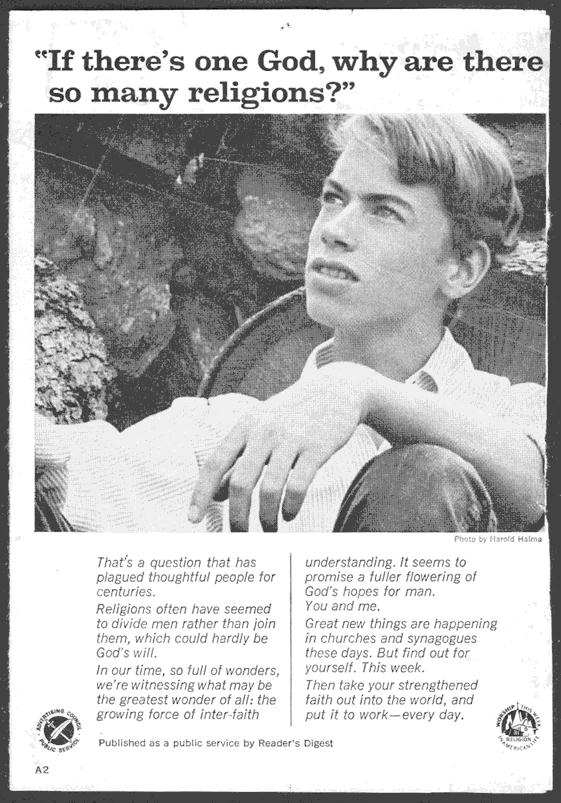
I started here

Back in Romeoville, Illinois, in 1964 maybe, or a little later, skimming through a Reader's Digest issue, I stopped at this full-page ad by Religion in American Life. It grabbed me. Why? Because the boy in the picture looked about as close to me as you could get, skinny, brownish hair, sitting like that lookin' up… that was me! Well, not really, but I carefully tore out the page and stuck it in whatever book I was reading at the time.

By then, we were not a religious family. My mom stayed up and prayed way into the night while she listened to all-night radio (sometimes I'd get up in the middle of the night and keep her company, it was good music), but none of us went to church anymore. Well, I did, sort of. My steady girlfriend was a Roman Catholic, and so, for a date, I used to accompany her to mass, and then go over to her house to hang out with her widowed mom and two sisters. Back then, there was nothing to do as a teenager, no drive-ins, nothing at all in this small town of a few thousand people, just ice skating on Lake Shirley (man-made mega-pond) or exploring the forest with my best friend Ed. Sheesh! Marijuana didn't even come to town till the year I left for college… to another small town of 5,000 people even further in the boonies, Carlinville. For me at college, a date with my steady girlfriend was lying side-by-side in a mown hayfield looking up at stars on a clear night! No hanky-panky! And then, stopping for a donut or two at a local bakery that opened at 4 a.m. on the way back to campus.

As I was saying, we weren't a religious family (except for mom). But something in me kept tugging, ‘why are we here?’…‘Is there really a God, or is this all a bad dream?’ Somehow, I kept going back to this page torn out of a cheap magazine.

I've kept it all these years, maybe because it accompanied me as I took the first few steps… venturing inside a Catholic church with my girlfriend, finding the old family bible and starting to read it (at Proverbs!) and taking notes, starting to write poetry with spiritual themes, exploring the Eastern religions… Well, yes, I did take a few wrong turns, and that continued on through college. But it was there that I found my first Christian friends, kids like me who were struggling with issues of life and death (to us), and who tolerated me as a ‘weirdo’ who wanted to hang around them and do InterVarsity Fellowship things even though I was (as a lapsed Catholic), at very best, only an ‘almost Christian.’

Just a reminder that everything and everyone has humble beginnings, no matter how notorious they become in middle age…

A ramble on Psalms

The biblical book of Psalms is really an amazing book. Tehillim, ‘praises’ is what the book is called in Hebrew. Mizmor, ‘psalm’ (Psalm 3) is what an individual psalm is called, along with a few other terms, such as shiggayon ‘wild, passionate song’ (Psalm 7), miktam (Psalm 16), tefillah ‘prayer’ (Psalm 17), shir ‘song’ (Psalm 30), and maskil ‘didactic poem’ (Psalm 32).

In the process of typing the psalms into my new blog Jerusalem Psalter, it was impressed on me how repetitive the psalms are in terms of their content. The same words are used over and over again, even the same themes recur with almost monotonous regularity—something I had never noticed before, reading and praying them day by day. For in reading the psalms and praying them, one doesn’t notice these details: one knows only the Lord before whom we are presenting ourselves. ‘Lay aside all earthly cares, that you may receive the King of all…’

This repetition of words and themes makes the book of Psalms in Hebrew, the Tehillim, to easiest and best place to start in the Old Testament, if you want to begin learning the biblical language. What surprised me most when beginning to pray the psalms in Hebrew was the simplicity, saying much with few words. In this, it resembles classical Chinese more than any other language I’ve studied. Hebrew words are ‘thought pictures’ in almost the same way, and a single particle of speech has immense freedom to express relationships between ideas that any modern language requires a dozen different words to achieve.

Aside from the linguistic notices, I also became aware of how warlike, aggressive and even vengeful many of the verses of the psalms are. You notice this when reading them as a text, but when reading them as scripture and as prayer—I don’t know why—they don’t affect you the same way. As Christians, and probably as Jews, we pray these words and inside of us we ‘just know’ somehow the movements of the spirit within us that correspond to the words, without taking them literally. There is a quality in the psalms, too, that corresponds only to a similar quality in us, that of the willingness and fact of struggle.

Before I entered the world of men and had to deal with life as it comes (I mean, in contrast to being a child at home, or even a college student), the psalms meant nothing to me. I knew Psalm 23 by heart in the King James version because of its use everywhere, especially at funerals. Beyond that, if I read the psalms at all, they were just biblical passages with no special significance. When I ran across verses that I’d heard in church or in bible movies, it garnished a little more of my interest, but an ‘academic’ interest in the psalms, or in the whole Bible per se, is not what the Book is for.

I had been picked on, bullied, most of my childhood years, and even in high school, for various reasons. For one thing, I never learned to fight, and growing up in inner city Chicago in the 1950’s, well, what can I say? Luckily I had a friend or two along the way who stood by me as guardian angel. In junior high it was a boy whose last name was Moses. In high school it was a youth whose last name was Yglesia (Spanish for ‘church’). What more could I ask for? With these two friends, I hardly had anything to fear from bullies, though I sometimes got into trouble when I was alone.

It was in young manhood, though, that persecution became real, and fierce. You wouldn’t have expected that. After all, this was modern late 20th century America, and by then I was living in Oregon, the ‘paradise of the hippies’ and other peaceable types. But did I find a safe niche among this group? Not on your life! Instead, I was in the working class, rubbing shoulders with guys who never outgrew their 6th grade bully mentality, one in particular was him we called ‘Jim Australia.’

Why he got this name, who knows? He wasn’t an Aussie, but I gather he was an ex-con, he had served time in prison. Some say he’d been in Australia and got into trouble there. I wouldn’t be surprised if that were true, but I think his appearance conformed to what some folks thought an Australian should look like. He was a big man, of stocky build, had a full bushy beard and head of dark hair, a Scot or Irishman by ancestry, and he loved to pick a fight, and he always seemed angry. We never saw him smile, not once.

This ‘gentleman’ worked in the last furniture factory in Portland, where I worked. He was probably in his mid to late 30’s and I, a boy of 24 years who had just met the Lord and gotten saved. I had been working in a century-old furniture factory in a rural town where the other employees were unbelievably savage, cruel, mean and immoral. Since I wouldn’t cheat on my wife and do drugs, I quickly became a pariah there. The managers liked me, though, because of my careful work, and they gave me jobs in the shop that isolated me from these others as much as possible. It was working there that I gave my life to the Lord, as I have recounted elsewhere.

But I couldn’t take it anymore and began praying for a job where I could be with at least one other Christian. After a car wreck (it was my fault), and some other hardships, I decided that I had to leave small town America and go to the ‘big city’ to find a better job. I hadn’t stopped praying either. The prayer was answered when I found work at Portland’s last large furniture factory. There I was trained in every woodworking skill by Philip, a man 32 years my senior, who was that ‘one other Christian’ I had been praying for. But nothing is ever as easy as you think. With this blessing came also a warfare.

Jim Australia hated me from the first day he laid eyes on me, and before long he was actually trying to kill me, or at least ‘accidentally’ put me in harm’s way. He had been mean to others before, but he fastened his hate on me like a magnet. Once he pushed me into a bin of wood—that was gentle. Another time he aimed and threw a claw hammer at my head from a dozen feet away. God knows how I escaped injury. Another time he shoved me out the door of the bus as it stopped to drop us off at the factory, on an icy day sent me sprawling into the traffic of the adjoining street, and just after a truck had passed. This man meant trouble. He even discovered the route I walked to church, and waited in gangways to ambush me.

It was at this time of my life that I began reading the psalms, and as these things happened to me, the psalms started taking on life for me, started attaching themselves to the moments of my daily life. At first, it was the bad things that drew meaning from the psalms, but quickly my spirit began to discover all the blessings in these same divine songs. The Lord started teaching me and ‘surrounding me with songs of deliverance’ and I began to compose music and sing the very songs that were printed in my Jerusalem Bible, whether waiting for the bus, or at home, or walking down the street.

Without realizing it, I was starting to live in the Word, and the words of the psalms began to become my wisdom, my protection, my shield, my rock of safety—yes, here it begins! What David sang was becoming my song, and what David was, an anointed of the Lord, a king in His heavenly Kingdom, well, that is what the Father wants all of us to be. When we pray the psalms we step into King David’s shoes. What? But we’re not worthy? Of course we aren’t, I never said we were, but what God wants for us outweighs all our doubts and even all our faith, all our criticisms and all our enthusiasm.

‘Pause awhile and know that I am God, exalted among the nations, exalted over the earth!’ (Psalm 46)

Glory to You, O God, glory to You!

Again, discipleship

Thanks to brother Hilarius for these quotes from Bonhoeffer's ‘other book’ Life Together…

It is not simply to be taken for granted that the Christian has the privilege of living among other Christians. Jesus Christ lived in the midst of his enemies. At the end all his disciples deserted him. On the Cross he was utterly alone, surrounded by evildoers and mockers. For this cause he had come, to bring peace to the enemies of God. So the Christian, too, belongs not in the seclusion of a cloistered life but in the thick of foes. There is his commission, his work. “The Kingdom is to be in the midst of your enemies. And he who will not suffer this does not want to be of the Kingdom of Christ; he wants to be among friends, to sit among roses and lilies, not with the bad people but the devout people. O you blasphemers and betrayers of Christ! If Christ had done what you are doing who would ever have been spared?” (Luther).
…

God' people must dwell in far countries among the unbelievers, but it will be the seed of the Kingdom of God in all the world.
…

…it [the gathering together] will finally occur visibly at the end of time when the angels of God "shall gather together his elect from the four winds, from one end of heaven to the other" (Matt. 24:31). Until then, God's people have remained scattered, held together solely in Jesus Christ, having become one in the fact that, dispersed among unbelievers, they remember Him in the far countries.

So between the death of Christ and the Last Day it is only by a gracious anticipation of the last things that Christians are privileged to live in visible fellowship with other Christians. It is by the grace of God that a congregation is permitted to gather visibly in this world to share God's Word and sacrament. Not all Christians receive this blessing… Yet what is denied them as an actual experience they seize upon more fervently in faith…

Sunday, January 16, 2011

Forgiveness

The following is a testimony of a young Indonesian Orthodox brother, which I found on Facebook, but its actual source is here. What he says about his life in Christ shows Orthodoxy from yet another perspective, from ‘another angle of the Throne,’ and for that reason I wanted to share it. His candid confession of a temptation he endured and overcame through Christ is near the end of his story, and it gave me the title for my post. I also have faced a similar temptation, and very recently. Here is what Jeff, our brother in Indonesia, says…

Both my wife and I are Indonesian of Chinese descent. We were Christian Protestant, or should I say “Kristen” in the term that most Indonesians recognize it as. Sometimes, I was also a little confused when some people threw me a question like, “Kamu Kristen atau Katolik (are you a Christian or a Catholic)?” which my most basic logical knowledge assumed that those two are supposedly the same.

Like many such things, it was a question I did not understand and left me with many more questions. The fact is that some people sit and listen in Churches, while others sit and occasionally kneel on padded wooden surface which have been specifically designed and constructed behind the sitting benches, and some others would most of the time stand and sing aloud with very well equipped music instruments and sound system placed on the front stage of the Church. Above all else, I was actually afraid to ask anyone about these matters and differences. I kept all these questions locked somewhere in my heart at that time.

One unexpected day, an unexpected friend, showed us a Church that I had never encountered. It was the simplest Church that I have ever seen. A church without chairs or benches, a Church without a microphone, a Church without a stage, without any sort of sound system, speaker or any musical instrument. It was a square room with nothing in it but the Altar humbly standing before me. My first reaction about this Church was that it had no real financial budget probably, and I mean no offense by that. My wife was seriously afraid that it might be a satanic Church. Were we ever wrong!

We then went home, did research and homework about it, and we discovered that it was an Orthodox Church.

Christian Orthodox, the very first of its kind, when there was only still one of its kind before the countless many that we have today. Then came the big day, the day I met Father (Romo) Daniel for the very first time, and that was the day, the day I have all the questions that were “locked in my heart” explained from the Holy Bible itself! Every question was miraculously answered from and by the verses of the Bible. It was the day I have finally found the missing piece of the puzzle.

The inevitably growing love, to want to learn and listen and know more about the Orthodox teachings by Father Daniel, has led us to the growing interest to be Orthodox. During that time, we heard a few friendly warnings about being spiritually and mentally challenged upon all those who are going to be baptized in Christian Orthodox. To be honest, I somehow did not choose to believe it. They said the challenge or the test would usually strike at our greatest weakness. It is the wicked way evil obstructs the good deed and holy path that we are nearing towards. Every time I heard that, I just responded with a nodding smile, and I truly, honestly, did not quite believe it. Again, I was totally wrong.

The truth that evil DOES exist! Evil caught me in the most unexpected way, at my most unexpected weakness – forgiveness. While I was very actively involved in hearing Father Daniel’s teachings, recording his teaching sessions almost every day, an appalling disastrous incident took place upon me. I was betrayed by a friend. Caught unprepared, I broke into pieces in every way, betrayed by faith, back stabbed by the growing love I have for Him. I could almost blame God for the pain that I suffered, but I knew it was not Him who did this to me. I totally lost the will to become Orthodox that time. The pain was so deep that it was hell on earth.

Father Daniel later discovered about this devastating incident. He was there for me like a savior to my empty soul. He guided me with his words of wisdom from God. He gave me verses to read from the Holy Bible. He kept giving me words to heal my wounds, to strengthen my weakened soul. After some time, Father Daniel has slowly made me realize that it was a weakness that I had to overcome within me, to forgive my friend. It just seemed so impossible at that time, when there was nothing but raging anger and wicked vengeance in me, but I did not give up and did not ignore all that Father Daniel had said to me. He kept guiding me through the way.

Eventually one day, when I had finally overcame that hellish time, when I could bring my heart to forgive and restored peace in my heart, I decided to be baptized and become Orthodox along with my family. We were baptized at Tritunggal Maha Kudus Orthodox Church in Solo when Metropolitan Hilarion was there to visit as well.

So, I guess that’s it, the story of my journey to becoming an Orthodox that I will never forget. Thank you for the opportunity given to share this story with the wonderful friends out there.

Psalm 84, prayed on the 16th day of the month—today—seems very close to the spirit of this young man. May the full blessing of the Lord, the living God, be with him and his household. Amen.

Saturday, January 15, 2011

Short, but sweet


Who hated sin more than the saints? But they did not hate the sinners at the same time, nor condemn them, nor turn away from them.
They suffered with them, admonished them, comforted them, gave them remedies, as with sickly members.
They did all they could to heal them.

Abba Dorotheos of Gaza
AD 505~565

What do you do?


Forgive me, brethren, but I am an anti-religious bigot.

I like to think that God is so shameless that He would rather come down to our level, be incarnated as one of us, so that He could touch us one by one, face to face, and enter into a relationship with us, rather than stay on His heavenly throne and be entertained by our religious activities.

If I feel this way, you might ask, why then do I go to church services, and when I am there, why do I kiss ikons and the gospel book, why do I make prostrations, light candles, cross myself, and do any number of other religious things? And from the way I talk, you’d have to assume that I also pray and read the bible and religious literature, and besides that, I’m always pushing Greek and Hebrew into the conversation. So how can I say that I am not a religious person?

The answer is simple. For some people, religion is what you do to come into contact with God. For others, being in contact with God is what makes you to do things that people think is religion, but ‘pure, unspoiled religion in the eyes of God our Father is this: coming to the help of orphans and widows when they need it, and keeping oneself uncontaminated by the world’ (James 1:27).

This is the Bible speaking, yet people still think of religion as the externals of worship, or even worse, mere talking about God and acting ‘religious.’

It is exactly that kind of religion that I don’t believe in, that kind of religion which, if I oppose anything in this world, I oppose. All the wars of religion ever fought and all atrocities committed in the name of God are the results of making that religion mankind’s god.

What happens to you when you approach the Most High is quite different. You realize His great humility, His generous patience, in letting you touch Him and walk with Him.

He actually runs, and asks you to run along after Him, even along beside Him, but He knows you can barely walk sometimes, and so He slows His pace to keep back with you, since you’re not yet strong enough to keep up with Him. Still, He runs, and He wants you to catch up with Him, to catch Him.

You see, none of this is ‘religious talk,’ I don’t worship the ‘Holy Name of Jesus,’ I venerate His humility in allowing Himself to be circumcised as an eight day old infant. It seems more important to know for sure that He has come and pitched His tent among us, than that He is enthroned on high.

Anyone can worship a God ‘on high.’
It’s when He has come and is standing in your midst,
then, what do you do?

Parents

This is not the time of year to be remembering and celebrating one's parents… or is it? These two poems written by a friend many years ago, I found when searching for another poem he had written that I wanted to quote in my post To become theology. I had to satisfy myself with just the last line of that poem, but I found these two poems written in memory of his parents, as well as his wonderful
The Sanctification to Priesthood. I had met Fr Ihor's father—a true saint of God he was, simple, caring, loving Christ and the Church—but of his mother, I know only of the impression her life made on that of her young son, opening to him the gates of the priestly calling. I offer these two poems to you, brethren, not as entertainment, but as a communication of piety.


To My Mother, in Memoriam
by Presbyter Ihor Kutash

“Mother! You are a basket of cut flowers, sweet, and beautiful,
and fading slowly.”

—Presbyter Loren Kubin*

My Mother!
I knew thee so little, and yet I know thee so well.

You were a flower that bloomed
and filled my young days with the sweet aroma of love.
Love was in your soft eyes
as you tenderly brushed my tousled hair,
as you calmed my fears
during sleepless, feverish nights,
as you knelt with me before the Holy Icons,
tracing the Sign of the Cross upon me
and listening to my childish repetition of the Prayer you spoke,
as you helped my little fist hold the unwieldy pencil
for the first time and guided it to form
the first word I spelled—“God”,
and, then, as you watched your puzzled little son
crying softly beside the bed upon which you were,
like a flower, fading away,
and commending me to my father,
and one day,
the blossom was gone,
and only its ineffably sweet memory has stayed
in my maturing mind.

But my Mother!
I knew thee so little,
and yet I know thee so well!


My Father
by Presbyter Ihor Kutash

My father was a strong man,
a man of principle, and simplicity and honesty,
and courage and faith, and love, and happiness.

There was a kind of glow—
not some mystical, esoteric glow—
but a light of human goodness
that he spread among those he knew.

My father was a weak man,
often lonely, sorrowful, in pain.

My father strove with doubt in his own soul.
He strove with anger, with hatred, with remorse.

My father ran the race and unexpectedly,
suddenly,
finished his course.

My father died.
My father lives,
his Master's strength made perfect in his weakness.

+ + +


* Fr Loren Kubin (may his memory be eternal) was a close friend of Fr Ihor and also a priest. Here we see the two presbyters celebrating the wedding service of Fr Ihor's beloved sister Helen and her husband Albert. Fr Loren is in the foreground in black and gold, and Fr Ihor is wearing green and gold. I was blessed to be acquainted with both men of God.

Friday, January 14, 2011

Far flung

Many years ago I saw a film where some people walking down a road were offered a lift from somebody they knew who was driving down the same road. Their response, cheerful enough, was, ‘Thanks, but no—we have feet!’

I have chosen to live as much as possible within walking or at least biking range of most of my needs, but I still drive almost everywhere.

One of the things I liked most when I was in Japan was that people still did a lot of walking, even though they have about one car for every two people.

As for ‘going to church’ and the distances involved, I have always tried to live close to my parish and can still walk there if I have to.

Part of the problem with ‘church’ is that houses of worship are no longer where people live. They were, up until the 1950's in most places, but after that, due to the mobility allowed by cars, church buildings began to be isolated from their congregations. This extremely unnatural development is, I believe, in large part responsible for the decay of the churches in America.

Churches are now, and have been for forty years, morphing into ‘Christian centers’ and ‘religious restaurant’ chains. No wonder, then, that people treat them as such, casually entering the sanctuary with mocha or Pepsi in hand, wearing baseball caps and shorts.

When I first became a Christian at the age of twenty-four I decided I wanted to live as close to church as possible. In fact, I lived three short blocks away from my first parish, Saint Andrew’s, when I first moved to Portland.

Where I chose to live was entirely driven by where I worshiped. At that time too I first heard about a pan-Christian movement in Lansing, Michigan, called The Work of Christ community.

People from all different denominations began to make proximity to their churches and to each other as Christians the highest priority in their lives. They even formally covenanted to stay together in neighborhoods of the inner city rather than escape to suburbia.

That community is still in existence, and it has grown over the years. Many of the members were and are Orthodox Christians, and in fact, I first read about it in an Orthodox publication, Theosis, A Journal of Orthodox Charismatic Renewal.

(The charismatic renewal movement in Orthodoxy has nearly died out, except for Fr Eusebius Stephanou in Florida, but that initial experiment in prioritizing our lives by our being in the Body of Christ is still with us.)

As part of the bigger picture, instead of having a ‘green patriarch’ like Patriarch Bart (forgive me, your all-holiness) sailing around in his ecology ship and holding symposia with the sparklers of the world system, we Orthodox would do well to avoid being caught by the looming energy crisis and do our part to really conserve, and not just look the part, by making where we live and worship and, if possible, work and shop, the same locality.

We should locate ourselves around our houses of worship, clustering there because we really believe that membership in the community of God’s people is more important than any worldly advantages. We evidently don’t do this because deep down, and not really very deep down, we don’t really believe in the importance of the Church.
We think of Church in terms of membership and of our responsibility in terms of our pledge, and let it go at that.

Now, as an Orthodox Christian and a cultural Asiatic, I am drawn to living in the country. In my young adulthood I was an incipient ‘back to the lander’ and lived on a rented acreage on the banks of the North Saskatchewan River, worked as the hired man on a dairy farm outside of Wetaskiwin, Alberta, and finally, when I moved to Portland, the first place I owned was an old farmhouse on a quarter acre on the edge of town in Saint Johns. Not much land, but it gave me a taste of living the life of a poor, small farmer.

I still think it’s great to live in the country and all, and I’d love to do that again too, but if I did, I’d build a chapel on my land, and try to grab any passing priest to come and say liturgy with us.

When that weren’t possible, I’d make the chapel a daily place of prayer and study and, eventually, sooner or later, if I was faithful, God would send more of His people to stay with me, and before you know it, we’d have a congregation! That’s how real churches have come into being all over the Christian world from day one.

Energy imperialism and its deceptive benefits have, in my opinion, diluted—and deluded—the Body of Christ, and we see its depredations daily. Far flung and fancy free, our culture has spread itself mighty thin, and what affects the culture affects the Church too, it affects all of us. Instead of talking ‘community,’ we just need to be it, and that doesn’t happen by accident.

These are just some thoughts which reading this post at Forty Days in the Desert brought to mind.

Lord, have mercy!