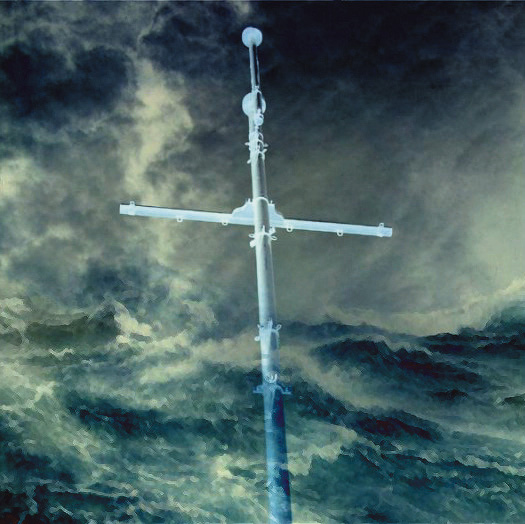
Thursday, September 22, 2011

The cross

The cross.

I used to wear a cross once.


All Orthodox are supposed to wear the cross they received at baptism.

That original cross of mine is packed away among my memorabilia, I hope. I did wear a cross for at least 20 years of my adult Christian life—the cross of San Damiano, an ancient icon painted by Serbian Orthodox monks that found its way into a small church in central Italy, dating from the days when Italy was still an Orthodox land. The cross of San Damiano was the icon from which Christ spoke to Francesco of Assisi, ‘Repair My Church which, as you can see, is lying in ruins.’

I stopped wearing my cross because it was worn out, and because at some point, my cross changed from something metallic and detachable, to being a part of me, something others can't see, something I can never take off. When I knew that for sure, that I was bearing my cross, then I didn't have to wear it.

The cross is something you can't really talk about, when it's the reality of your life. All the jabber and blab about the cross, however eloquent, is still just words. To enter into the reality of the cross is a gift of God. When He grants it to you to suffer, and to suffer in ways you never knew existed, then there is no longer an image outside yourself that really stands for anything much. The whole panoply of Orthodox iconography, in fact, dies away into mere imagery, when the cross is your life.

I know I wanted to communicate something in this post, but it isn't really possible, I know that now. But crossbearers know each other.

Their sanctuary is the time and place where in this world they meet for even a moment, their communion is feeding each other with the broken fragments of their lives that Christ has taken to Himself and returned to them, ‘This is My Body broken for you.’

No matter how big the visual cross, whether it's empty, plain wood, or has an icon of Jesus on it, whether the ceremony were slow and awe-inspiring, or the quick, efficient march that we experience in some contemporary churches, it would be the same. 


It can never compare to the reality of being pressed like raw dough with the seal of the true cross, so as to be baked in the oven of tribulations, to come out as pure communion bread. That's our life in Christ, broken but not divided, eaten but not consumed. Christ is in our midst. He is, and ever shall be.

He prunes His branches

I am the true vine, and my Father is the vinedresser. Every branch in me that does not bear fruit he takes away, and every branch that does bear fruit he prunes, that it may bear more fruit. Already you are clean because of the word that I have spoken to you. Abide in me, and I in you. As the branch cannot bear fruit by itself, unless it abides in the vine, neither can you, unless you abide in me. I am the vine; you are the branches. Whoever abides in me and I in him, he it is that bears much fruit, for apart from me you can do nothing. If anyone does not abide in me he is thrown away like a branch and withers; and the branches are gathered, thrown into the fire, and burned. If you abide in me, and my words abide in you, ask whatever you wish, and it will be done for you. By this my Father is glorified, that you bear much fruit and so prove to be my disciples. As the Father has loved me, so have I loved you. Abide in my love. If you keep my commandments, you will abide in my love, just as I have kept my Father’s commandments and abide in his love. These things I have spoken to you, that my joy may be in you, and that your joy may be full.
John 15:1-11

The Word of God is so pure: His truth is so clear. No one can add to it, no one take away from it. He tells us astonishing things. He tells us what is almost too strong for us to hear. We're satisfied to hear Him speak of Himself as the vine, and when He calls His Father the vinedresser we're not surprised. We love to hear Him talk about Himself and His Father. They're both divine somehow, both one, and we're pleased that the Father sent His Word to us as His Son, and that He loves us. We know and believe. We want this to be enough for us.

But the Word doesn't stop there, doesn't keep the topic on heaven, but begins to draw the circle wider, including more and more, getting closer to us. What are these branches that are in Him? What is the fruit He's talking about? What happens to the unfruitful branches after the Father takes them off the vine? Why do the fruitful vines have to be pruned, why must they be injured to bear more fruit?
It just doesn't make sense. A fruitful vine should be encouraged, treated well, so it can bear more fruit, not punished by being cut back. That's how we think.

So far, so good. We think maybe this is all just some kind of metaphor or parable for divine things, having nothing to do with us. After all, Christ is the vine, and He has branches, some of which are fruitful and some not. This must be an allegory. But wait! What is He saying? He's changed the subject. Now He's telling us that we're clean, that we're clean because of the word He has spoken to us. What word is that? What does He mean, 'Abide in me, and I in you'? This saying is starting to make us sweat. Does He really mean to get us that close? He's roping us in.

He can't be serious! The divine Being who humbled Himself to become one of us, a man, wasn't that daring enough? Does He really mean to make us one with Himself somehow? We know we can't bear fruit by ourselves. We never intended to. We were quite happy to let Him bear all the fruit and sprout branches. Isn't that what angels are for? Isn't it them that the Word is talking about when He addresses somebody as 'sons of God'? He can't possibly mean us. We're only humans!

We're in for it now! We're in over our heads! His words are like hooks that have pierced our ears and dragged us like fish into His net. Or is it pruning hooks? It sounds as if we are the branches after all, and we haven't a choice in the matter. Well, no choice except to not bear fruit, and in that case, to be cut off. He was very clear about that, wasn't He? And if we do bear fruit, we're going to be pruned. It looks like we're damned if we do, and damned if we don't. Well, maybe not really damned if we do, but for sure, we're in for it. It's no holiday to be pruned!

But what's the alternative? To not bear fruit? We can look like we're attached to the vine, but if we really aren't, there just won't be any fruit. The choice, it seems, goes a bit further back. It's not whether or not to bear fruit. It's whether or not to be attached, really attached, to the vine. It doesn't look like we'll be able to pretend on this one. Either we are, or we aren't.

So what does He mean by bearing much fruit, anyway? Shouldn't we find out what kind of fruit He wants us to bear, and then try our hardest to bear it? Maybe that will make Him happy, and perhaps He won't prune us after all. But He's not telling us what kind of fruit, only serving the ball back into our court, telling us to ask for whatever we wish, and it will be done for us. Is that what He means by bearing fruit? It sounds too easy. It sounds like nothing depends on us at all. So He wants us to bear fruit, but then not to exert any effort, just ask and let it be done for us?

The life of grace is truly a mystery. 'How shall I say where I end, and where you begin. How shall I say, what shall I play, shall it be you or the wild wind? As Pan with the unsane eyes, or with the wild horns, or when I am crowned with a paper crown, or with the crown of thorns.' The Divine Nature, shared among the Persons of the Holy Triad, beginningless, endless, unborn in eternity, unbegotten on earth, One without a partner, yet Bridegroom of every soul as of a single Bride! He speaks, He summons the earth…

By this my Father is glorified, that you bear much fruit and so prove to be my disciples. As the Father has loved me, so have I loved you. Abide in my love. If you keep my commandments, you will abide in my love, just as I have kept my Father’s commandments and abide in his love. These things I have spoken to you, that my joy may be in you, and that your joy may be full.

Yes, it's really true. He prunes His branches.

Wednesday, September 21, 2011

Again and again, pray

O God, how can we whose minds are so unstable keep our eyes focused on You, so that we can do what we see You doing every day and all around us? For You fill our world at every moment with creatures just like us, falling into need and sin, or arising out of it following the call of life that You’ve planted in us, though we might not know it. Your Word has been strewn among us, seeking that fertile humus in which it can sprout, grow and eventually bear fruit, so that it does not return to You void.

Open our eyes, Lord, to see the world as You see it, at every moment, in every place hearts crying out for mercy, to receive it, but also to bestow it. Show us, Father, that we are not alone, and that to show mercy can be as humble as yielding to another’s infirmity, to overlook our brother’s ignorance, to forgive one who injures or insults us before, or even without, being asked.

Help us to see that mercy has no size limit, large or small, visible or hidden. It is an arrow that never fails to hit its mark. That to stand confidently before Your seat of mercy is to be merciful wherever we are, just as You are merciful. And to always pray what we hear Jesus praying every day, “Father, forgive them, for they do not know what they are doing.”

Sunday, September 18, 2011

Repentance and salvation

…the Lord pities each individual and desires his salvation. What love toward sinners the Creator Himself must have had in order to become incarnate, to endure abuse, beatings, mockeries and death on the Cross for their salvation!

If we choose to respond to God's love for us with indifference, disbelief, unwillingness to fight with our sins, conscious transgression of the commandments, self-justification instead of tearful repentance, what awaits us? God's face will turn away from us. ‘With what measure ye mete, it shall be measured to you,’ (Mark 4:24), says the Lord.

If through our actions we reject God's love, the Lord will reject us.
‘I know ye not, depart from me into everlasting fire,’
(Matt 25:41). This is God's judgment, proclaimed already here on stubborn sinners who regard God's Word with contempt, who distort the Gospel in order to justify their sinfulness. Woe to them! Eternal torment, tears and gnashing of teeth await those who disdain God's love, who sell their Christian dignity for the filthy pleasures of this life, who prefer to do the devil's will.

A man will forever remain with the one whose will he fulfilled here on earth. One who was the devil's slave will remain so after death and will share in the dreadful fate of the demons.

...You have every opportunity, both internal and external, for repentance and salvation, which is so rare in this day and age. If you do not take advantage of this now, but keep putting off the work of salvation, you may easily fool yourself. We cannot be certain that tomorrow belongs to us. The Lord warns us all: be ready each minute, for you know not what day or what hour they will come for your soul (cf., Matt 24:44; Luke 12:40).

I strongly advise you: do not make excuses for yourself in any sin, no matter how small it seems. Every sin is a transgression of God's will, an indication of disloyalty to God. On the other hand: ‘One who loves Me,’ says the Lord, ‘keeps My commandments’ (John 14:15). For this reason, each sin committed should be cleansed with repentance.

Work upon your salvation. Try to free yourself of this world, which always was and will be an enemy of all things spiritual—even of God Himself.

‘The world will hate you,’ says the Lord (John 15:18). Who is this 'you'? Everyone who believes in Jesus Christ and tries to live by His holy commandments.

— Abbot Nikon (Vorobyev) 1894-1963

No turning back

Και ηκουσα φωνην μεγαλην λεγουσαν εν τω ουρανω Αρτι εγενετο η σωτηρια και η δυναμις και η βασιλεια του θεου ημων και η εξουσια του χριστου αυτου οτι κατεβληθη ο κατηγορος των αδελφων ημων ο κατηγορων αυτων ενωπιον του θεου ημων ημερας και νυκτος.

And I heard a loud voice saying in heaven Now is come salvation and strength and the kingdom of our God and the power of his Christ for the accuser of our brethren is cast down which accused them before our God day and night.
Revelation 12:10


The word "categorize" comes from the Greek word meaning "accuser" as in, satan being the accuser of the brethren.

There are so many better things to do with our time than tear people down, criticize them, categorize them, objectify them, divide them and condemn them. Even if we start only by loving them, Christ would reveal to us all the other good things we could do for them and for Him, none of which belong to the order of this fallen world.

When He says “love one another as I have loved you” and when He says “love your enemies” someone can always find an excuse why not to follow these simple instructions. But alas! There is no excuse. When Christ prayed from the cross, “Father, forgive them, for they know not what they do,” He wasn’t kidding, and He isn’t kidding about loving our enemies and even each other. Or are we rebels and enemies start to finish, blind, deaf and dumb to His precious and all-knowing Word?

When the accuser strikes a chord in our hearts, let’s stop our ears so as not to hear him and agree with what he says about our brothers. To believe him, and find a reason not to love, is to lie to Christ, to trample His love, to trample not death as He did by His love, but on love itself, to trample Him.

What do you think He will say to us on the Day of His return, if we have denied Him by our judgment, our slander, our suspicion, our hatred of each other?

There is no turning back, if you have responded to the call of Jesus, there is only one thing to do, follow Him. That means to do what we see Him doing in the scriptures, and to follow His commandment, and it is only one—to love.

And pray for me, Romanós the sinner.

Perfect Joy

One winter’s day, as St. Francis was going from Perugia with Friar Leo to St. Mary of the Angels, suffering sorely from the bitter cold, he called Friar Leo, that was going before him, and spake thus, Friar Leo, albeit the friars minor in every land give good examples of holiness and edification, nevertheless write and note down diligently that perfect joy is not to be found therein.

And St. Francis went his way a little farther, and called him a second time, saying, O Friar Leo, even though the friar minor gave sight to the blind, made the crooked straight, cast out devils, made the deaf to hear, the lame to walk, and restored speech to the dumb, and, what is a yet greater thing, raised to life those who have lain four days in the grave; write – perfect joy is not found there.

And he journeyed on a little while, and cried aloud, O Friar Leo, if the friar minor knew all tongues and all the sciences and all the Scriptures, so that he could foretell and reveal not only future things, but even the secrets of the conscience and of the soul; write – perfect joy is not found there. 

Yet a little farther went St. Francis, and cried again aloud, O Friar Leo, little sheep of God, even though the friar minor spake with the tongue of angels and knew the courses of the stars and the virtues of herbs, and were the hidden treasures of the earth revealed to him, and he knew the qualities of birds, and of fishes, and of all animals, and of man, and of trees, and stones, and roots, and waters; write – not there is perfect joy.

And St. Francis went on again a little space, and cried aloud. O Friar Leo, although the friar minor were skilled to preach so well that he should convert all the infidels to the faith of Christ; write – not there is perfect joy. 

And when this fashion of talk had endured two good miles, Friar Leo asked him in great wonder and said, Father, prithee in God’s name tell me where is perfect joy to be found?

And St. Francis answered him thus, When we are come to St. Mary of the Angels, wet through with rain, frozen with cold, and foul with mire and tormented with hunger; and when we knock at the door, the doorkeeper cometh in a rage and saith, ‘Who are ye?’ and we say, ‘We are two of your friars,’ and he answers, ‘Ye tell not true; ye are rather two knaves that go deceiving the world and stealing the alms of the poor; begone!’ and he openeth not to us, and maketh us stay outside hungry and cold all night in the rain and snow; then if we endure patiently such cruelty, such abuse, and such insolent dismissal without complaint or murmuring, and believe humbly and charitably that that doorkeeper truly knows us, and that God maketh him to rail against us; O Friar Leo, write – there is perfect joy.

And if we persevere in our knocking, and he issues forth and angrily drives us away, abusing us and smiting us on the cheek, saying, ‘Go hence, ye vile thieves, and get ye gone to the workhouse, here ye shall neither eat nor lodge;’ if thus we suffer patiently with love and gladness; write, O Friar Leo – this is perfect joy.

And if, constrained by hunger and by cold, we knock once more and pray with many tears that he open to us for the love of God and let us but come inside, and he more insolently than ever crieth, ‘These be impudent rogues, I will pay them out as they deserve,’ and issues forth with a big knotted stick and seizes us by our cowls and flings us on the ground and rolls us in the snow, bruising every bone in our bodies with that heavy stick – if we, thinking on the agony of the blessed Christ, endure all these things patiently and joyously for love of Him; write, O Friar Leo, that here and in this perfect joy is found.

And now, Friar Leo, hear the conclusion. Above all the grace and the gifts of the Holy Spirit that Christ giveth to His beloved is that of overcoming self, and for love of Him willingly to bear pain and buffetings and revilings and discomfort; for in none other of God’s gifts, save these, may we glory, seeing they are not ours, but of God. Wherefore the Apostle saith, ‘What hast thou that is not of God, and if thou hast received it of Him, wherefore dost thou glory as if thou hadst it of thyself?’ But in the cross of tribulation and of affliction we may glory, because this is ours. Therefore the Apostle saith, ‘I will not glory save in the cross of our Lord Jesus Christ.’

One of Us

‘You’re not one of us.’

Painful to hear. Even more painful not to hear, but to experience the undeclared fact. To be excluded. To be silenced, because to speak would call forth ‘the colors,’ making it impossible to pretend. This is the unwritten law of human relationships since the beginning, this the invisible fence of real apartheid between insiders and out. No respecter of persons, from twosomes to nations, and everything between.

Coming into the world we naturally expect to belong. Belong to what or to whom, it doesn’t matter. Just to belong. We came from many, we expect to go to many, to find our place in circles where as few as one other or as many as millions orbit, not us but, some center of gravity. Sometimes, if something goes wrong, yes, then we might expect all to orbit ourselves, but this annihilates what it means to belong.

This is what forms the history of the human world from small to great, all societies, lands, and times. It produces exiles and nomads across the face of the earth. Some of these disappear and are quickly forgotten. Others fill the human memory with tales of tragedy. Peoples called Gypsies are pressed out of denying human flesh, to wander poor. Others called Jews are pressed out the same, yet prosper.

The same pattern profiles all who enter the world of men. ‘You are one of us,’ or ‘You’re not one of us.’ Among those pressed out the pattern never ceases reasserting itself. Though everyone is excluded at least once, most find a hole where they can find comfort, and out of which they can afflict yet others. Never learning what exclusion means as they deal it out, quickly forgetting once having been strangers.

Nothing that happens to us, good or bad, is without final victory. Everything that happens to us, good or bad, can utterly destroy. All things rush to their conclusion as a mighty stream races to hurl itself over the cataract, but we are not carried along as helpless victims. The cataract pours, and we are hurled over the edge, and only victory or annihilation awaits us. Whether we are wanted, or unwanted, it waits.

Mate, parents, relatives, friends, acquaintances, associates, co-workers, team members, co-religionists, fellow citizens, mere humans, from one to multitudes, ‘You are one of us,’ or ‘You’re not one of us, get out!’ Rarely spoken by words in this age of political correctness and kindness that kills, the threshing floor of these less than angels continues to mutilate and trash souls born to love, dividing them from life.

Luckily or unluckily we have been granted life. Gratefully or ungratefully we have no choice but to accept it. Mercy upon our tormentors and upon us. Peace upon those who turn us away at the door, and upon us when we refuse welcoming, knowing or unknowing. The lying threshing floor has no power over the truthful wheat rejected as chaff. Live expecting to hear words finally from Him,
‘You are one of Us.’

Saturday, September 17, 2011

Miracle

Τίς Θεός μέγας, ως ο Θεός ημών;
Συ εί ο Θεός ημών ο ποιών θαυμάσια μόνος.
Who is so great a god as our God?
You are the God who alone works wonders.

The deeper you enter into the mystery of suffering, following the Lord, the more miraculous does the world become. You have left behind the kind of life that you lived all alone, with yourself as your guide, your wishes your command, where you never looked back to your Master except when your way forward to your delight was barred. Then, you stopped, turned around, and asked Him for a miracle, maybe. Or was it yourself that you asked? No matter. Now, you have left that life behind you.

To follow the Master, to have Him as your delight, His wishes your command, His living Word your guide, living no longer alone but always with Him, taking what He gives, what greater miracle can you want? The world has become all miracle, because He has pitched His tent here. The world has become all miracle, because it has become all cross, it has become the place where suffering is transfigured into sovereignty. Dying with Him, we share in His kingdom, Who is the King of Glory.

‘Lost, let them nail me, while my ransomed soul a steed of Spirit mounts, and my hungers hang. Let me inherit what the jailer stole, and hidden, as I thirst, what prophets sang.’ {+}

The whole world was shining with brilliant light and, unhindered, went on with its work; over them alone there spread a heavy darkness, image of the dark that would receive them. But heavier than the darkness, the burden they were to themselves. But for Your holy ones, all was great light…
Wisdom of Solomon 17:19-20, 18:1 Jerusalem Bible

The treasure of abandonment


The treasure is everywhere.
It is offered to us at every moment and wherever we find ourselves.
All creatures, friends or enemies, pour it out abundantly, and it courses through every fiber of our body and soul until it reaches the very core of our being.
If we open our mouths they will be filled.
God’s activity runs through the entire universe.
It wells up around and penetrates every created being.
Wherever they are, it is there also.
It runs ahead of them, it stays with them, and it follows after them.
All they have to do is to allow its waves to sweep them forward, fulfill the simple duties of their religion and status in life, accept cheerfully all the difficulties they meet, and surrender to the will of God in all they have to do…

This is authentic spirituality,
and it is valid for all times and for everyone.
We could not choose to become good in a better, more miraculous, and yet easier way than by the simple use of the means offered us by God; the whole-hearted acceptance of everything that comes to us at every moment of our lives.

Sorrowless


Abba Dorotheos of Gaza writes,

People usually get annoyed either because they are in a bad mood, or they are nurturing unpleasant thoughts about another. However, the main reason for our annoyance is that we don’t reproach ourselves: this incurs spiritual disturbance and loss of inner peace. The true and genuine path toward a calm disposition is continual self-reproach. Even if a person had accomplished many good deeds yet doesn’t hold fast to the path of self-reproach, he will never cease being annoyed and insulting others, thereby losing the fruits of his good labor. In contrast, what joy and tranquility that person acquires who reproaches himself! Wherever he goes and whatever unpleasantness happens, or whatever insults he hears; he has convinced himself beforehand that he deserves all types of sorrows. That’s why when something unpleasant does happen, he doesn’t get annoyed.
What more sorrowless condition can there be?

This kind of saying, ‘we should always reproach ourselves,’ always seemed nonsensical to me, somehow masochistic, and I didn't understand it or want to believe it was true, but I kept running across it, not so much in the scriptures, but in the Church fathers. I just figured it must be some kind of personal excess of theirs, and it just wasn't a word meant for me. It sounded to me like an instruction to always be putting oneself down, always blaming yourself for everything. That just didn't seem right.

But I was stupid and shallow in my understanding. Still, I have much compassion for people who thought like I did, because they really do misunderstand what is meant by self-reproach, and no one can naturally be ready to receive this word with understanding and reap the sorrowless condition that results from it, no one can be glad as long as they think of it as sorrow.

Self-reproach is the constant remembrance that all is lost, that all we hoped and worked for is vain and lost, that nothing we wanted to accomplish saw success, that everything we sought and slaved for came to nothing. Self-reproach is the willing acceptance and realization that of ourselves we are total failures, that we have missed the mark, that we gambled and lost, that we deserve nothing good, that our lives were empty and joyless, and that, like Job, we inwardly ‘shout for joy to see the tomb.’

“How is this possible? This is sheer madness!
It's much worse than I thought!”

Such is the response of the natural man,
who trusts in his own strength, his wisdom,
his virtue or his valor.

He forgets that his birth was nothing that he wrought,
that his health and life were nothing that he earned,
that the excellence of which he is so proud is nothing that he bought,
that the grave awaits him, as it awaits all,
and from it no one has returned.

Yes, it is much worse than almost anyone has thought. I know that now, and I know that only when you know for sure that nothing you can do, could do, or ever could have done would have achieved what only the Son of God has achieved for you, then you are able to truly reproach yourself, only then know for sure how to reproach yourself, only then finally know why to reproach yourself, and only then arrive where you can say for certain, as did Abba Dorotheos,

“What more sorrowless condition can there be?”

What we come up with

Yes, most of the time what we 'come up with' astonishes me.

What we come up with? Yes, I mean, what we Christians come up with, the stuff that we show the world to let them know about us… oops! I mean, about Christ!

Oversimplified, it can be called ‘churchianity.’ Gosh! I wonder sometimes if all words ending in ‘anity’ have a touch of unreality in them. Nothing unique to our day and age. It's a wonder that Christians a thousand years ago didn't trip over the Goddy—read ‘gawdy’—stuff they had hanging from their necks.

What does one convert to, now or in any age of the world? Is it Christ, or Christianity? These seem to be two doors to Somewhere, marked Entrance and Exit Only, like the doors at my local WinCo or Home Depot.

On an old Jesus Freak comic from 1973, the cover shows a cartoon of a city marked City of Peace!

Standing in the doorway is a white-robed cartoon Jesus with His arms outspread in welcome. Beside the door is another sign, Admission Free!!! Meet Receptionist with an arrow pointing back to Jesus.
Click on the image to enlarge it.

Two methods.
(1) Know Jesus first, and then join the Church.
(2) Join the Church first, and then meet Jesus.

As a Catholic Christian, I was processed using the second method. I didn't meet Jesus in the Church, however. I had to go back out and let Jesus find me ‘out there.’ Then, thanks to method 2, I came to know Jesus, and He sent me back to the Church.

It is because of my personal life experience that I prefer method 1. But that method almost always owes its victory to method 2.

My saying (forgive me, I am not the first, I'm sure) is ‘I witness for Christ, and He witnesses for the Church.’ And believe me, when I say ‘witness,’ I don't mean ‘big business’ or anything systematic. I don't have a missionary society or call myself ‘we’ when I outline my beliefs and programme. Why? because my beliefs are unimportant, and I have no programme. And I am not a ‘society.’ It's just me—right now, ‘just another blogger.’

It seems when we witness for the Church, people sometimes respond for the wrong reasons. When we witness for the Church, things can go wrong on both sides, the convert's and the Church's.

When we witness for Christ, if someone responds with a desire for conversion, we can rely on the living God who really is there to deliver that person into the Church. How can He not? for Christ Himself says, ‘No one can come to Me unless the Father draws him.’

No fear for mistaken appearances.
God alone is faithful,
and by His mercy alone,
so are we.

Counterfeit of love


War is sweet when brothers stick together,
and bitter, when every man is for himself.

Faith is fake when men manipulate the scripture,
but when they let it form them, firmly fruitful.

This is the proof of scriptures.
What book, when men obey it, brings grace and peace,
but hate and war when they surrender to it all?
Yet either, only worshiped, slips men’s souls.

Beauty, and the body, incite to love
that enters by the eyes and departs the same,
that is no love, but feeling and self pleasing.

Love, and the soul, incite to beauty,
that enters by the heart and does not gray,
that keeps its youth and knows no age.

Lost to pleasure only, enslaved by need,
devouring flesh, burnt up in the fire of passion,
the memory infected yields life for death.

Counterfeit of love, it blinds its victims,
making dark seem bright,
but love, it dies as it is seeded,
and rises to be harvested as light.

— Romanós

Seek the Lord…

The idea of cultivation and exercise, so dear to the saints of old, has now no place in our total religious picture. It is too slow, too common. We now demand glamour and fast flowing dramatic action. A generation of Christians reared among push buttons and automatic machines is impatient of slower and less direct methods of reaching their goals. We have been trying to apply machine-age methods to our relations with God. We read our chapter, have our short devotions and rush away, hoping to make up for our deep inward bankruptcy by attending another gospel meeting or listening to another thrilling story told by a religious adventurer lately returned from afar.

The tragic results of this spirit are all about us. Shallow lives, hollow religious philosophies, the preponderance of the element of fun in gospel meetings, the glorification of men, trust in religious externalities, quasi-religious fellowships, salesmanship methods, the mistaking of dynamic personality for the power of the Spirit: these and such as these are the symptoms of an evil disease, a deep and serious malady of the soul.

For this great sickness that is upon us no one person is responsible, and no Christian is wholly free from blame. We have all contributed, directly or indirectly, to this sad state of affairs. We have been too blind to see, or too timid to speak out, or too self-satisfied to desire anything better than the poor average diet with which others appear satisfied. To put it differently, we have accepted one another's notions, copied one another's lives and made one another's experiences the model for our own. And for a generation the trend has been downward. Now we have reached a low place of sand and burnt wire grass and, worst of all, we have made the Word of Truth conform to our experience and accepted this low plane as the very pasture of the blessed.

What God in His sovereignty may yet do on a world-scale I do not claim to know: but what He will do for the plain man or woman who seeks His face I believe I do know and can tell others. Let any man turn to God in earnest, let him begin to exercise himself unto godliness, let him seek to develop his powers of spiritual receptivity by trust and obedience and humility, and the results will exceed anything he may have hoped in his leaner and weaker days. Any man who by repentance and a sincere return to God will break himself out of the mold in which he has been held, and will go to the Bible itself for his spiritual standards, will be delighted with what he finds there.

Let us say it again: The Universal Presence is a fact. God is here. The whole universe is alive with His life. And He is no strange or foreign God, but the familiar Father of our Lord Jesus Christ whose love has for these thousands of years enfolded the sinful race of men. And always He is trying to get our attention, to reveal Himself to us, to communicate with us. We have within us the ability to know Him if we will but respond to His overtures.
(And this we call pursuing God!) We will know Him in increasing degree as our receptivity becomes more perfect by faith and love and practice.

—Aiden Wilson Tozer (1897-1963)

Seek the LORD while he may be found;
call on him while he is near.
Isaiah 55:6


דרשו יהוה בהמצאו קראהו בהיותו קרוב׃

You will seek me and find me
when you seek me with all your heart.
Jeremiah 29:13


ובקשתם אתי ומצאתם כי תדרשני בכל לבבכם׃

Friday, September 16, 2011

Yearning for Yom Kippur

It's only mid-September, and here I am already yearning for Yom Kippur. Other days will get in the way—and I will take them as they come—but what I heard on the evening of the Day of Atonement, October 12, 2005, stays with me, especially as the day draws near.   

So much has happened in the years since then, that my ‘conversation’ takes on an almost mythological aspect. In short, this is what happened…

After pondering for many days my life and where it had led me, I went into my arbor (pictured above) and presented to the Lord an account of it. I was very, very sorry, not despairing, but hopeful that the Lord would accept my repentance and accept me, even me, back into His fold, and let me begin to serve Him.


Sure, I went to church and up to that day had probably never missed a Sunday service. Sure, I did all the ‘expected’ things, and even some volunteer work. But over the years, my cowardice in answering the call of Christ to the extraordinary life had resulted in a life with little or no fruit. The extraordinary—‘perissós’—comes from Matthew, in Greek…


και
εαν ασπασησθε τους φιλους υμων μονον τι περισσον ποιειτε; ουχι και οι τελωναι ουτως ποιουσιν
;
And if ye should salute your brethren only, what do ye extraordinary? Do not also the Gentiles the same?

Matthew 5:47 Darby

So, although I had lived the first 30 years of my Christian life as an unprofitable servant, I asked the Lord for another chance, this time to make good on my original decision to follow Christ at the age of 24. Though I joke about it, the impression was quite serious. ‘Forty-nine years.’


‘What? I have 49 years? But I'm 54 now!’
 I pondered again, what can this mean? ‘For the first 5 years, I was not accountable? The next 49 years were mine to give, and I lost them? So now, I have 49 years to make it up?’

No, that's not really how God works. That might be how my miniscule mind has to verbalize it, to even begin to understand, but no, that's not how God works. What I knew for certain, what I know for true, is that the Father accepts my repentance through Jesus Christ, our true and living High Priest. He accepted my life, and let me start again.


From that day on, I made it my will to seek His will, to act on the Word, to not suppress the Spirit, to not draw back my hand when asked for help (not by men, but by God, who alone is humble enough to ask for our help!). This is what I have tried to do in the years since that day. And here I am, still standing, like a tree after heavy pruning, stripped of most of my leaves, all the unfruitful branches cut away (they were dead wood), waiting for the next season. Waiting for the Lord to call forth from me what I still have to give.


As God's fellow workers we urge you not to receive God's grace in vain. For he says, "In the time of my favor I heard you, and in the day of salvation I helped you." I tell you, now is the time of God's favor, now is the day of salvation. We put no stumbling block in anyone's path, so that our ministry will not be discredited. Rather, as servants of God we commend ourselves in every way: in great endurance; in troubles, hardships and distresses; in beatings, imprisonments and riots; in hard work, sleepless nights and hunger; in purity, understanding, patience and kindness; in the Holy Spirit and in sincere love; in truthful speech and in the power of God; with weapons of righteousness in the right hand and in the left; through glory and dishonor, bad report and good report; genuine, yet regarded as impostors; known, yet regarded as unknown; dying, and yet we live on; beaten, and yet not killed; sorrowful, yet always rejoicing; poor, yet making many rich; having nothing, and yet possessing everything. 

2 Corinthians 6:1-10 NIV


One thing that has happened to me is that I have become, strangely, more and more ‘invisible.’ I was even going to call this post ‘Invisible Man,’ because this is how I feel much of the time. Now that I have been trying to live a repenting life, now that I am openly following the call of Christ, what I told my wife Anastasía when I shared this moment with her is coming true: I will follow the call, wherever it leads me, whether it makes my earthly life better or worse, whether people love me or hate me, whether I am approved or disapproved, praised or slandered…


What I have actually discovered is that many of those I counted on to be supportive have fled. What I find is that I am invisible even when I am with them in the same physical space. In this last age of the world, the politically correct way of killing someone is to pretend they don't exist…


Here is an
apolytikion composed for Romanós the Melodist, my nameday saint…


God's image was perfectly preserved in you, O Father, for taking up the Cross you followed Christ. You taught us by example to disdain the flesh, a passing thing, but to see the soul which is immortal. Wherefore, O holy Romanós, your spirit rejoices with the angels.

I want to live my life as he lived his. Notice, no mention at all of the 800 hymns he wrote, or of the miracle by which he was given the gift of hymnography. Only that he took up the Cross. My hope is that I can run my race to the end as he ran his…


By faith, Romanós shouldered his cross and followed the Man of sorrows even to the end. By faith he saw the One like a son of man coming with the clouds. And by his faith in Christ, he conquered and overcame and was not hurt at all by the second death.

Wednesday, September 14, 2011

Bright testimony

Thank you, Jewel, and Robin. I couldn't resist posting this, borrowed from the blog Robin of Berkeley and titled…


I was driving through a rough and tough part of Oakland this morning. I don’t generally travel there but was en route to a doctor’s appointment.


It was a part of Oakland under siege: with no businesses to speak of; where drive-bys are common, and drugs, gangs, and thugs rule the streets. As I drove down the busy avenue, I (as well as everyone around me) shut my windows tightly, locked the doors, and made no eye contact with absolutely anyone.


But when I stopped at a red light, I saw an unusual sight: a black man on the corner, bellowing something at the top of his lungs. Actually, this isn’t all that strange a sighting since the crazed and drug-addled will often start yelling, both in Oakland and Berkeley.


But this man was well-dressed, and he also had something rarely seen around here: a light in his eyes. Curious, I took the risk to lower my windows and listen to what he was saying.


Standing amidst the druggies and the passersby averting their eyes, he yelled, “I am different than you. I have God in me. I am a changed person, and you can be too. You can have all your sins washed away right now, just like that.”


Excited, I looked at him and smiled. Though there were hordes of people and cars around, we locked eyes. Although we were strangers, I recognized him, and he recognized me.


Speaking even more forcefully he shouted,
“Don’t you want to be forgiven? Don’t you want the love and the hope that can only come from God? Come to God right now. Let Him deliver you.”

We locked eyes again, and I gave him a big thumbs up. Looking pleased, he returned with his own thumb’s up, and continued his message even stronger and louder.


When the red light changed to green, I slowly made my way up next to him. Now I had both my side windows wide open. I waved and he waved back; and he shouted to me with great warmth, “I love you!” My eyes filled with tears.


Where in the world could you see such a sight, of a black and a white stranger communing in a dark, foreboding part of town? And where else would you hear a black man tell an unknown, white woman that he loves her?


There’s only one place — and that’s in God’s grace. There’s only one avenue for true unity and love, and that is God’s mercy. No other vehicle or channel exists.


It doesn’t matter how many White Privilege seminars are held, or how many social programs are created. Obama, Eric Holder, Michelle, SEIU. . they won’t bring people together. They want to split us into a million pieces.


The left’s philosophy of racial unity via billy clubs is criminal. Anyone who believes that Obama, et al. will usher in peace and prosperity is lying to himself. The true revolution will not come from flash mobs, or Facebook insurrections, no matter how many people lie bleeding.


Leftists confuse power for force. Force is easy; it’s the tool of cowards. But real power? True power only comes from God.


And that is why my brief encounter with the street preacher moved me so: because I saw in full technicolor, the power of God to change lives and to move mountains.


When God shines His light on us, He brightens the darkest part of town. Black and white and yellow and brown can unite as one, but only if the great conciliator is God.


Because, as the wise street minister preached: it is only God who can heal. It is God alone who can wash away our shame, guilt, grief, and brokenness, and make us whole again.


So I say this directly to you: If anything I have written resonates, even a teeny bit, don’t ignore it. Don’t push what I’m saying under the rug. Don’t wait for a rainy day.


Because one thing is for sure: everyone on this planet will one day breathe his last breath. And we haven’t a clue when that moment will arrive.


We don’t have a minute to lose to restore ourselves before God.


And this: our world desperately needs as many bright lights as possible to illuminate the way during these dark times.

A brief Bible study

“Most assuredly, I say to you, he who believes in Me, the works that I do he will do also; and greater works than these he will do, because I go to My Father. And whatever you ask in My name, that I will do, that the Father may be glorified in the Son. If you ask anything in My name, I will do it.”
John 14:12-14

James and John, the two sons of Zebedee, came up to Jesus, saying, “Teacher, we want You to do for us whatever we ask of You.” And He said to them, “What do you want Me to do for you?” They said to Him, “Grant that we may sit, one on Your right and one on Your left, in Your glory.” But Jesus said to them, “You do not know what you are asking. Are you able to drink the cup that I drink, or to be baptized with the baptism with which I am baptized?” They said to Him, “We are able.” And Jesus said to them, “The cup that I drink you shall drink; and you shall be baptized with the baptism with which I am baptized. But to sit on My right or on My left, this is not Mine to give; but it is for those for whom it has been prepared.”
Mark 10:35-40

There were also two others, criminals, led with Him to be put to death. And when they had come to the place called Calvary, there they crucified Him, and the criminals, one on the right hand and the other on the left.
Luke 23:32-33

“Therefore whoever confesses Me before men, him I will also confess before My Father who is in heaven. But whoever denies Me before men, him I will also deny before My Father who is in heaven.”
Matthew 10:32-33

One of the criminals who hung there hurled insults at him: “Aren't you the Christ? Save yourself and us!” But the other criminal rebuked him. “Don't you fear God,” he said, “since you are under the same sentence? We are punished justly, for we are getting what our deeds deserve. But this man has done nothing wrong.” Then he said, “Jesus, remember me when you come into your kingdom.” Jesus answered him, “I tell you the truth, today you will be with me in paradise.”
Luke 23:39-43

Who shall ascend into the hill of the LORD? or who shall stand in his holy place? He that hath clean hands, and a pure heart; who hath not lifted up his soul unto vanity, nor sworn deceitfully. He shall receive the blessing from the LORD, and righteousness from the God of his salvation. This is the generation of them that seek him, that seek thy face, O God of Jacob. Selah. Lift up your heads, O ye gates; and be ye lift up, ye everlasting doors; and the King of glory shall come in. Who is this King of glory? The LORD strong and mighty, the LORD mighty in battle. Lift up your heads, O ye gates; even lift them up, ye everlasting doors; and the King of glory shall come in. Who is this King of glory? The LORD of hosts, he is the King of glory. Selah.
Psalm 24:3-10

Who is this King of glory?
The LORD strong and mighty, the LORD mighty in battle.

Asleep… and awake

I used to avoid Thomas Merton because I thought he had evolved out of Christianity and Christ by his explorations and experimentation with Eastern religious and philosophical thought. Consequently, I've read very little of what he wrote. In the final analysis I think what he did was confuse a lot of people, and blur the distinction between following Christ and merely believing in Him.

Now, I don't avoid Merton for any such reasons, but just because our paths are not probably going to cross. I have found Christ sleeping in the boats of the non-Christian religions and cultures, and all I want to do for the crews of those boats is awaken Him for them, and let Him awaken them to the Truth.

Now, I also find myself written off by some people because I am not afraid to go among the non-Christians and learn of them and from them. It startles people that I should know about the gods of India, for example, and that I don't think it is blasphemous to visit their temples or even to sing or hear their songs.

But there is only One Divine Nature, One God, to whom all paths do not lead from our end, but by Whom all things are possible from His end. And there is only One Lord Jesus Christ, the Word of God from before the ages who came to us as a little child, and as a young man died for us, and not only for us, but for the whole world.

And not the gates of Hades or its captors could keep Him down, or out, or defeat Him in any measure, for He takes it captive, and releases all who seek Him from its darkness, all without asking our leave. And where I walk, following Him, takes me on many journeys 'where angels fear to tread,' and yet I trust Him. As I often say, there is no loss with Jesus.

No loss, nothing and no one. 'I have saved everyone You gave to me, except the one who chose to be lost,' says Jesus.

Holy Cross - September 14

What our Saviour saw from the Cross - Tissot

There is much more to this feast day than a mere commemoration of the physical relic of the Cross, glorious though it may be. We can never forget, amidst the trappings of religion that often encumber and conceal it, that the Cross was endured for us, and it is also meant for us, those of us who follow Jesus. What does the world look like to us? Are we standing with our feet on the ground, looking up and adoring the crucified Lord? Or is our flesh nailed down to the Cross for love of Him, with whom we look upon a world that, lost in its own sin and suffering, gazes upon us, uncomprehending?

In Paradise of old, the tree stripped me bare, for by the eating thereof, the enemy brought in death. But now, the most holy tree of the Cross that doth clothe all men with the garment of life hath been set up on earth, and all of the world is filled with most boundless joy. Seeing it exalted, ye people, now, let us the faithful all cry out with one accord to God in faith: Thy house is full of glory, O Lord.
— Elevation of the Holy Cross - Sessional Hymn of the Canon


Here follow some gleanings on the Cross from earlier posts on
Cost of Discipleship.

Discipleship means the Cross
The knowledge of the Cross
is concealed in the sufferings of the Cross.

The Cross is the door to mysteries. Through this door the intellect makes entrance in to the knowledge of heavenly mysteries. The knowledge of the Cross is concealed in the sufferings of the Cross. And the more our participation in its sufferings, the greater the perception we gain through the Cross. For, as the Apostle says, "As the sufferings of Christ abound in us, so our consolation also aboundeth by Christ."

God does not create a cross for man. No matter how heavy a cross a man may carry in life, it is still just wood, from which man himself was made, and it always grows from the soil of his heart.

The way of God from the beginning of time and from the creation of the human race has been the way of the cross and death. How did you get your idea that everything is just the opposite? You must realize that you are outside the way of God, that you are far from Him, that you do not wish to walk in the steps of the Saints, but want to make some special way for yourself and travel by it without sufferings. The way of God is a daily cross. No one has climbed to heaven by living a life of pleasure.

Christians often assume that to ‘take up our cross’ means simply to carry a burden. When we run into a life trouble, we will say things like ‘oh, this is just my cross to bear.’ We basically shrug it off, totally missing the significance of the cross.

Ever consider that the cross is not meant to be a burden?

It is meant to cause death.
The cross is meant to kill us!
It is an instrument of death!
Oh that wonderful cross! — {+}


Christianity can be many things to many people, but unless it is first and foremost the cross, it can devolve into ritual, culture, or magic. Not that everyone will have the same cross to bear and to die on, not that what it looks like or feels like will be the same for all, not that those who follow Christ to Calvary will all understand what is happening to them the same way, but nonetheless the cross awaits us all, at least all of us who seek to follow Jesus.

Why, then, do you fear to take up the Cross, which is the road to the Kingdom? In the Cross is salvation; in the Cross is life; in the Cross is protection against our enemies; in the Cross is infusion of heavenly sweetness; in the Cross is strength of mind; in the Cross is joy of spirit; in the Cross is excellence of virtue; in the Cross is perfection of holiness. There is no salvation of soul, nor hope of eternal life, save in the Cross. Take up the Cross, therefore, and follow Jesus. Christ has gone before you, bearing His Cross; He died for you on the Cross, that you also may bear your cross, and desire to die on the cross with Him. For if you die with Him, you will also live with Him. And if you share His sufferings, you will also share His glory. See how in the Cross all things consist, and in dying on it all things depend. There is no other way to life and to true inner peace, than the way of the Cross, and of daily self-denial. Go where you will, seek what you will; you will find no higher way above nor safer way below than the road of the Holy Cross.
— Thomas à Kempis,
The Imitation of Christ, Book 2, Chapter 12


                       Cross, do not fail me
                       when it comes my hour
                       to bleed. As to a strong-masted vessel,
                       let me be bound to you to share your power.
                       Hug me close as the wind we together wrestle.

                       Lost, let them nail me                       
                       as my ransomed soul
                       a steed of spirit mounts and my hungers hang.
                       Let me inherit what the jailer stole
                       and hidden, as I thirst, what prophets sang.
— Romanós

You have not the making of your own cross, although unbelief is a master carpenter at cross-making; neither are you permitted to choose your own cross, although self-will would fain be lord and master; but your cross is prepared and appointed for you by divine love, and you are cheerfully to accept it; you are to take up the cross as your chosen badge and burden, and not to stand judging it too severely. This day Jesus bids you submit your shoulder to His easy yoke. Do not kick at it in petulance, or trample on it in vain-conceit, or fall under it in despair, or run away from it in fear, but take it up like a true follower of Jesus. Jesus was a cross-bearer; He leads the way in the path of sorrow. Surely you could not desire a better guide! And if He carried a cross, what nobler burden would you desire? The Via Crucis is the way of safety; fear not to tread its thorny paths.

Beloved, the cross is not made of feathers, or lined with velvet, it is heavy and galling to disobedient shoulders; but it is not an iron cross, though your fears have painted it with iron colours, it is a wooden cross, and a man can carry it, for the Man of sorrows tried the load. Take up your cross, and by the power of the Spirit of God you will soon be so in love with it, that like Moses, you would not exchange the reproach of Christ for all the treasures of Egypt. Remember that Jesus carried it, and it will smell sweetly; remember that it will soon be followed by the crown, and the thought of the coming weight of glory will greatly lighten the present heaviness of trouble.

The Lord help you to bow your spirit in submission to the divine will before you fall asleep this night, that waking with tomorrow's sun, you may go forth to the day's cross with the holy and submissive spirit which bec
omes a follower of the Crucified.             
— Charles Spurgeon, man of God (1834-92)


Take up the cross, and follow Me.
Mark 10:21

Tuesday, September 13, 2011

Not new lamps for old

Our upbringing and the whole atmosphere of the world we live in make it certain that our main temptation will be that of yielding to winds of doctrine, not that of ignoring them. We are not at all likely to be hidebound; we are very likely to be the slaves of fashion. If one has to choose between reading the new books and reading the old, one must chose the old: not because they are necessarily better but because they contain precisely those truths of which our own age is neglectful. The standard of permanent Christianity must be kept clear in our minds and it is against that standard that we must test all contemporary thought. In fact, we must at all costs not move with the times. We serve One who said ‘Heaven and Earth shall move with the times, but my words shall not move with the times.’

C. S. Lewis, Christian Apologetics, 1945.

“Remember who your teachers were…”
2 Timothy 3:14