Monday, March 10, 2008

Sarakostē

For forty days, for us, He struggled with the tempter in His humanity.
For forty days, for Him,

let us struggle with the tempter in our humility.
What is this humility?
To know that we, who are but dust and of yesterday, have been raised on high with Him, and made worthy to share with Him the glory of His victory over sin and death.

Sunday, March 9, 2008

The Christian soldier

Do you think that the title of this post poses an anomaly, a paradox, or a contradiction of terms? Didn't our Lord Jesus Christ preach non-violence, and non-resistance to evil?
Doesn't Fr Paul, the proistámenos of Holy Trinity Greek Orthodox Cathedral, teach that not even God can conquer evil, that evil can only be transformed?
How then can anyone speak of the Christian soldier?

What about the hymn, Onward Christian Soldiers?

Onward Christian soldiers, marching as to war,
with the cross of Jesus going on before.
Christ, the royal Master, leads against the foe;
forward into battle see his banners go!


At the sign of triumph Satan's host doth flee;
on then, Christian soldiers, on to victory!
Hell's foundations quiver at the shout of praise;
brothers, lift your voices, loud your anthems raise.

Like a mighty army moves the church of God;
brothers, we are treading where the saints have trod.
We are not divided, all one body we,
one in hope and doctrine, one in charity.

Crowns and thrones may perish, kingdoms rise and wane,
but the church of Jesus constant will remain.
Gates of hell can never gainst that church prevail;
we have Christ's own promise, and that cannot fail.


The lyric of this hymn is careful to avoid anything that would suggest that our battle is anything but spiritual, but from my reading of the Bible and of the history of the martyrs of Christ, it’s clear to me that there is no way one can draw the line between internal spiritual warfare and the struggles that we face in the “real” world. There is only one arena of spiritual combat, and it takes in all possible worlds, internal and external, psychological and social, by word and deed, in the inner and the outer man.
Yes, as Christians, we too fight a jihád, but with the knowledge that the victory is Christ’s and that He bore the punishment for our transgressions in His flesh, hanging on the Tree.

Today is the feast-day and commemoration of the holy Forty Martyrs of Sebaste, as well as the last day before the onset of the Orthodox sarakostí (“40 days,” or Lent). It is a fitting reminder that we are to follow Jesus into the wilderness, where He provoked satan to do battle, and where He won the victory in word that He would later seal by His deed, shedding His blood on the Cross.

Why was there no mention of the 40 Martyrs, or of their witness and martyrdom (one word in Greek, μαρτυρια) in church today?
Why wasn’t their icon put out for veneration?

True enough, Fr Paul rattled off their commemoration in pure koiné Greek at the end of the service, but they were never mentioned in a tongue anyone could understand. You’ll hear nothing about battle from this pacifist priest, he spoke only of peacefulness and reflection, and forgiveness… Yes, again asking us to forgive him, “a sinful and unworthy priest.” Well, it is hard, I know, to forgive your enemies and pray for those who deceitfully use you, but… I suppose we must. We forgive you, Fr Paul! God knows you deserve it.

But of the 40 Martyrs, thought by some to be the Thundering Legion, let’s make ourselves aware, and join them in carrying forward the battle, behind Jesus our King, against the world, the flesh, and death itself!

Yes, “blessed are the peacemakers,” especially when they are soldiers, policemen, and others we have commissioned to keep the peace and who, like the 40 Martyrs of Sebaste, do not flinch from doing what they know is right, no matter what the cost, even at the cost of their lives.
U.S. soldiers pray in a circle before leaving Camp Victory for their patrol mission on the streets of Baghdad.

Friday, February 29, 2008

Salt of the earth

We who are called of Jesus Christ know for sure that we are at least what He says we are, “salt of the earth” (Matthew 5:13), and “a city set on a hill,” and even “the light of the world” (Matthew 5:14).
The last epithet He also said of Himself (John 8:12), but it butterflies my stomach when I hear Him saying something of me that He says of Himself.

So what does that make us? It’s true, some are called to be prophets, some teachers or apostles (Ephesians 4:11). But all of us are called to be “salt,” that is, the world’s preservative, and in another sense, the bite, because, as Martin Luther quipped, “what’s the good of salt if it doesn’t bite?”

Thursday, February 28, 2008

Must America be a theocracy?

After a succession of Republican-sponsored theocracies starting with the presidency of Ronald Reagan and continuing to the present administration of President George W. Bush, the Democratic party has just about had enough, and it believes the same of the American people.

Gradually increasing in strength from a modestly God-affirming but strongly ground-standing President like Ronald Reagan, who could perhaps be compared to one of the Crusader kings of the Middle Ages, the Republican dynasty came close to establishing a new emperor Constantine in George W. Bush. More aggressively supportive of Christian causes than his father the elder President George Bush, his career relative to his father’s in some ways reflected that of emperor Contantine relative to his father, Constantius Chlorus. But unless you know the history of the later Roman Empire, such comparisons are probably irrelevant. Suffice it to say that in the current President we have as close as we could expect to come to having a Christian emperor like Constantine the Great. Since the critics of Republican politics call it a theocracy, let me ask this question.

Which do you prefer, a theocracy with an anointed emperor at the helm, or a theocracy centered on a divine savior? America seems to be hell-bent on having one or the other. Oddly, though, since we are possibly the most materialist nation of all time and, though we give lip-service to whatever we are free to call “God,” we’re much better at trying to save others than we are at saving ourselves. I mean, economically, politically, socially and religiously, we want to save the world, but we would rather be left alone ourselves, to pursue our private “dreams.” We’re very generous with others, very reckless with ourselves, and our brand of Christianity follows suit.

Again, I ask, which do you prefer, a theocracy with an emperor, or one ruled by a god?

Myself, there is only one Theocracy, and it’s neither emulated nor represented by any current institution on earth, not church, not state. Despite America’s “manifest destiny,” I cannot and will not attribute to America the role of savior-nation to the world. There’s only one nation that has been given that role.

Who knows why we have this fatal bent in our American psyche, but we must have a theocracy at all costs, at any cost, even if it means giving to a mere man the worship that belongs only to the Most High.
πολλοι ελευσονται επι τω ονοματι μου λεγοντες οτι εγω ειμι και πολλους πλανησουσιν (Mark 13:6)

Tuesday, February 26, 2008

How can you say you love Jesus…


…but not the Church? This is a common saying nowadays of people who pretend to be believers but pit themselves against the Church.
I should say, they've made a rather big mistake, and one that's sure to cause them endless grief later on, if they don't come to their senses.
The ground of their complaint is itself a deeper mistake. They've mis-identified the Church, thinking it's one thing, when in fact it's quite another. They've had plenty of help doing it, too, from the institution itself, from the institutional church.

What the institutional church often does has absolutely little to nothing to do with the actual life of salvation. You simply cannot limit yourself to thinking that the institutional church is what Christ calls the Church. It's not.

The Church of Christ, His Bride, is present wherever He really is present in their midst, in reality, not in mere imagination or in shows of public piety.

When Christ is in our midst, we don't have to force ourselves to believe it; we know it, because the Spirit guarantees His presence by the signs that follow. And that presence among us which reveals the invisible church, making us visible to each other, bestows on us actual grace, not pretended, and establishes us in the Kingdom, and the Kingdom in us. That's the Church, the Bride of Christ, against whom no one who truly loves Jesus the Bridegroom can ever find fault, because He is with her and in her, and she with and in Him.

Brothers, find this Church and find yourself within her, and no matter what happens to the institution called "church" your faith can never be shaken; not because of her, but because her Spouse is with her, and hence with you, always.

Wednesday, February 6, 2008

The Border

Originally, the border between the Church and the world was put up, not by the Church, but by the world, which could find no use for, and would not tolerate, this indigestible people. The Church constituted something like an Indian reservation or a ghetto, or even worse, a leper colony within society, a social entity which should not be, but nonetheless was. It was an embarrassment for and accusation against the classes that ruled the world.

Among those untouchable and unmentionable people, leaders arose, chosen not for their excellence or eminence in any worldly endeavor, but for their abject surrender to the service of the others. The world looked on in wonder at these hopeless imbeciles following a crucified criminal, surprised that they could have so much love for one another, but even more stupefied at their lack of survival instinct—they didn’t fight back when attacked by the world, they prayed for, and even more incomprehensibly, thanked those who injured and killed them!

They would not contribute any more than was exacted from them for the maintenance of the world system. They didn’t stand up for their own rights. They didn’t agitate for social reforms or strive for the betterment of any society except their own. Only among themselves, by common and unwritten consent, did they abolish customs that the world regarded normal, but which they abhorred—infanticide, sexual license, slavery, the “festivals.” In this regard, the world felt justified in labeling them “haters of humanity,” in segregating and controlling them by an elaborate system of “tests,” such as the performance of acts of public worship to the state deities.

The charge of atheism brought against them was designed to infuriate the working masses of the world, which by and large were “religious,” and which could be depended upon to punish the Church at the slightest provocation, thereby freeing the world rulers from overt responsibility for the persecution of these deranged trouble makers, undeserving of the name “human.”

No, the world had no use for, and would not tolerate, this indigestible people. It would give them no avenue for worldly success or security—economic, educational, social—not unless they, individually, renounced their allegiance to their pathetic God by publicly conforming to the world system and taking what they called among themselves “the mark of the beast.” If they did that, they were allowed the cross the border. They were free at last from the unreasonable restrictions placed upon them by their crazy beliefs.

After some time had passed, the Church, to the astonishment and discomfort of the world and its rulers, had grown much larger than had been anticipated. The elaborate system of tests and containment strategies that they devised could not keep the borders of this neglected area from expanding. The Church even crept into places it had never been seen before. It was to be expected that among the unschooled rabble, some would defect to this weird cult, lured by the rumors of “brotherly love” and other such nonsense. Everyone knew that these were just cover-ups for their unnatural practices, hypocrites all of them.

But now, and with more and more regularity every day, it seemed that once responsible citizens of the world were becoming uncooperative and difficult, excusing themselves from participating in the rites and rituals, even refusing the world’s most reasonable demands. The infection had spread, from the mere denizens even to the rulers of the world order. What was to be done? How was the world to maintain the border between itself and the Church?

There was nothing else to do but, swallowing its pride (just for a moment), the world would have to “become” the Church. It would have to get inside (disgusting!) the barricade where all that refuse and filth calling itself “human” was holed up, and somehow harness that teeming multitude to a new “world machine” under its benign and rational management.

Since the other side of the border was now larger than the world, there was nothing to do but jump the fence. Soon, “under new management” the Church, having become the world, would be so universal, so thoroughly ecumenical, that to be a leader of it would be an even greater honor than it once was to be a world ruler in former times.

It didn’t matter, not really, that the world would have to let go its old props and proof texts and principles. The Church had a Book that it had gathered together from one of those barbaric, backward tribes, adding to it a few chapters of its own. These could be imbued with new meanings, this Book could be used as a kind of Trojan horse by the world rulers to bring their powerful premises into play, first blocking, then replacing the so-called “promises” in that stupid Book.

“The kingdom of the world has become the kingdom of our Lord and his Christ, and he will reign for ever and ever.” See? Their own Book is talking about us! Now, no one can oppose us! To make sure of this, all we have to do is establish “tests” to qualify only those who agree with us, send them to school, and teach them to parrot our plans. As for those who won’t…

So a new border had to be put up.
Again, it was put up by the world, not by the Church.

It became difficult, sometimes and in some places, to distinguish just who was on this side of the border, and who was on the other. The world had learned how to juggle names, titles and powers in such a way that sometimes even it got confused about who was who and which was which. The new border, though, did work. The Church was contained, even though imperfectly. The world now had a free hand to save itself, to save the planet, to liberate all humanity from the darkness of ancient superstition—Imagine that! A dying and resurrecting God!—and from the “haters of humanity” who think that they alone possess the truth, and that there is only one way!

“The nerve of that bunch of fanatics who call themselves ‘the Church’—why, we can’t even see them! But we can hear them, and they trouble us still, even to this day.”

But, my brothers, let me remind you of these things…

There is no need to be afraid, little flock, for it has pleased your Father to give you the Kingdom.
Luke 12:32

You must not love this passing world
or anything that is in the world.
The love of the Father cannot be
in any man who loves the world.
1 John 2:15

If the world hates you,
remember that it hated Me before you.
If you belonged to the world,
the world would love you as its own;
but because you do not belong to the world,
because My choice withdrew you from the world,
therefore the world hates you.
Remember the words I said to you:
A servant is not greater than his master.
If they persecuted Me,
they will persecute you too;
if they kept My word,
they will keep yours as well.
But it will be on My account that they will do all this,
because they do not know the One who sent Me.
John 15:18-21

I have told you all this
so that your faith may not be shaken.
They will expel you from the synagogues,
and indeed the hour is coming
when anyone who kills you will think he is doing a holy duty for God.
John 16:1-2

I have told you all this
so that you may find peace in Me.
In the world you will have trouble,
but be brave:
I have conquered the world.
John 16:33

Tuesday, February 5, 2008

Renouncing Iconoclasm

We have to renounce iconoclasm.
In so doing, we inherently set ourselves against certain forces within modernity.
The truth is eschatological, that is, it lies in the future, but we also believe that this eschatological reality was incarnate in Christ, the Beginning and the End, the Alpha and the Omega.
We do not oppose the future in embracing the Tradition we have received.
We embrace the future that is coming in Truth, rather than the false utopias of modern man’s imagination.

This thought, embraced and revealed in these few words, I found in the side panel of the blog Glory to God for All Things. A dear friend and sister in Christ forwarded me a link to a post at this blog entitled A Personal Salvation, and after reading it (it was excellent and true), I nosed around the blog and found the words quoted above. As far as Orthodox Christian blogs goes, it seems more deeply and simply Orthodox than many I've visited. The point that made sense to me in Renouncing Iconoclasm was that by faithfulness to the ancient faith, we are not trying to hold back the march of time and progress, the future. Instead, we are standing our ground in the eternal, which was from the beginning, so that we will be found standing there at the end, in the coming Kingdom of God, "the future that is coming in Truth."

Gretchen, thanks for sending me the link. I've added it to the side panel, so I can visit it again and recommend it to others.

Sunday, February 3, 2008

Once saved, always saved?

It's funny how "when it rains, it pours," isn't it?

A fellow blogger in Japan has a post entitled
Once Saved, Always Saved?
which I've commented on twice.

Today in his homily, our deacon contemptuously referred to the idea of "once saved, always saved." This phrase is certainly a Protestant logo, but there are probably as many ideas of what it means as there are believers in it.

Still, from an Orthodox viewpoint, is it true or false?

Our deacon, as well as our presbyter, are ex-Protestants, with possible Romophile (lovers of Rome) leanings (the deacon denies it). The average Orthodox believer (and I'm one of them), when we think at all (that is, thinking as the Western Christian thinks), knows that Rome means trouble, and that evangelical Christians are less of a danger, because they're trying to believe rightly rather than conquer others. That is also the Orthodox way, to strive to believe rightly, and so we can learn from each other, and since we know Who the Head of the Church is, we feel no compulsion to "conquer the brethren." Sounds familiar?

So, Fr Deacon ridicules the idea that you can't lose your salvation. "Of course, you can!" he says. But what I say is, "If you can lose it, it wasn't salvation in the first place!" Bringing the subject up at all is not Orthodox, it's divisive, but it's easier to talk about ideas all day instead of just living them, and so it goes. What I commented to my fellow blogger, I'd say to the deacon as well…

Here you're skirting those regions of the mind where the Western Christian has often strayed, saying and thinking things which the human mind cannot fully either comprehend or express rightly. As a result, drifting into these mental countries and settling there, building theological cities surrounded by philosophical walls, they gradually factionalize and soon come to fight over what is now so far removed from their true spiritual fatherland, they have lost sight of it altogether, preferring to strengthen their city walls against each other.


Does the Word of God explicitly say anywhere "once saved, always saved"? Yet the Word does declare that the Lord is faithful, even when we are unfaithful, and many such things that point to the certainty of our salvation once we turn to the Lord, accept Him in faith, and are born from above.
Personally, I believe that salvation is secure, once we have confessed with our lips that Jesus is Lord and believed in our hearts that He was raised from the dead (Romans 10:9), and that everyone who calls upon the name of the Lord will be saved (Romans 10:13). But I live my life in Christ according to the living words that I find in the Bible, trusting in them and not in any derived jingle. You see, the meaning is the same. Eastern (Orthodox) Christians tend to practice theology rather than speak it. I try to practice what the Word of God teaches and in so doing, "once saved, always saved" becomes true for me. Not by anything I do, mind you, but by God's grace, by letting Him do for me what I could never do for myself.

The danger, of course, is that if one builds his spiritual life around a derived saying instead of the whole Gospel Truth (the whole Word of God lived and believed), he's building a house on sand. Not in human words, but in the Word of God, is salvation. Jesus says, he who listens to His words and acts on them is building his house on bedrock (Luke 6:47-48). This, my brother, is what you and I are doing. Let's try to steer clear of the tactics of the one who divides (Greek, διαβολος, "devil") and accuses (Greek, κατηγορος, from which we also get "categorize"), and avoiding pointless controversies (2 Timothy 2:23), let's slip through the pews and escape to walk together with Jesus, guarded by the unity of the mind of Christ (Romans 15:6), which brings all thoughts into obedience to the Word (2 Corinthians 10:5), and in which we share fully when we keep His commandment to love one another (John 13:34).

Historically, in the Church of the seven councils, there was too much fighting over mere words. The (mostly Greek) fathers indulged in their propensity for rhetoric and argument, nit picking each other to death, looking for the lice of heresy. To be sure, of Arius they had to make an example, the speculative writings of Origen they had to censure, else the Church would have moved from the bedrock of biblical truth and onto the sand spit of human philosophy. But of some of their other deliberations, we can only shudder and pray for mercy.

Why condemn Nestorius for calling Mary Χριστοτοκος (Christ-bearer) instead of Θεοτοκος (God-bearer), and thus alienating an entire branch of Syrian believers? Is the Gospel really diminished if we just call Mary what the bible calls her, "highly favored" (Luke 1:28) and leave it at that? Because of the foolishness of men at that council, the whole body of Protestant disciples (rightly fleeing the corruptions of Rome) is now kept separate by the Orthodox, when in the light of the Gospel we are one.

My fellow blogger wrote that "God purifies by fire," perhaps implying that we need to correct the false beliefs of others? I responded…

Yes, God does purify with fire, but it's the angels' job, not ours (and that, at harvest time), to sort the tares from the wheat, lest we uproot some of the wheat (before it's ripe) as well (Matthew 13:24-30). Practically speaking, what I mean is, within the disciple flock, let's edify and strengthen what is sure and good in each other, and let Christ in His mercy, interceding for us in our foolishness before the Throne (Hebrews 4:14-16), purify us with the fire, not of our words and thoughts, but of His, and inwardly, with the correction of a father for his sons.

Whether you believe that once saved you are always saved, or whether you don't, my point is this: There is nothing to be gained and much to lose in debating and defining such things which, in the end, are all useless, vain speculations. Instead, let's seek first the kingdom of God and His righteousness, and all these things will be given to us as well. (Matthew 6:33).

Ramblings on the Body of Christ

Again, it will be like a man going on a journey, who called his servants and entrusted his property to them. To one he gave five talents of money, to another two talents, and to another one talent, each according to his ability. Then he went on his journey …
… 'Take the talent from him and give it to the one who has the ten talents. For everyone who has will be given more, and he will have an abundance. Whoever does not have, even what he has will be taken from him. And throw that worthless servant outside, into the darkness, where there will be weeping and gnashing of teeth.'

Matthew 25:14-30 NIV

Did you know that the Body of Christ, that is, the Eucharist or Holy Communion, is actually referred to by Christ in His parable of the Ten Talents? What? No? Me neither! But that doesn't mean it ain't true. After all, Holy Trinity Cathedral's preaching deacon says it is! Here's how…

Coming to church every Sunday but not coming forward to receive the Body of Christ in Communion is like being the foolish servant who was given only one talent and buried it, instead of investing it. That's right. And to confirm this notion, Fr Deacon quoted from a modern English translation of John Chrysostom's Homily III on Ephesians. I tried to find his text on line, but all I could find was Christian Classics Ethereal Library's 19th century "ye and thou" version. It was interesting what John Chrysostom (Greek 'golden mouth', his nickname) had to say, but I still couldn't quite make the connexion between the parable and what Fr Deacon was trying to get across. Here's some of the things the deacon read to us…

"I observe many partaking of Christ’s Body lightly and just as it happens, and rather from custom and form, than consideration and understanding. …

"Oh! the force of custom and of prejudice! In vain is the daily Sacrifice, in vain do we stand before the Altar; there is no one to partake. These things I am saying, not to induce you to partake any how, but that ye should render yourselves worthy to partake. Art thou not worthy of the Sacrifice, nor of the participation? …

"Look, I entreat: a royal table is set before you, Angels minister at that table, the King Himself is there, and dost thou stand gaping? …

"He hath invited us to heaven, to the table of the great and wonderful King, and do we shrink and hesitate, instead of hastening and running to it? And what then is our hope of salvation? We cannot lay the blame on our weakness; we cannot on our nature. It is indolence and nothing else that renders us unworthy."

In his own words to us, Fr Deacon admonished us for coming to church and not receiving the Body of Christ. With Chrysostom he said, without receiving Communion, there's no point in being in church at all. Sheesh! You'd think that'd make people's heads take a tumble. But no! I looked around and the yiayias and pappous (grandmas and grandpas) were quietly taking this all in without batting an eyelash or squirming in their seats. And at Communion time, as usual, most of them, along with many of their juniors, stayed standing, while the rest of us sinners went up to receive. Hmm! And this in the face of the deacon reminding us, that after three absences in a row from the Cup, we are automatically excommunicated!

Orthodoxy can be quite funny. If I was an outsider looking in (is there ever really an 'outsider' among Christians?), over several Sundays in a row, I would be completely baffled. Who are these people who seem to be saying one thing now, and the complete opposite the next? Talk about diversity! Brothers, it wasn't always like this here, nor will it always be…

So, here it was, time for Communion. As usual, the kids and women go up first (and any men who are helping them). Then, it's our turn. We usually have three Cups, Fr Deacon on the left (that's where I usually go), the Proistámenos (senior pastor) in the middle, and Fr Marín (our Romanian priest) on the right. As I consider myself a goat, I go the left and let the sheep go right and center (though who knows, left and right from the nave might be right and left from the Throne). Fr Deacon and I have old ties to a church we both attended once, Saint Mark's. I also like to go to him for Communion because I know he likes to say the "formula" with my Russian-sounding name, "The servant of God, Román, receives the Body and Blood of Christ, to the forgiveness of sins and life eternal," to which I respond emphatically, "Amín!" It's kind of a ritual between us.

Today, however, just the way the line sorted itself out, I found myself standing in front of Fr Paul in the middle, a rare occurrence.
I quickly made a metanoia (bent down, touched the floor with the fingers of my right hand opened forward, and then after straightening up, crossed myself with my right hand), to show respect to Christ in the mysterion. Then, I grabbed a swatch of the red communion cloth and held it under my chin and opened wide like a good baby to receive the Body of Christ into my gaping mouth. The spoon held a morsel of bread like a blood-soaked sponge. As I partook, and wiped my lips on the cloth, all Fr Paul said was, "The Body of Christ." That was it! I still pronounced the "Amín!" as usual, but it just wasn't the same.

Where was "The servant of God, Romanós…"?
In Orthodoxy, every little thing counts. Nothing is added unecessarily, but also, nothing is taken away.
"…if anyone adds anything to them, God will add to him every plague mentioned in the Book; if anyone cuts anything out…" (Revelation 22:18-19 JB) It's because our worship is the earthly counterpart of the Divine Liturgy that is always going on in heaven, according to the book of Revelation, "…and day and night they never stopped singing: "Holy, Holy, Holy is the Lord God, the Almighty; He was, He is, and He is to come." (Revelation 4:8 JB).

Did I learn anything new today? Well, I dunno. Maybe this… Nothin' but nothin' quenches the thirst of a human soul like Jesus Christ, the Word of God. And if I haven't learned to partake of Him always and everywhere I go, then I haven't found Him anywhere.

"Lord, give us that bread always."
Jesus answered, "I am the bread of life.
He who comes to Me
will never be hungry;
he who believes in Me
will never thirst."
John 6:34-35 JB

Wednesday, January 30, 2008

Glory be to God…

Glory be to God for everything!
Glory be to God for having created me in His image and likeness.
Glory be to God for having redeemed me, the fallen.
Glory be to God for having extended His solicitude to me, the unworthy.
Glory be to God for having led me, the sinner, to repentance.
Glory be to God for having offered me His holy words, like a lamp in a dark place, thus setting me on the path of righteousness.
Glory be to God for having illumined the eyes of my heart.
Glory be to God for having made known to me His holy name.
Glory be to God for having washed away my sins through the bath of baptism.
Glory be to God for having shown me the way to eternal bliss. This way is Jesus Christ, the Son of God, who says of Himself,
“I am the way and the truth and the life.”

Thursday, January 24, 2008

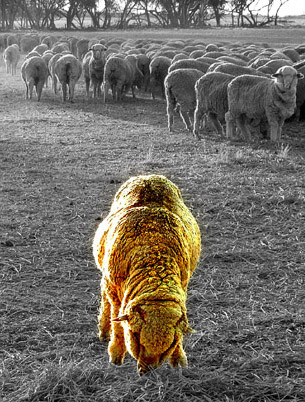
The Golden Sheep

“You know, if he weren't so fierce, he could stay with us!
Why can't he just be a nice sheep?”


"Nay, nay, have a care, Psyche. This flock has not the gentle ways of sheep. While the sun burns aloft, they are themselves as fierce as flame; but when the shadows are long, they go to rest and sleep, under the trees; and you may cross the river without fear and pick the golden fleece off the briers in the pasture."

Ψυχη, Psyche (Greek for “soul”) looked at her invisible lover, the god Έρως, Eros (Greek for “spiritual love”) while he slept, using a lamp concealed in a pottery jar. For this, she lost her invisible palace as well as her lover, and had to search the world over until she could find him again. The mother of Eros was the goddess Αφροδιτη, Aphrodite (Greek goddess of romantic love), who set Psyche to several tasks, impossible to fulfill without divine help. This help was given her, secretly, by Eros who still loved her and wanted her to find him. One of the tasks was to bring tufts of wool from a flock of golden sheep, Μηλοι Χρυσεοι, Meloi Chryseoi, sheep that were too fierce to be approached by mortals. She listened to the advice of the naiads (nymphs, Greek for “brides”) who told her to wait until night when they dozed. Then she could cross the stream and gather tufts of their wool off the thorns. Psyche followed their advice and in the end was reunited with Eros.

There are sheep, and then there are golden sheep.

Wednesday, January 23, 2008

Guard your thoughts

The devils, being spiritual beings, direct most of their attacks against us at our minds, where our spirits are lodged. There they plant thoughts (λογισμοι in Greek) which are all but indistinguishable from our own thoughts, except for their objects.

Our spirits being regenerated and indwelt by the Holy Spirit present thoughts consistent with our new spiritual natures. They are good and pure, rational and just. They lead us from one good to another, if we follow them. But the thoughts planted by the evil one and his angels are the opposite. They add drag to our spiritual natures, try to bring us down, and lead us from one evil to another, sometimes by trickery, sometimes by flattery.

Here is our problem in these last times…


We have been taught (by the world) to believe that all our thoughts reflect who we are and what we ourselves desire, and that to follow them is not only natural but commendable. So, whatever thought comes to mind, whatever the devils plant there, be it an apparent good, some transitory pleasure or speculation, or something pitted against the truth of God’s revealed Word and which we know to be wrong (but only there, so the devils lisp in our mental ear), we think it right to follow, to try out, to experiment with, to experience.

In former days, for most Christian souls, thoughts were not accepted inwardly nor acted upon if they went against what the conscience knew was right. Whether traced back to the devils or merely to fleshly weakness, bad thoughts, imaginations and fantasies were rejected, boldly and as a matter of course. Now, however, with the lie that whatever we think is possible (and therefore, permissible), even souls that acknowledge Christ can justify themselves in following every and any whim.

“Go where no one has ever gone before, do what no one has ever done. Follow your dream, your vision. Life is a journey.”

Yes, my brothers. Life is at least a journey.

But it’s more than that.
It’s a pilgrimage from the “City of Destruction”
to the “Celestial City.”
John Bunyan was right.
Brethren, guard your thoughts!

Then one said to Him, “Lord, are there few who are saved?” And He said to them, “Strive to enter through the narrow gate, for many, I say to you, will seek to enter and will not be able. When once the Master of the house has risen up and shut the door, and you begin to stand outside and knock at the door, saying, ‘Lord, Lord, open for us,’ and He will answer and say to you, ‘I do not know you, where you are from,’ then you will begin to say, ‘We ate and drank in Your presence, and You taught in our streets.’ But He will say, ‘I tell you I do not know you, where you are from. Depart from Me, all you workers of iniquity.’ Luke 13:23-27 NKJV

Saturday, January 12, 2008

Blessèd Number Nine

Now when He saw the crowds, He went up on a mountainside and sat down. His disciples came to Him, and He began to teach them saying:


"Blessèd are the poor in spirit,
for theirs is the kingdom of heaven.
Blessèd are those who mourn,
for they will be comforted.

Blessèd are the meek,
for they will inherit the earth.
Blessèd are those who hunger and thirst for righteousness,

for they will be filled.
Blessèd are the merciful,

for they will be shown mercy.
Blessèd are the pure in heart,

for they will see God.
Blessèd are the peacemakers,

for they will be called sons of God.
Blessèd are those who are persecuted because of righteousness,

for theirs is the kingdom of heaven.

"Blessèd are you when people insult you, persecute you and falsely say all kinds of evil against you because of Me. Rejoice and be glad, because great is your reward in heaven, for in the same way they persecuted the prophets who were before you.

"You are the salt of the earth. But if the salt loses its saltiness, how can it be made salty again? It is no longer good for anything, except to be thrown out and trampled by men.


"You are the light of the world. A city on a hill cannot be hidden. Neither do people light a lamp and put it under a bowl. Instead they put it on its stand, and it gives light to everyone in the house. In the same way, let your light shine before men, that they may see your good deeds and praise your Father in heaven."
Matthew 5:1-16 NIV

Why, when the beatitudes (οι μακαρισμοι in Greek) are listed, are they called the Eight Beatitudes? It seems to me there's a ninth "blessèd", which I have quoted in full and bolded. Even if I am not found among any of the eight blessed categories, I hope at least to be included among those in the ninth one. Although most of the time, I’m insulted and slandered behind my back or out of earshot, today it was to my face. I quoted the beginning of the Sermon on the Mount from Matthew because some of the other things Jesus said there have relevance to what follows.

Today I had one of my illusions shattered.

I bicycled down the mountain to visit an old friend. Before becoming Orthodox, he was a deacon at an Episcopal church where I used to do lay ministry. Talking about those days, he mentioned the former rector of that church, who is still alive but left the ministry and became a Roman Catholic. This former priest was someone whom I respected as a man of lofty principles, even if he wasn’t as on fire for spreading the gospel as I was. The church had once been notorious as a homosexual haven, but when he became rector, he “cleaned up the place” as I remember being told.


Today I was shocked to hear that this elderly ex-priest had discovered he was gay about fifteen years ago, and was living with his lover! (He and his wife divorced while he was still the rector. Everyone thought it was her fault.) As if this weren’t shock enough, my friend admitted, yes, this priest had told him that he was “gay” and had actually asked him to… well, you know… (he refused, of course!) and the very next Sunday, still preached a sermon castigating the homosexual life style.

Which of my illusions was shattered?
I’ve been thinking a good long time of how impossible it would be to be living a double life, sexually or otherwise, and still be able to face people with whom you have a trust relationship on a daily basis. I just couldn’t believe anyone could be that dishonest. I’ve been falsely accused of things I’d never done, and I defended myself with the argument that if I were guilty of such things, I couldn’t face the world or even look at myself in a mirror. Now, I have to say, if Father so-and-so could do these things and still consecrate the Eucharist and hear confessions, then anyone could, even me! I just didn’t think humans could be that bad. Call me naïve.


I got over the shock as I pedalled my bike up the mountain in the twilight. A beautiful crescent moon hung in the evening sky as I passed Kappaya, my favorite Japanese restaurant. I would’ve liked to have stepped in there for a bowl of Agedashi-dofu to tide me over for the rest of the ride but, though the lights were on, they would not be open for another half hour. So onward and upward…

It was chilly, and I’d chosen to make my ride clad in very light clothes, no jacket or scarf, just a pair of light cotton pants, a T-shirt and a long sleeve shirt over that. By the time I got home, I had a hacking cough for the first ten minutes. Then, I noticed I’d gotten a call from my friend Brock. I returned the call. He was at a coffeehouse we frequent, and I decided to join him. I changed shirts, grabbed my scarf, hoody and my Greek and Gullah New Testaments, hopped in my car, and drove over to meet him. When I arrived, he was working on his latest screenplay on his laptop while visiting with a mutual friend. The fellow had just lost his job and needed some encouragement, though he pretended not too. Brock kept company with him and just let him talk. Sometimes you need to do that with a grief.

There were a lot of grieving people around today. I spent some time with two of them, one with a past grief that he was still mourning, one with a present and maybe future grief, one older than me, one younger.

The older was a man a few years my senior who had lost his wife a few years ago. In his case, the mourning has taken the form of turning away from Christ. Though he was a Christian while his wife was alive, after her death he renounced Christ and reverted to Judaism (he has Jewish ancestry). I’ve been getting to know this man gradually over the last few months. He has noticed that Brock and I are constantly studying the Word of God, in Greek and English, and from conversation with Brock found out that I study both the Church fathers and the Jewish rabbinical writings. So he likes to encounter me, and we dialog. I speak of Jesus to him in Hebrew terms, call Him ha-Mashiach and call God the Father ha-Shem, and I respect my friend’s Jewish scruples. Today, though he hasn’t trusted me enough to talk about what happened to his wife, he mentioned her to me for the first time. It’s odd talking to him because, of course, the man is a Christian who has simply talked himself out of belief in Jesus, somehow because his beloved wife was taken from him. It’s not quite the same as talking to a person Jewish from birth. Being ready to confess Christ before men, that’s all it takes. Christ does the rest, and in His time, not ours. Though we may not see how the story ends, we still have our part to play, following Jesus.

Now, the younger man. He’s about twenty-five years old, confined to a motorised wheelchair, and his constant companion is a prison-trained dog, a gentle and patient pup named Parker. Brock and I have gotten to know this boy over the past six months or so.

He wheeled in this evening, went straight to the end of the coffee bar and stayed there, talking to one of the baristas. I went over to say ‘hey’ when I noticed he had a drink already and was on his cell, so I went back and sat down. I looked up from time to time (I was reading the Gullah New Testament) to see what he was doing, and I just felt something was wrong. Finally, I just went over to him across the room, knelt down beside him on one knee, and asked him if everything was alright. I could see that he was really stressed out and looked like he was ready to cry. All thoughts of giving him a little present I had with me died away with my first look. Nothing earthly would matter to this young man.

He started unraveling his grief. His mom is in the hospital. She's a diabetic and has a bad hernia problem, for which she was hospitalized last week. While there, she was tested and cancer was discovered, a bad kind. The family’s on welfare, they are ex-Mormons, and his mom’s physical ailments are in part due to the way she gave birth to my young friend. Somehow, instead of a normal C-section, she was cut open vertically, severing all her frontal muscles and causing chronic hernia. This was of course a long time ago. Since then, she developed diabetes, and has been in poor health generally. My friend is afraid she will die, because of other factors too numerous to mention here, which he described to me.

After he talked it out, I started explaining to him what he could do. Just two things.

“Keep visiting your mom,” I said, “and phone her whenever it’s appropriate. Let her know you love her and believe in her. That will help give her the will to hang on, to live.”
Then I told him the other thing he could do, “If you haven’t prayed yet, start to pray for your mom, talk to God our heavenly Father about her. Ask Him to heal her and spare her life. Don’t worry if you haven’t prayed before, God knows how it is, how you feel, how your mom feels, how troubled you are. He understands. He knows you through and through, and He loves you. You don't have to bargain with Him. Just say, ‘Father, please heal my mom and save her life, but Your will be done, not mine.’ And keep talking to Him whenever you’re alone or can’t sleep. Remember, you can’t do anything, but you can do these two things, Visit your mom and stay with her as much as they let you, and talk to the Father about her, asking in Jesus’ name.”

I had my arm around his shoulders and touched him and looked at him while speaking to him as if he were my own child. Then I just spontaneously started praying for him and his mom right there at the bar (there was no one too close, so it was rather private). Both of us had wet eyes. It was a good prayer time.

Just as I finished praying, and continued speaking a few more words of encouragement, I noticed an attractive young woman trying to go around us to the very end of the bar. She petted Parker the dog who was napping on the floor as she stepped over him, and then she sat down on a high stool facing us, with her back to the wall.

As I was still talking quietly to my friend, this girl, smiling broadly and looking right at the two of us, loudly said, “Don’t let him brainwash you with religion!” I stopped talking for just a few seconds, looked up and straight at her with a shocked stare, and then finished giving my friend the last few words I had for him. Then, as I was getting up to leave, I looked at this girl again and said to my friend, “I hope she was just joking when she said that!” As I walked away with Brock, who was watching it all in silence, I heard her start talking again, “Oh yeah, I was brought up as a Christian, but…” I didn’t hang around to hear her finish her sentence. As I left, I prayed, “Father, give increase to the seed Your hand has planted,” still shocked at the effrontery of this girl.

In my spirit, I just kept commending my young friend and his mom to the care of our all-loving and merciful God, as Brock and I walked out to my car where we prayed together before parting. I had never experienced this kind of thing before, even when we used to pray for people publicly in downtown Portland. We’d never look to see who’s watching. We’d just pray, there, on the spot, as God commands. But now I know this can happen, and so I’m sharing this story with you, so that you will be encouraged also, and ready for anything, always remembering what I had to remind myself today,

“In the world you will have trouble, but be brave: I have conquered the world.” John 16:33b Jerusalem Bible

Thursday, January 10, 2008

Orthodoxy as a commodity

This evening when I opened my Outlook Express inbox, I found the following bulk email message from the proistámenos (head pastor) of my Greek Orthodox community, Aghía Triás in Portland, Oregon…

Dear Roman,

Have you ever wondered about the Orthodox Church’s position on abortion, capital punishment, and torture? Why Orthodox Christians cannot be cremated? Whether an Orthodox Christian can donate organs or receive a donated organ?

Beginning this Saturday, January 12, we will resume our program of Vespers educational discussions. Vespers will begin at 5:30 and end at 6:00 PM, after which a short lecture and discussion section will take place in the church. Topics for this month include “Sanctity of Life” (January 12), “Cremation,” (January 19), and “Organ Donation” (January 26).

Saturday evening Vespers is a wonderful and deeply prayerful opportunity to prepare for the Sunday Liturgy, and explore some fascinating topics of discussion and conversation. I hope to see you there.

Yours in Christ,

Fr. Paul Schroeder

This message may seem harmless enough to most of the visitors to my blog, few if any will be my fellow Orthodox Xtians. After all, this is what “church” is all about for many of them. So, what am I getting at?

Well, most people go to churches that have a set of authorized beliefs, teachings or practices. Many churches have “adult education opportunities” to upgrade the knowledge of their members as to these teachings. This is not uncommon in Orthodoxy at all, and certainly not wrong when done within the Orthodox íthos (environment), in the right way, at the right time. And if they do have this “programatic” structure to their church activities, they have to advertise, and publish schedules.
So what? And what better way than to put an ad in the paper, use a lighted marquee or billboard out in front of the church or, better yet, broadcast this stuff in the form of Christian junk mail? How else are we gonna get people in the door? Offer ’em a free mocha or latté? Whoa there! Not in holy Orthodoxy! …yet.

Orthodoxy Lite.
At Holy Trinity on Saturday nite.
Come ‘n’ get it!

No thanks. Not for me.
Neither Jesus Christ nor His bride the Church are a commodity to be traded on the spiritual Dow (Tao?) Jones. I’m not a consumer.

Driving down N.E. Glisan or any other main street in Portland or any other town, it’s hard to distinguish the “churches”, “fellowships” and “Christian centers” from the fast food outlets and the “whatever ‘R’ us” mega-stores. But it’s not just the cheap marketing tricks that cloy one's spiritual sensibility. It’s also what goes on inside these places, the shameless showmanship, the deconstruction of worship, the Nicolaitan contempt for the idiots in the pews or padded seats by the religious professionals on stage.

Back to Aghía Triás mou, in reverse order quoting from the invitation…

Saturday evening Vespers is a wonderful and deeply prayerful opportunity to prepare for the Sunday Liturgy, and explore some fascinating topics of discussion and conversation. I hope to see you there.
No thanks. Not for me.
Saturday evening Vespers should be a wonderful and deeply prayerful opportunity to prepare for the Sunday Liturgy, but it isn’t anymore. The evening service, which used to last for an hour or a bit longer without a homily, opening for us a sacred kairós (acceptable time) in which to pray and worship the Lord in spirit and truth, has been re-engineered with almost ISO standards precision, to fit a half hour time slot, ‘because we’re all so busy’, thus giving us more time for “some fascinating topics of discussion and conversation.” Duh… But what about our preparation for the Sunday Divine Liturgy?

We no more prepare ourselves for worship in spirit and truth by dissipating ourselves with “discussion and conversation” than we prepare for Holy Communion by stuffing our throats with country breakfast! In Orthodoxy, we approach God in fear and awe, not with short, little minds impatient for the next mental titillation.

“Pause a while and know that I am God,
exalted among the nations, exalted over the earth!”

Psalm 46:10 Jerusalem Bible
________________
Have you ever wondered about the Orthodox Church’s position on abortion,
capital punishment, and torture? …


Uh, no. Actually, I haven't. And why not?
Because the “Orthodox Church” has no position, as if it were a worldly religious institution like the Vatican or the United Nations (yes, I said United Nations, a religious institution, and I leave it to the reader to decide who’s the “god” of this “church”).

The Orthodox Church receives the teaching of Christ and the Holy Apostles, and hands these over to those who have faith. Who are they? Those of whom holy apostle Peter wrote,

“You are a chosen race, a royal priesthood, a consecrated nation, a people set apart to sing the praises of God who called you out of darkness into His wonderful light.”
1 Peter 2:9 Jerusalem Bible

What is Peter talking about? This is not a religious institution or corporation with professionals who alone possess the qualifications necessary to dispense cheap grace and teaching to the consumers. No, my brothers of the spiritual Israel. It’s not what but who that the apostle is writing about. As metropolitan Anthony exhorted us when he visited us once in the ‘catacomb’ church of Saint John the Forerunner, “You can do eighty percent of what we bishops and priests can do! You are a holy nation, a royal priesthood! Don’t force us to do it all!” And as he once proclaimed from the royal doors of the ikonostasis (icon wall) of Aghía Triás, “People of God! Come with us! Come with us, up Mount Tabor! Meet the Lord with us, transfigured!”

What is happening here? I mean, at Aghía Triás?
The treasure hidden in a field, Orthodoxy, which a man will sell all he has (all his intellectual conceits, vain imaginings and hopeless programs) so that he can run to purchase that field, yes, that treasure is beginning to be buried under a “worthless image” of it. Man’s thoughts, man’s programs and plans, “truth” weighed and measured in effigy to be sold as the real goods. Not only have the evangelical victories of the Reformation been undone among their spiritual descendants, but now the apostasy is peacefully settling into the heartland of Christianity. Why is it settling in unopposed?
Have they bought us?

No. Not at all. Quoting holy apostle Peter again,

“Remember, the ransom that was paid to free you from the useless way of life your ancestors handed down was not paid in anything corruptible, neither in silver nor gold, but in the precious Blood of a Lamb without spot or stain, namely Christ.”
1 Peter 1:18-19 Jerusalem Bible

And also holy apostle Paul,

“You must keep to what you have been taught and know to be true; remember who your teachers were, and how, ever since you were a child, you have known the Holy Scriptures—from these you can learn the wisdom that leads to salvation through faith in Jesus Christ.”
2 Timothy 3:14-15 Jerusalem Bible

Brothers, stay awake! for the time is close… (Revelation 1:3)

Tuesday, January 8, 2008

Psalms for the 8th Day

Yahweh, do not punish me in Your rage,
or reprove me in the heat of anger.
Your arrows have pierced deep,
Your hand has pressed down on me;
no soundness in my flesh now You are angry,
no health in my bones, because of my sin.
Psalm 38:1-3 Jerusalem Bible

Lord, all that I long for is known to You,
my sighing is no secret from You.
Psalm 38:9

I said, ‘I will watch how I behave,
and not let my tongue lead me into sin;
I will keep a muzzle on my mouth
as long as the wicked man is near me’.
I stayed dumb, silent, speechless,
though the sight of him thriving made torment increase.
Psalm 39:1-2

So tell me, Lord, what can I expect?
My hope is in You.
Free me from all my sins,
do not make me the butt of idiots.
I am dumb, I speak no more,
since You Yourself have been at work.
Psalm 39:7-9

Yahweh, hear my prayer,
listen to my cry for help,
do not stay deaf to my crying.
I am Your guest, and only for a time,
a nomad like all my ancestors.

Psalm 39:12

Happy the man who puts
his trust in Yahweh,
and does not side with rebels
who stray after false gods.
Psalm 40:4

How many wonders You have done for us,
Yahweh my God!
How many plans You have made for us;
You have no equal!
I want to proclaim them again and again,
but they are more than I can count.
Psalm 40:5

You who wanted no sacrifice or oblation
opened my ear,
You asked no holocaust or sacrifice for sin;
then I said, ‘Here I am! I am coming!’
In the scroll of the Book am I not commanded
to obey Your will?
My God, I have always loved Your Law
from the depths of my being.
I have always proclaimed the righteousness of Yahweh
in the Great Assembly;
nor do I mean to stop proclaiming,
as You know well.
I have never kept Your righteousness to myself,
but have spoken of Your faithfulness and saving help;
I have made no secret of Your love and faithfulness
in the Great Assembly.
Psalm 40:6-10

As a doe longs for running streams,
so longs my soul for You, my God.
My soul thirst for God, the God of life;
when shall I go to see the face of God?
I have no food but tears, day and night;
and all day long men say to me,
‘Where is your God?’
I remember,
and my soul melts within me:
I am on my way to the wonderful Tent,
to the house of God,
among cries of joy and praise
and an exultant throng.
Psalm 42:1-4

When my soul is downcast within me,
I think of you;
from the land of Jordan and Hermón,
of you, humble mountain!
Deep is calling to deep
as your cataracts roar;
all your waves, your breakers,
have rolled over me.
In the daytime may Yahweh
command His love to come,
and by night may His song be on my lips,
a prayer to the God of my life!
Psalm 42:6-8

Great grace cannot be possessed in peace…

…because many conflicts arise against it. The more grace a man has, the more the devil attacks him. But a man should not on that account stop being guided by his grace, because the harder the battle, the greater will be his crown, if he wins…

Someone said to him, “I am often tempted by the worst kind of temptation, and I have often asked the Lord to take it away from me—and He does not take it away.” Brother Giles answered him,
“The better the armor with which a king arms his soldiers, the more bravely he wants them to fight.”

Sunday, January 6, 2008

Today the Uncreated

Ποίημα Σωφρονίου Πατριάρχου Ιεροσολύμων
(Poem of Sophronios, patriarch of Jerusalem)

Τριας υπερούσιε, υπεραγαθε, υπέρθεε, παντοδύναμε, παντεπίσκοπε, αόρατε, ακατάληπτε
Triad beyond all being, beyond all goodness, beyond all godhead,
all-powerful, all-vigilant, invisible, incomprehensible;
Creator of the spiritual beings and rational natures,
innate goodness, unapproachable Light
that enlightens everyone coming into the world,
shine also in me your unworthy servant.

Enlighten the eyes of my mind that I may dare to sing
the praise of your measureless benevolence and power.
May my supplication for the people here present be acceptable,
so that my offences may not prevent the Holy Spirit
from being present here; but permit me now
without condemnation to cry out to you and say,

Master, lover of mankind, beyond all goodness,
Almighty, eternal King:
We glorify you, the Creator and Fashioner of the universe.
We glorify you, only-begotten Son of God,
without father from your Mother, without mother from your Father.
For in the preceding feast we saw you as a babe,
but in the present one we see you full and perfect man,
our God, made manifest as perfect God from perfect God.

For today
the moment of the feast is here for us
and the choir of saints assembles here with us,
and Angels keep festival with mortals.
Today the grace of the Holy Spirit
in the form of a dove dwelt upon the waters.
Today the Sun that never sets has dawned
and the world is made radiant with the light of the Lord.
Today the Moon with its radiant beams
sheds light on the world.
Today the stars formed of light make the inhabited world lovely
with the brightness of their splendour.
Today the clouds rain down from heaven
the shower of justice for mankind.

Today the Uncreated by his own will
accepts the laying on of hands by his own creature.

Today the Prophet and Forerunner draws near,
but stands by with fear seeing God’s condescension towards us.
Today the streams of Jordan are changed into healing
by the presence of the Lord.
Today all creation is watered by mystical streams.
Today the failings of mankind are being washed away
by the waters of Jordan.
Today Paradise is opened for mortals
and the Sun of justice shines down on us.
Today the bitter water as once for Moses’ people
is changed to sweetness by the presence of the Lord.
Today we have been delivered from the ancient grief,
and saved as the new Israel.
Today we have been redeemed from darkness
and are filled with radiance
by the light of the knowledge of God.
Today the gloomy fog of the world is cleansed
by the manifestation of our God.
Today all creation shines with light from on high.
Today error has been destroyed
and the coming of the Master makes for us
a way of salvation.
Today things on high keep festival with those below,
and those below commune with those on high.
Today the sacred and triumphant
festal assembly of the Orthodox exults.
Today the Master hastens towards baptism,
that he may lead humanity to the heights.
Today the One who does not bow
bows down to his own servant,
that he may free us from servitude.
Today we have purchased the Kingdom of heaven,
for the Kingdom of the Lord will have no end.
Today earth and sea share the joy of the world,
and the world has been filled with gladness.

The waters saw you, O God,
the waters saw you and were afraid.
The Jordan turned back
when it saw the fire of the godhead
descending in bodily form and entering it.
The Jordan turned back
as it contemplated the Holy Spirit
in the form of a dove,
descending and flying about you.
The Jordan turned back
as it saw the Invisible made visible,
the Creator made flesh,
the Master in the form of a servant.
The Jordan turned back
and the mountains leapt
as they saw God in the flesh,
and the clouds uttered their voice,
marvelling at what had come to pass,
seeing Light from Light,
true God from true God,
the Master’s festival today in Jordan;
seeing him drowning the death from disobedience,
the goad of error and the bond of Hell in Jordan
and granting the Baptism of salvation to the world.

Therefore I too, a sinner and your unworthy servant,
recount the greatness of your wonders
and, seized with fear, in compunction cry out to you:

Great are you, O Lord, and wonderful your works,
and no word is adequate to sing the praise of your wonders.
Glory to you, O Lord, glory to you!

Theophany in Japan

Here is a video that lets us have a glimpse of the Theophany blessing of the waters as celebrated in Japan. The bishop in this video is really getting into the spirit of the feast… joyful, childlike and free…


When you finish watching the video that is posted above, a series of thumbnails of additional videos of the Theophany service, and other Japanese Orthodox videos, will appear at the bottom of the window that you can click and watch. I've watched most of them, and what surprises me is the uniformity with Orthodoxy elsewhere. In spite of musical variation (the Japanese Church uses Russian Orthodox chant), the ceremonial, sound, feel and look of the services is the same as in my Greek church. There's also some cool video footage of Orthodoxy around the world. Since I first posted this, I notice that some of the other videos have changed. The one of the Ethiopian Orthodox service that I mentioned before is gone, replaced by others, so they just keep coming (and going)! Take a look!
(There's also a video or two in the group which I didn't care for much. That's alright! As stated in the side panel of my blog, “Links to and from this blog are not intended to imply [my] agreement with the views expressed in any of the sites or [video] documents thereby provided.”)

The beginning of the Gospel… the Jordan

The feast-day of Theophany, January 6, marks the day when our Lord stepped out of thirty years of obscurity to reveal Himself as the Son of God and to embark on a divine mission that would end three years later with His Crucifixion and Resurrection.

This was the starting point for all the parables, the healings and the miracles that would form the living Gospel of Jesus Christ.
Cyril of Jerusalem writes,

The beginning of the world—water,
the beginning of the Gospel—the Jordan.

When Christ came forward to be baptized in this ancient river's waters, the mysterion of the Holy Triad (το μυστηριον της αγιας τριαδος) was revealed to the world.
As the troparion for the feast teaches,

…the voice of the Father bore witness to You,
calling You His beloved Son,
and the Spirit in the form of a dove
confirmed the truthfulness
of His Word.

It's no wonder that this feast is also called the feast of Illumination (τα φωτα), for it was on this special day that mankind was enlightened by this mysterious event.

The feast day of Theophany reminds us that Christ came to take the sins of the world upon Himself. Just as He died (His immersion in the Jordan) and rose again (coming up out of the waters of the Jordan), so too we must die to our old, sinful ways and rise again cleansed, renewed and reborn. On this day, our Savior indicates the way to our salvation.