Wednesday, March 7, 2007

Pelagia

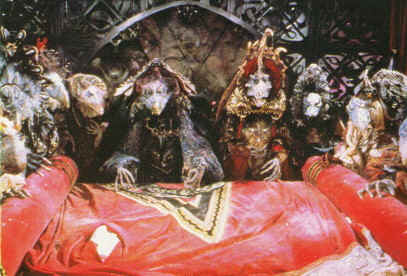
And as we sat, certain of the bishops besought my master Nonnus [nobody] that they might have some instruction from his lips: and straightway the good bishop began to speak to the weal and health of all that heard him. And as we sat marvelling at the holy learning of him, lo! on a sudden she that was first of the actresses of Antioch passed by: first of the dancers was she, and riding on an ass… bare of head and shoulder and limb, in pomp so splendid, and not so much as a veil upon her head or about her shoulders. They [the bishops] groaned, and in silence turned away their heads as from great and grievous sin. But the most blessed Nonnus did long and most intently regard her: and after she had passed by still he gazed and still his eyes went after her. Then, turning his head, he looked upon the bishops sitting round him. “Did not,” said he, “the sight of her great beauty delight you?” They answered him nothing. And he sank his face upon his knees, and the holy Book that he held in his good hands, and his tears fell down upon his breast, and sighing heavily he said again to the bishops, “Did not the sight of her great beauty delight you?” More…. (Clicking the link will download a PDF booklet containing the whole story, which can be read on line, or downloaded to your PC, or printed.)
Gathered together some grumbling old men
warming the bleachers since Lord knows when
hawkers of halos and stoners of flesh
couldn’t distinguish the stale from the fresh
side-saddle straddling some bloody steps
crumbling old queens in their evening dress
cake-eaters all swathed in delicatesse
who wouldn’t know bread and who couldn’t bless
Though everyone saw her, nobody looked
as she rode among them, her whole body booked
decked out in pearls, the wages of fame
rage of the girls, her stage wasn’t tame
flaunting her curls, PELAGIA her name

Casting his eyes on the trespassing jewel
daring to question, nobody was fool
fearing no vision, he followed her down
letting her beauty delight like the dawn
sinking his face in the Word that he ate
nobody lamented their holiness’ fate
put under conviction their righteous hate
undraped their consciences, silenced debate
Though everyone saw her, nobody looked
as she rode among them, her whole body booked
decked out in pearls, the wages of fame
rage of the girls, her stage wasn’t tame
flaunting her curls, PELAGIA her name

Why did she wander, what led her inside
this room where the mirrors let nobody hide
where nobody speaking caught hold of her ears
kissed by her lovers and pierced by their jeers
Drawn by the bride-groom, suspended in praise
her heart came unraveled with one loving gaze
Where could she room now, her house all ablaze
Run to the wedding-feast and change her ways
Though everyone saw her, nobody looked
as she rode among them, her whole body booked
decked out in pearls, the wages of fame
rage of the girls, her stage wasn’t tame
flaunting her curls, PELAGIA her name

Bare head and shoulders and legs she ran
right into the bakery to look for a man
Pushing aside the grandmothers who swept
she found holy feet, hung on them, and wept
Oh, what a damaging love to display
scandal to snobbery, death to dismay
There nobody loved her but gave her away
in a font to her husband through the spray
Though everyone saw her, nobody looked
as she rode among them, her whole body booked
decked out in pearls, the wages of fame
rage of the girls, her stage wasn’t tame
flaunting her curls, PELAGIA her name
—Romanós

Monday, March 5, 2007

Defying the barking dogs


This is a poster that I created, quoting something I wrote to a 'pastor' who banned my partner in evangelical crime and myself from commenting on his blog. Without realizing it, I wrote the passage in the style of Byzantine liturgical poetry, but I couldn't see that until I expressed it on the poster. The image of 'Christ driving out the money-changers' is by the painter Domínikos Theotokópoulos, a.k.a. 'El Greco'. This poster is for those for whom it is intended. If you want to download a copy, click on the poster and wait for it to enlarge; then, right click and 'Save picture as' to your PC.
Kalí sarakostí, adelphoí mou agapitoí!

Sunday, March 4, 2007

To go or not to go (to confession)

The second Sunday of Sarakostí, called the second triumph of Orthodoxy because it celebrates the victory of Gregory Palamás over the arch-fiend Barlaam of Calabria, who called the monks of Mount Athos "navel gazers." Gregory was rewarded by being made archbishop of Thessaloniki in AD 1347. Barlaam said that the monks' lives of prayer were a waste of time that could never bring them close to God. Palamás defended the monks, asserting that we can best know God through the work of Jesus Christ, and that through intense prayer it is possible to "see the uncreated Light of Mount Tabor." So, chalk another one up for Orthodoxy and the "imperial church." In retrospect, one has to wonder how important all these monastic squabbles were and are for the average followers of Jesus Christ, who don't have to define and defend, who just "follow the Lamb wherever He goes" (Revelation 14:4) because they "know His voice" (John 10:27).

There's something about monasticism that just has to be said. Within Orthodox Christianity we have this wild institution—monasticism—that seems to be at the rudder of the Church, has always provided a corrective when things seemed to go wrong. Like any human construct, it cannot be considered infallible, but must be subject to the same critical evaluation that any institution is, even more so, since it mans the rudder of the Church—we're not just talking about earthly propositions here, but the "ark of salvation."

The modern Orthodox Christian is taught that it is indispensable to have a spiritual father, to confess one's sins to, to get guidance and instructions from, to be obedient to, with an obedience that can (sometimes) subvert reason. At their best, these elder/disciple relationships can, in fact, bring a person closer to God (though they can add nothing to one's salvation). At their worst, these relationships can almost unhinge one's salvation and certainly can cause an unspiritual co-dependence that creates more bondage than it relieves. Now, here's the rub. Though we're taught that we must have a spiritual father and go to confession regularly, few do, relatively speaking; and if they did, there wouldn't be enough time for the priests to hear them all.

Now here's where the Sunday sermon comes into play. Father Paul, the appointed epistle (Hebrews 1:10-2:3) and gospel (Mark 2:1-12) notwithstanding, preached his usual wild take-off, but today it was enlightening. He started by giving us the illustration of people using "temporary fixes" to solve problems that deserve more serious effort—for example, "temporarily" fixing a farm gate with some baling wire. The fix really is temporary, though we forget to fix it right until it breaks again. Father Paul applied this to the Church's handling of confession.

The early Church didn't have the "sacrament" of confession as we know it today. The Church was still a tight group of people working out their salvation together. Sins were confessed among them publicly, and the group forgave the repenting sinner, together, and publicly restored him.

After Constantine, the Church grew too quickly, because it was "in" to be a "Christian." The leaders of the Church set up a temporary fix—they designated the bishops and presbyters to be the "forgivers" in the name of the community, and sinners would confess privately, be absolved, and quietly restored to fellowship.

Unfortunately, rigor mortis set in, or at least a profound but respectable laziness, and the Church found itself unwilling or unable to return to the earlier state of affairs. It was easier to just say, "times have changed" or "the Holy Spirit has evolved our understanding, and it's better this way." But even within Orthodox Christianity, the voice of the real Holy Spirit was still heard and followed by some. Father Paul gave three examples.

Symeon the New Theologian taught that a follower of Christ could confess to any other Christian (not just clergy) and even be forgiven. He was, of course, practically stoned for his teaching by some of his contemporaries, yet the Orthodox Church considers him on a par with holy apostle and evangelist John the Theologian, calling him the New Theologian, that is, the new apostle John.

John of Kronstadt, a Russian priest of modern times, had so many people coming to him for confession, that he had them all just speak their confessions aloud publicly while standing in the church service, and he forgave them all publicly and absolved them—and this was considered by all to be perfectly acceptable as a "sacrament."

Finally, even closer to home, Father Elías Stephanópoulos of Holy Trinity, Portland, Oregon, who pastored this community for 19 years before losing a battle with terminal cancer, used to periodically read the prayers of absolution over the entire congregation. What's implied by this action is that those who had repented of their sins and confessed, if only to one another or even to God alone, received the blessing of forgiveness at the hands of the priest and in the name of the Church.

And I want to add one more witness of my own. Aretí Vlahákis, a lifelong member of Holy Trinity who was an evangelical spirit and whom I knew only in her old age, passed on many things to us "younger" disciples. She also said, that confession to a priest was not the only way to confess your sins. She also said what the Word of God teaches, "confess your sins to one another" (James 5:16). Aretí really knew her Bible. May her memory be eternal.

So, back to where Father Paul left us. After giving us his three examples of how "confession" could be administered, he left it with us, to decide "to go or not to go," though this is not the way he put it. What he said was something that implied that the time has come, at last, to discover what the Lord wants us to do as persons and as a community, to make "forgiveness of sins" a reality, and not keep trying to fix the gates of our souls with mere "baling wire."

Father Paul, if you read this, you spoke a true word today. Let's hope we're listening, all of us.

Saturday, March 3, 2007

God does not want those whom He will save… to be ignoramuses

God does not want those whom He will save, who seek His mercy, to be ignoramuses, unmanly, cowardly, or spiritually untested. It is a matter of divine inheritance stored up for experienced Christians. So He places temptations before us so that our obedience to His commandments may be demonstrated. His illumination is within us; knowledge of His will is taught by the Scriptures; furthermore, our conscience guides us like a compass. All of the above enlighten us in the face of temptations. But when evil prevails over our will, we do not obey His commandments.

We were created with free will, and free will cannot be controlled by others. As such, if we feared God, we would not fall into temptation. If we did not love ourselves more than God, we would not tend towards sin. But His goodness did not leave our falls without a rectifying remedy, whereby we return once again and a victory occurs in spite of our fall.

All who compel themselves to be saved, the Scriptures call righteous, justified by faith. God will not let them fall, for they are struggling properly. He will not let them be tempted beyond their strength when they are making every effort to be patient. But when we are cowardly and lukewarm, when we have a slothful will, this constitutes an occasion for a temptation beyond our strength.

Your grumbling is sinful; it is a result of self-love and unmanliness. Have patience in everything; thank God; blame your lukewarmness, and not God, Who was crucified for you and, consequently, must love you. Since He loves you, how can He let you fall into temptation? Seek forgiveness from Him, and secure yourself with patience.


Elder Ephraim of the Holy Mountain (Athos)

Thursday, March 1, 2007

Holy Cows in the Polder

To start off the month of March in Cost of Discipleship, I want to direct my readers elsewhere, specifically to this article by Marc van der Woude,
entitled Holy Cows in the Polder.
Despite the image and the title to his article, this is not a light-hearted topic. With the courtesy and sensitivity characteristic of our European brothers, he has introduced a bit of humor to the subject, but please give his article your fullest attention. It deserves it! Here's a sample of what he says:

"I have a simple (some might say 'simplistic') insight: if it is true that Jesus called us (the Church) to proclaim and manifest the Kingdom of God in the earth, so that the gates of hell cannot prevail, then from a strategic point of view it is likely that satan assigned his strongest demons (those of religion, money, control, deception, etc.) to the church. All these demonic spirits have to do is what they also do in other religions - inspire human beings to create and maintain religious (church) systems and mindsets that breed unhealthy codependence, keep people occupied with all kinds of side-matters, and therefore render them relatively unfruitful and harmless. Therefore, any true reformation inevitably has to address things that are foundationally wrong in the way the church operates."

Sunday, February 18, 2007

Christ for the New Age

This is a comment I wrote on the topic of Christians attending "New Age" fairs. There was one recently held in Finland, that some young brethren attended, despite the disapproval of the straight and narrow.
It is exactly right to go to a New Age festival and witness for Jesus.
Why? Precisely because it is there that He is wanted.
What? How can that be? They want Buddha, they want Krishna, they want to do yoga, to meditate, to raise their consciousness, to arouse the kundalini, to see the One in All, but not Jesus!

No, my Christian friends.

They DO want Jesus, they DO want the Living God, the One Who is, Who was, Who is to come, the Pantokrator.
They WANT Him.
What they DON'T want is just another "version."
What they don't want is your ideas about a God who seems helpless to transform your lives, a God whom you seem to own, a God to whom you give your left-overs (even when you proudly give your tithe, you do it so you can receive His blessing, and so you can be seen as prosperous and victorious).

The Jesus the New Age wants is the Jesus who is looking for THEM, who walks to them in His disciples' feet, who smiles at them with His love in His disciples' eyes, who helps them with His disciples' hands.

The Jesus who comes in grace, willing to lay down His life in His disciples' willingness to lay down theirs, even to giving up their freedom without counting the cost.

New Age fairs are like this world of which they are a part, they include the sincere but also the insincere, those interested in the Truth but also those who want to make a profit from those who hope that money can buy Truth.

But the Truth cannot be bought or sold, no, not that way.

We are not those who buy or sell the Truth, for we know the Truth who has purchased us with more than money, and we could never sell Him who bought us at the price of His own blood.

We can go among them, the New Age seekers, following Him Who is already walking in their multitudes, seeking His sheep.
How ironic that man should think that he can seek God, or that he must seek Him.
No, it is the God we did not know who came to seek US.
And now that He has found us, who better to send out with Him to gather the rest of His lost sheep?

Go with Jesus.

Saturday, February 17, 2007

Cast out of Paradise

This is the last Sunday before the beginning of the Great Fast (Sarakostí, "Lent"), beginning on Monday (Kathará Dheftéra, "Clean Monday"). As the day begins at sundown according to Orthodox understanding, the first service of Sunday (Kyriakí, "the Lord's [day]") is the vesper service on Saturday night. I want to invite my readers and visitors to join us on the journey to Pascha. To start on this pilgrim way, I would like to share with you some of the spiritual poetry that comprises our worship for this day.

“The Lord, my Creator, took me as dust from the earth, and with the breath of life He gave me a soul and made me a living creature.
He honoured me as ruler on earth over all things visible and as a companion of the Angels.
But Satan the deceiver, using the serpent as his instrument, enticed me by food, separated me from the glory of God and gave me over to the earth and to the lowest depths of death.
But as Master and compassionate, call me back again.

“Wretch that I am, I have cast off the robe woven by God, disobeying Your divine command, Lord, at the counsel of the enemy, and I am clothed now in fig leaves and in garments of skin.
I am condemned to eat the bread of toil in the sweat of my brow, and the earth has been cursed so that it bears thorns and thistles for me.
But, Lord, who in the last times were made flesh of a Virgin, call me back and bring me into Paradise again.”

“O precious Paradise, unsurpassed beauty, tabernacle built by God, unending gladness and delight, glory of the just, joy of prophets, and dwelling place of saints, with the sound of your leaves implore to the Maker of all to open for me the gates which I closed by my transgression, and may count me worthy to partake of the Tree of Life, and of the joy in which I delighted when I dwelt in you before Adam was banished from Paradise through disobedience and cast out from delight, beguiled by the words of a woman.

“Naked he sat opposite the place, lamenting, Woe is me!
Therefore let us all make haste to accept the season of the Fast and obey the traditions of the Gospel, that through them we may become well-pleasing to Christ and once more receive Paradise as our dwelling.”

“Adam sat opposite Paradise and, lamenting his nakedness, he wept,
Woe is me! By evil deceit was I persuaded and robbed, and exiled far from glory.
Woe is me! Once naked in my simplicity, now I am in want.
But, Paradise, no longer shall I enjoy your delight; no more shall I look upon the Lord my God and Maker, for I shall return to the earth whence I was taken.
Merciful and compassionate Lord, I cry to you, Have mercy on me who am fallen.”

“Through eating Adam was cast out of Paradise.
And so, as he sat in front of it, he wept, lamenting with a pitiful voice and saying,
Woe is me, what have I suffered, wretch that I am!
I transgressed one commandment of the Master, and now I am deprived of every good thing.
Most holy Paradise, planted because of me and shut because of Eve, pray to him who made you and fashioned me, that once more I be filled with your flowers.
Then the Saviour said to him,
I do not want the creature which I fashioned to perish, but to be saved and come to knowledge of the truth, because the one who comes to me I will in no way cast out.”
(John 6:37)

"I am the resurrection and the life. He who believes in me will live, even though he dies; and whoever lives and believes in me will never die. Do you believe this?"
John 11:25-26 NIV

Monday, February 12, 2007

Living a crucified life


I wrote this recently as a comment to a young Christian brother who is struggling with the fact that professed Christians “settle for less” than Christ's standard to “seek first his kingdom and his righteousness, and all these things will be given to you as well” (Matthew 6:33 NIV).

With all due respects to your Dad, there is nothing merely earthly that is worth going down for, when you have been raised up by Jesus.

Even Confucius says things like, “Wealth and rank are what every man desires; but if they can only be retained to the detriment of the Way he professes, he must relinquish them” (Analects, 4:5).

Now, if this is true for enlightened, philosophical pagans, it’s true of Christians, or at least it should be. Is this any different, really, than Christ's admonition? “If your hand causes you to sin, cut it off. It is better for you to enter life maimed than with two hands to go into hell…” (Mark 9:43 NIV).

I am an example of one who chose the right over the profitable. It has made most of my relatives my enemies in the long run (not blood-sucking enemies, just people who hold me in contempt), has lost me all the prestige and professional “respect” I ever had, and has even marginalized me at church. But fortunately, I don't care.

It’s sad when a person loses the respect and love of a wife or other family member for choosing the right; it’s just as sad to experience the same loss for not choosing the right, yet it still happens. I’d rather have the first than the second.

It’s all in the Bible. If you choose the right persistently, young brother, you cannot avoid living a crucified life. And if there’s any other kind of Christian life worth living, tell me about it.

Sunday, February 11, 2007

Small talk on Judgment Day (Sunday)

Today is “Meat-Fare” Sunday, also known as “Judgment Day” Sunday in the Orthodox Church. The readings are Matthew 25:31-46 for the gospel and 1 Corinthians 8:8-13, 9:1-2 for the epistle. I referred to this Sunday in my previous post, But Lord, when did we see you like that? — And now it's here. Its icon is usually ‘the Day of Judgment’ which you'll see if you click on the link for the gospel reading above. Another icon that’s rarely shown but which I like better, is one shown in my previous post, Love Sets No Limits. Rather than showing Christ at His glorious coming, with all humanity standing judgment before Him, the other icon shows what the Lord was getting at when He revealed the criteria for eternal life versus eternal punishment for those who call Him, ‘Lord’. By the way, the reason this day is called “Meat-Fare” Sunday is because it’s the last day to eat flesh meat until Pascha (the Lord's Passover, Easter).

After chanting both the epistles in Greek and English, and the gospel in Greek, thankfully the deacon read the gospel. The reason for chanting is that before the days of PA systems, chanting carried farther than speaking could. Now, in this modern time, when people listen to music for the melody and often tune out the words, it’s not a good idea to chant the scripture readings, because I notice that the people around me are either straining to make out the words or else, having given up, just waiting patiently for the sermon. Hopefully the sermon will touch on and explain the scriptures.

The sermon, hmm, well, yes, the sermon…
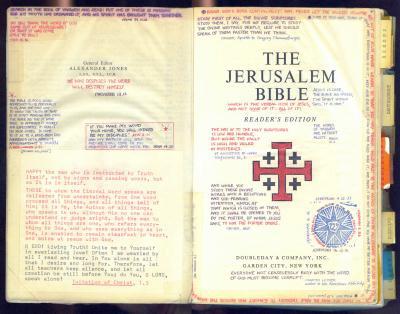
When the preacher came down into center aisle and started his talk with something about ‘carrots and sticks’ I stuck my right thumb into my working ear, unzipped my bible case and opened my Jerusalem Bible at random, and started reading, hoping to find something to take away with me that I could feed on. It was difficult, because his talk was very loud and animated and it got through even my hearing-impaired left ear. On and off his words mixed with my bible reading. Finally, I just gave up, and decided to attend.

It was just then, that the preacher said some words worth remembering. He told an anecdote about Bishop Anthony of San Francisco, our previous chief shepherd, who reposed on Christmas Day, 2005. (See my previous post,
Worlds in Collision, for more about this great man of God.) This is the gist of what he said…

When he was working in the diocesan offices, at lunch time he would grab a small brown sack with his lunch and head for the kitchen to eat it, alone.
But when Bishop Anthony ate lunch at the office, he always went into the kitchen and made lunch for everyone who was working that day, and they all ate together.
Bishop Anthony said, “In my village on Crete, we have a saying, ‘It is a curse to eat alone,’ and so I try never to eat alone.” This made me remember something I wrote in my post, Thinking of Communion last August, “the sharing is better food than the eating.”

Hearing this story brought many things to mind, but especially the times I was blessed to sit with bishop Anthony at table, during one of his many visits to Holy Trinity in Portland. He didn’t surround himself only with ‘clergy’, but often escaped them to break bread with the rough and tumble of his flock.


By the way, yes, that's bishop Anthony in the photos scattered about. May his memory be eternal.

Thursday, February 8, 2007

Soon we head out on the road to Pascha

Even though it's not even the beginning of Sarakostí (Lent), I'm already thinking of Pascha (the Lord's Passover).
I was trying to explain to an evangelical brother the problem caused by the Latins adding "filioque" to the original Symbol of Nicæa. He responded that he never heard of that one, but knew only of the controversy of "he descended into hell" being in the Nicene Creed. He said he thought it was probably unscriptural. What he didn't know is that the Symbol of Nicæa doesn't include these words; they're in the Latin baptismal formula called the "Apostles' Creed." Well, the two texts that refer to Christ's "descent into Hades (She‘ol)" are 1 Peter 3:18-19 and Ephesians 4:9-10. My purpose is never to dispute, but simply to report was has been handed over to us. But, as I say, it got me to thinking about the resurrection of Christ, which for us Orthodox Christians, is never more than a week away every day of the year. This reminded me of some beautiful passages from our Orthodox spiritual treasury, that I want to share especially with my evangelical brethren, since they are as much deserving of hearing them as we are, if not more so.

SOMETHING strange is happening.
There is a great silence on earth today, a great silence and stillness.
The whole earth keeps silence because the King is asleep.
The earth trembled and is still because God has fallen asleep in the flesh, and He has raised up all who have slept ever since the world began.

God has died in the flesh and she‘ol trembles with fear.

He has gone to search for our first parents, as for a lost sheep.

Greatly desiring to visit those who live in darkness and in the shadow of death, He has gone to free from sorrow the captives Adam and Eve, He who is both God and the son of Eve.

The Lord approached them bearing the cross, the weapon that had won Him the victory.
At the sight of Him Adam, the first man He had created, struck his breast in terror and cried out to everyone:
“My Lord be with you all.”
Christ answered him: “And with your spirit.”

He took him by the hand and raised him up, saying:
“Awake, O sleeper, and rise from the dead, and Christ will give you light.
For I am your God, who for your sake have become your son.
Out of love for you and for your descendants I now by My own authority command—
all who are held in bondage to come forth,
all who are in darkness to be enlightened,
all who are sleeping to arise.


“I order you, O sleeper, to awake.

I did not create you to be held a prisoner in she‘ol.
Arise from the dead, for I am the life of the dead.
Arise, work of My hands.
Arise, O My likeness, you who were created in My image.
Rise, let us leave this place,
for you are in Me and I am in you.
Together we form only one person and we cannot be separated.

“For your sake I, your God, became your son;
For your sake I, the Lord, took the form of a slave;
For your sake I, whose home is above the heavens, descended to the earth and beneath the earth.
For your sake, for the sake of man, I became like a man without help, free among the dead.
For the sake of you, who left a garden, I was betrayed to the Jews in a garden, and I was crucified in a garden.

“See on My face the spittle I received in order to restore to you the life I once breathed into you.
See there the marks of the blows I received in order to refashion your warped nature in My image.
See on My back the marks of the scourging I endured to remove the burden of sin that weighs upon your back.
See My hands, nailed firmly to a tree, for you who once wickedly stretched out your hand to a tree.

“I slept on the cross and a sword pierced My side for you who slept in paradise and brought forth Eve from your side.
My side has healed the pain in yours;
My sleep will rouse you from your sleep in she‘ol.
The sword that pierced Me has sheathed the sword that was turned against you.

“Arise, let us leave this place.
The enemy led you out of the earthly paradise.
I will not restore you to that paradise, but I will enthrone you in heaven.
I forbade you the tree that was only a symbol of life, but see, I who am life itself am now one with you.
I appointed cherubim to guard you as slaves are guarded, but now I make them worship you as God.
You hid yourselves, as if naked, from God: but behold—hidden within you is the naked God.
The throne formed by cherubim awaits you, its bearers swift and eager.
The bridal chamber is adorned, the banquet is ready, the eternal dwelling places are prepared, the treasure houses of all good things lie open.
The kingdom of heaven has been prepared for you from all eternity.”

He's already out there

Christ is already out in the world, looking for His lost sheep. (Matthew 18:12)
When we go out, we are accompanying Him.
He lets us join Him. (John 15:16)
He who does not gather with Me, scatters. (Matthew 12:30)
If you confess Me before men, I will confess you before My Father in heaven. (Luke 12:8)


Isn’t reading the bible out loud in public just a waste of time?
Who would be listening?
If you’re reading out loud, it’s not a waste of time, because even if no one else is listening, you are listening, and your partner is listening.


He who is not ceaselessly busy with the Word of God must become corrupt. (Martin Luther)

The world asks, Christians? Where are the Christians? I don’t see any Christians!
You can be a Christian out in the world by reading the Word out loud in public. (1 Timothy 4:13)
You let unbelievers see that there is a Christian.

What if people come and harass me?
Don’t argue, don’t curse, answer back with a flavor of wit to disarm them (Colossians 4:6), don’t stand on ceremony, but never let any physical dishonor be done to the Word of God.
You cannot stop the mocking and reviling, but you can keep the Word from being physically attacked.

What if people come and ask me for help?
If they need prayer, stop and pray, right then and there. (Ephesians 6:18)
If they need advice, keep it to a minimum, but always only what the Lord gives you to say (John 3:11), never argue, condemn, or bully anyone. (2 Timothy 2:14)
If they need food or money for food, do what you can, according to your circumstances. (2 Corinthians 8:13-15)
Even if you have money and cannot give it for whatever reason, don’t worry.
You’re not there to save the world.
You’re there to read the Word and do as it says to the best of your ability, and to the extent of your capacity.

Don’t be a hero.
If you can and do help, then help quickly and immediately, but with a blessing and prayer, and then quickly forget about it. (Matthew 6:3)
Greet everyone with a smile and a cheerful greeting. (Pirke Avot 1:15)
If anyone calls you a hypocrite or harasses you, don’t worry about it, only God can judge, dogs can only bark.

Tuesday, February 6, 2007

Cross, do not fail me


Cross,
do not fail me
when it comes my hour
to bleed.
As to a strong-masted vessel,
let me be bound to you
to share your power.
Hug me close
as the wind we together wrestle.

Lost,
let them nail me
as my ransomed soul
a steed
of spirit mounts
and my hungers hang.
Let me inherit
what the jailer stole
and hidden,
as I thirst,
what prophets sang.

—Romanós

Monday, February 5, 2007

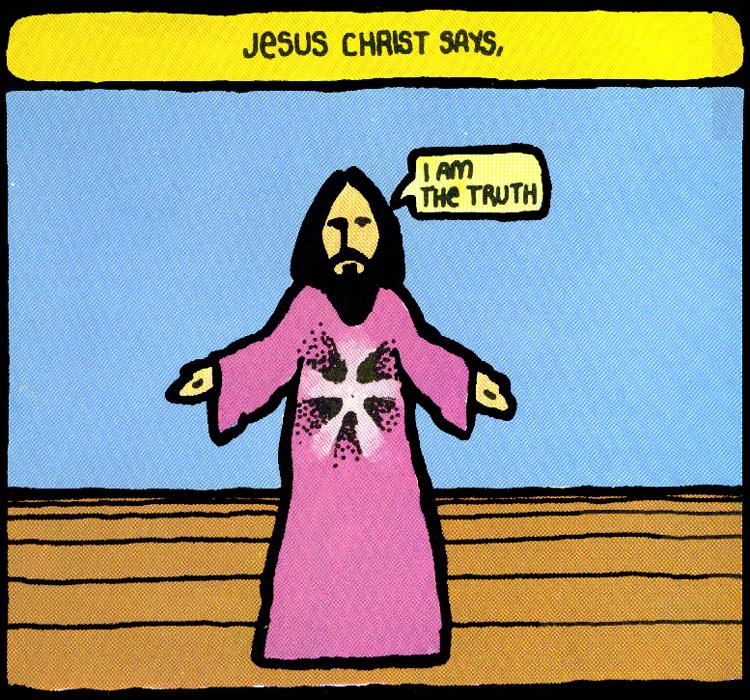
He IS the Truth


Dear Muslim Brother Rehman,

Thanks for sending me your message for Muslims only, the prayer you composed, and your open letter to Osama bin Laden. Your writings are admirable and in many places come very close to the truth of Jesus Christ. You must be very brave to speak out like this among your own people. You run the risk of being killed for your message.

I love the Muslim people, but I do not love the religion of Islam. I also do not love the religion of Christianity. There are times when the Christian religion acts as an oppressor of its own people and of other peoples. I am a member of the Greek Orthodox Church, which is a peace-loving form of Christianity, but even the Greek church has its faults in allowing its people to remain in ignorance of the Word of God (Jesus Christ), and continuing to emphasize the "religion" of Christianity.

I worship God in the temple, but I prove my worship to be genuine by imitating the apostle Paul, who said, "the God I worship spiritually by preaching the Good News…" and by following what James the brother of Jesus said, that "pure, unspoiled religion in the eyes of God our Father is this, coming to the help of orphans and widows when they need it, and keeping oneself uncontaminated by the world."


Jesus Christ is the Truth, He does not just tell us about it. He IS the Truth. When you read the Gospel of John in the Holy Bible you can easily see that the teachings of Jesus are true. You can also easily see that Jesus did not come to start a new religion.

Jesus was and still is a Jew. He is alive now, not like the hidden imam or anything like that, but really alive. He came to break the chains of religion. He came to bring to us the possibility of true union with God.

Yes, God is One, but His Oneness is not merely mathematical unity. God is so completely and perfectly One, so absolutely without a partner, that His Oneness is not changed or diminished by letting His Word (Jesus Christ) shine out as Light to the world of men, or by letting His Holy Spirit warm us and change us, mere humans, into the children of God, living in Him, joining in His Oneness while remaining forever truly ourselves.

This is what Christianity should be all about, not what passes for Christianity in the world, churches and religious groups fighting each other blindly.

Respecting you, dear brother, and your boldness in speaking out from inside the Ummah to your Muslim brothers, I still welcome you to know the Truth of God, that is, Jesus Christ, son of Mary, the Living One, the Word of God through whom all things were made in heaven, on earth and everywhere, and in whom all live and move and have being. I invite you to get a copy of the Holy Bible, and read what Jesus Himself has said and done, and see for yourself who is and who is not a prophet of God.

Go with God, dear brother, and may the One who made you find you and bring you into His Kingdom.

Romanós


Jesus declared, "I tell you the truth, no one can see the Kingdom of God unless he is born again."
John 3:3 (NIV)

Sunday, January 28, 2007

Uphill at 55 in a head wind

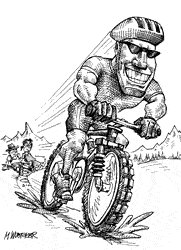
A sunny not too cold weekend in Portland, and after church services and a phone call to my friend, I hopped on my bicycle for the first time in six weeks, and headed down to visit Athanasios and Nektaria, about forty blocks away. I never wear a jacket when I bike. Just the thin cotton shirt I wore to church covered my skin, and my best cargos clad my bottom half. I'm not a sweaty person, especially on a chilly day. (By the way, the guy in the cartoon is NOT me!)

The ride down Mount Tabor heading south was great, wind in my face. "On the way home, wind'll be at my back. Good!" I thought to myself. As I turned to head west the slope gradually softened. Sunny and brisk, the way I like it. I felt like I was flying (my favorite dream). Happy to be alive and away from my weekday cubicle, I sang as I glided gently downhill through the Clinton neighborhood, an old Jefferson Starship song…
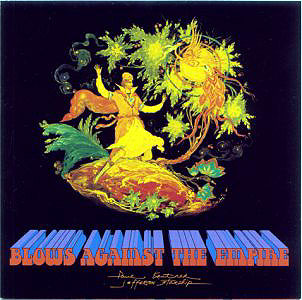
"Last electric Sunday morning,
waitin' in the park for the dawn,
listenin' to all the animals
in the park and in the city beyond,
flashin' with my lady,
sky turnin' black to blue,
she said, I got a surprise for you…
a child is comin',
a child is comin',
a child is comin' to you…"

I guess I was feeling young or something. After all, I am a 29 year old man trapped inside a 55 year old body. This weekend I saw a lot of babies, out in the world, and at church. I guess it made me feel like a young dad again, seeing all the young dads, and remembering how much fun it was to be young, poor, and in love.

In my exuberance I didn't notice that the wind was at my back on the way down.

The visit with Athanasios and Nektaria was great. I always feel at home there. They already had company, but when I arrived, they all made me feel like I was the guest of honor. The fellowship flowed like wine. The life of the unearthly Triad that draws us into Itself through the holy Spirit impressed itself on us like the crosses that the seal stamps on the communion loaves. Living the mystery of divine brotherhood in unaffected, childlike simplicity. Psalm 133 realised.
Two hours passed, but I felt we had been together for two days. The evening was coming on, time to hit the trail home.

After a round of hugs, kisses and well wishes, I snapped on my helmet, hopped on my bicycle, and off I went on my eastward ride home. The two blocks north flew by in a flash. I turned the corner to head east and… whoa! nearly fell off my bike as a strong east wind gusted me first to a grinding halt, and then, buffeted me so my progress was slow, like riding your bike in a foot and a half of flood water. I down-shifted as low as safety permitted, and then braced myself in the now almost icy wind, to make the uphill journey in the unexpected head wind.

Oh, that's right. The title of this ramble. You didn't think "uphill at 55" meant 55 miles per hour, did you? No, it's just about getting a 55 year old 6'1" frame weighing almost 200 pounds uphill, and in a winter head wind. Hey, but who's complaining? Though at times I had to just stop and stand there until my muscles would pump again, it was delicious to feel the icy wind blowing through my cotton shirt, and still feel the faint heat of the setting sun's final photons tenderizing the back of my neck.

It's always the last leg of my bike rides that's the killer, though coming home from Athanasios' house is the easiest uphill of any of my usual rides. I've never had to walk my bike coming home from his place, though riding up to the top of Mount Tabor from almost any other direction, I have to hop off the bike, walk it for a few blocks, and then ride the last block or two, so "it looks good" to myself and the neighbors. Wouldn't want the neighbors to see me walking my bike home!

The last leg, though, is the hardest. After I turned the corner to head north again, I noticed the headwind was mostly gone. The mountain is in the way. Still, my body was feeling like it was going to cramp up and roll me into a little ball like a frightened sow bug. So I stopped, looked up to the sky, and prayed, thanking the Lord for getting me this far and asking for strength for the final ascent. Two or three minutes was all, but when I hopped on, though it hurt and I was parched, I felt a second wind from the inside of me.

My mind separated from my body, which seemed to go on "automatic." My eyes focused on the cracks in the sidewalk (I was riding on the empty sidewalk now) like they used to when I was a small child and was made to walk further than I could bear, somewhere a counting was going on inside me like the voice of my Mom whispering, "we're almost there." My mind, to busy itself for the final few minutes of uphill challenge, began meditating.

"It's always easy to glide downhill, especially with the wind at your back. Anyone can do it. But how about the journey home? It's not easy, is it? Uphill is hard enough, but with the wind in your face! Hah! …People don't realise, when they think they're having a good time, when it's sunny, they're feeling on top of the world, they're in charge, young, beautiful, successful. They don't realise how easy it is to glide downhill, they're just enjoying it. Anyone can do it. Just join in the fun. But what happens when they have to get back?"

What was really at the back of my brain, stewing, was a matter that has nothing to do with my bike ride, except by analogy.

On my way to see my friends, I was happy, looking forward to seeing them again, singing, because I was happily remembering those days of youth, poverty and love. Like when I first got back to Orthodoxy, to Holy Trinity. It was a community that was young, poor and in love, in love with the Lord, poor in spirit but rich in grace, young in the ways of the world. A mighty man of God, Elias Stephanopoulos, was the pastor. Men of the church did the upkeep of the grounds. We made our own candles, recycling the stubs, us men doing the heavy work of dipping, assisted by boys, them women doing the lighter work of cutting the candles off the frames and boxing them. We charged 25 cents per candle then. We did this two or three times a year. The fellowship was natural, real, unaffected. We did this out of love. The choir sang under a director who was from us, who labored without pay. Many women and men gave their time and talents, because treasure was scarce.

Since those days, we have caught the American virus of "growth is success." We have been taught that we value God as much as we're willing to write checks to church for. We've been enlightened by the superior model of "church as mystical business." The ride was so smooth we didn't realise we were heading downhill with the wind at our backs. At what many thought was the beginning of the height of our glory, the classical school (Agia Sophia Academy) which was to develop into the first Orthodox day school in Portland, and which was lodged in our facilities, is leaving us (after this semester) for a smaller, humbler congregation on the West side.

Today we had a town hall meeting after church to talk about the prospect of Holy Trinity being raised to cathedral status. Mostly attended by the well-to-do, and mostly the well-to-do taking the open mic, we heard nothing but congratulation for us being selected for this honor.
No mention of the fact that a real ministry, the day school, had fled the ship. Even one such sign should've been enough to make one think. Instead, a successful businessman and promotion man enthusiastically told us that he studied a lot of data and found that our congregation has done more, gives more, and is in all respects superior to most other churches that are already designated "cathedrals." He said with justifiable pride and enthusiasm that we are "worthy" of this distinction. Another person speaking at the open mic a few minutes earlier had remarked that it's too bad that none of the "rank and file" members were present so we could hear their views. Well, I'm rank and file, but I know better than to pipe up, because I am only a "mystic" and not a "skeksi".
My wife, however, as usual had the last word on the open mic, so there, one of the rank and file got her two bits in. For some reason I couldn't quite hear what she said, except for little quips of "Holy Spirit" this and that. She's a diehard supporter of anything that smacks of prosperity, especially if you tack the word "God" on to it. Appropriately, she got a round of applause, and then the whole meeting drew to a quick close. What they're going to do next, God knows, but He's not telling me. I guess I'm not worthy.

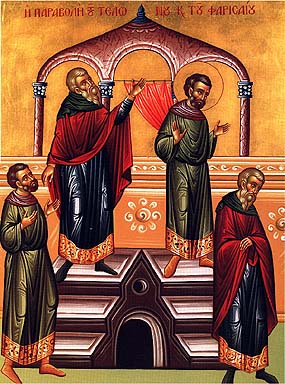
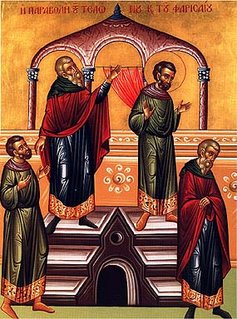
Funny that all this should take place on the Sunday of the Publican and the Pharisee. "Whoever exalts himself will be humbled, and whoever humbles himself will be exalted." I suppose the saying's true only within the context of the Divine Liturgy, but when you're back out in the "real" world…

If you've made it to the end of my worthless ramble, bravo! but now, PLEASE, turn off the computer and go read your Bible!

The Book I Didn't Write

A BOOK REVIEW

Friday evenings, after attending Shabbat services at Ahavath Achim, and maybe taking in a movie, Brock and I schmooze a bit over coffee at the Borders book store, and sometimes have a bit of mindless fun looking at “Christian” and “Inspirational” books that are sold there. The sheer numbers of these books and their awe-inspiring titles simply blow us away. Sometimes we spend nearly twenty minutes just showing each other the new ones we hadn’t noticed before, and we gape at them with dropped jaw and mesmerized eye like the two am ha-aretz that we are.

On one of our visits to the book store, overwhelmed as usual by these books that “have the gospel for sale”, I remarked to Brock, “You know, I’m really bored to disgust by all these other books written by people who just have to get it out and show the world how they’re right about this, or how they’ve discovered that long lost truth that will change your life or help you enter a new world. I get the feeling I’m plummeting down an Alice’s rabbit hole lined with unending shelves of other books. Wouldn’t it be great to walk into a book store and find this title? The Book I Didn’t Write.”
I have, in fact, a copy of that Book. In fact I have several copies in different editions. The one I’m showing here is my first and favorite, but there are others just as good. Even in all their different editions, they’re still the same one Book: The Book I Didn’t Write.

Now, as for the review. Here’s what some well-known commentators have said about this Book:

“Turn it this way, turn it that way, everything is in it, keep your eye on it, grow old and aged over it, and from it do not stir, for you have no better portion than it.”
—Rabbi ben-Bag Bag (Pirke Avot, 5:29)

“Read God’s Book continually: Nay, never let the sacred volume be out of your hand. Learn so that you may teach. Hold fast to the words of faith according to sound doctrine, so that you may be able thereby to exhort and refute the gainsayers.”
—Jerome (On the Duties of the Clergy)

“Study first of all the Divine Scriptures. Study them, I say, for we require to study the divine writings deeply, lest we should speak of them faster than we think. And while you study these divine works with a believing and God-fearing intention, knock at that which is closed in them, and it shall be opened to you by the Porter, of Whom Jesus says, ‘To him the Porter opens.’”
—Origen (Letter to Gregory Thaumaturgos)

“The way in to the Holy Scriptures is low and humble, but inside the vault is high and veiled in mysteries.”
—Augustine of Hippo (Confessions, III, 5)

“In the Holy Scriptures, Truth is to be looked for rather than fair phrases. All sacred scriptures should be read in the spirit in which they were written. In them, therefore, we should seek food for our souls rather than subtleties of speech, and we should as readily read simple and devout books as those that are lofty and profound. Do not be influenced by the importance of the writer, and whether his learning be great or small, but let the love of pure Truth draw you to read. Do not inquire, ‘Who said this?’ but pay attention to what is said. Men pass away, but the Word of the Lord endures forever.”
—Thomas à Kempis (On the Imitation of Christ, I, 5)

“Everyone not ceaselessly busy with the Word of God must become corrupt.”
—Martin Luther (Open Letter to the Christian Nobility of the German Nation)

“The Bible is God’s Word addressed quite personally to us, and the only way to know the truth of that is to start reading and using the Bible as though it were true. To approach it humbly and expectantly, to read it on your knees, to come to it as to a Word from God addressed with absolute appropriateness to yourself.”
—Richard Holloway (A New Heaven, p. 91)

Well, being the two dyed-in-the-wool sheep in wolves' clothing that we are, Brock and I have the same one track mind, our mind’s on its prey, we’re always on the prowl for, not what’s new, but for what makes new. What a blessing it would be if we could walk into a book store and find this Book alone on its shelves: The Book I Didn’t Write.

I humbly encourage all of you, my brothers, to throw away all your ‘other books’ (they will only make you miserable), and grab hold of The Book. Just say No, when the door-to-door peddlers come to the gates of your minds and wills, saying, “Come to us, for stolen waters are sweet.” Just hit the little delete button when you get an email advertisement from the purveyors of “Torah spades” (do not make of the Torah a spade to dig with). And lastly, consign your Amazon Wishlists to that little waste basket in the lower corner of your Windows desktop.

“All of it, my brothers! Throw it all away! It will only make you miserable.”
—Francesco di Bernardone, of Assisi

Sunday, January 21, 2007

Out on a Limb

Today is the Sunday of Zacchaeus in the Greek Orthodox Church. Here's the text, Luke 19:1-10 (NIV):

Jesus entered Jericho and was passing through. A man was there by the name of Zacchaeus; he was a chief tax collector and was wealthy. He wanted to see who Jesus was, but being a short man he could not, because of the crowd. So he ran ahead and climbed a sycamore-fig tree to see him, since Jesus was coming that way. When Jesus reached the spot, he looked up and said to him, "Zacchaeus, come down immediately. I must stay at your house today." So he came down at once and welcomed him gladly. All the people saw this and began to mutter, "He has gone to be the guest of a sinner." But Zacchaeus stood up and said to the Lord, "Look, Lord! Here and now I give half of my possessions to the poor, and if I have cheated anybody out of anything, I will pay back four times the amount." Jesus said to him, "Today salvation has come to this house, because this man, too, is a son of Abraham. For the Son of Man came to seek and to save what was lost."

Father Jerry preached on this text, and everything he said was well worth listening to, but his obvious delight in the comment by the Church father, Ambrose of Milan, caught a hold of me too:
When Zacchaeus was ‘in the crowd’ he couldn't see Jesus. It was only when he rose ‘above the crowd’ by climbing the sycamore tree that he was able to see Jesus. In fact, not only was he able to see Jesus, but Jesus was able to see him.

And what did Jesus do?
Did He call Zacchaeus like He called His other disciples, Levi and the rest, with "Follow Me"? …No. Instead, He gave Zacchaeus a concrete order, a single command, “Come down immediately!” And to top it off, He told him the reason right then and there, “I must stay at your house today.” If this is not the ultimate case of ‘too good to be true’, I don't know what is!

To have Jesus stay with you! With you, personally! What would I or anybody give, to have that said to us, “I must stay at your house today"? Well, this is what Zacchaeus gave, “Look, Lord! Here and now I give half of my possessions to the poor, and if I have cheated anybody out of anything, I will pay back four times the amount.” Talk about repentance! Talk about turning ‘about face’!

Is the ‘process’ of salvation really this easy?
You decide you want to see Jesus. You put yourself in a place where this is a possibility. You see Him, but more importantly He sees you. He gives you a concrete command. You do it. He enters your ‘house’ and you tell Him you want to make good on what you owe. And you hear Him declare, “Today salvation has come to this house, because this man, too, is a son of Abraham.” And what does it mean to be called a ‘son of Abraham’? The answer can be found fully in chapter 11 of the Letter to the Hebrews, which starts out, “It was for faith that our ancestors were commended.” (Hebrews 11:2 JB)

When people heard that Jesus was going to stay with Zacchaeus, a filthy collaborator with the Romans and a tax collector, they said “He has gone to be the guest of a sinner.” But what does the Word of God say about people like Zacchaeus? “…God is not ashamed to be called their God…” (Hebrews 11:16 JB)

Back to Father Jerry's sermon, he made different points than the ones I just digressed on, but they honed in on the idea of leaving the crowd, rising above it, as the surest way to see Jesus, be seen by Him, and be given a concrete command. That command is one that only Jesus can give, and it will vary for each of us. Yet, I believe that the first thing the Lord wants to do with each of us is ‘move in’ with us, no matter what it looks like to others.

“Anybody who receives My commandments and keeps them will be one who loves Me; and anybody who loves Me will be loved by My Father, and I shall love him and show Myself to him.” Judas—this was not Judas Iscariot—said to Him, “Lord, what is all this about? Do you intend to show Yourself to us and not to the world?” Jesus replied, “If anyone loves Me he will keep My word, and My Father will love him, and We shall come to him and make Our home with him.”
John 14:21-23 (Jerusalem Bible)

Saturday, January 20, 2007

Whose image is on this…?

Below is an excerpt from my son Jacob's web page (linked in my side panel), from an article called Break a Coin This Christmas, published 24 days ago. It's almost a sermon, really, or perhaps it was meant to be. I was startled by some interesting concepts I found there, beyond what I am quoting. I recommend you visit his site and read the rest of his article. It's interesting…
Break a Coin This Christmas

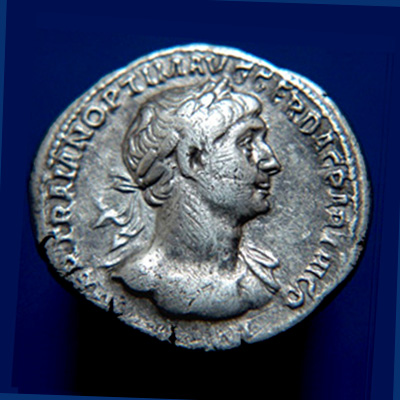
The coin pictured above is a denarius of emperor Trajan which used to be in my personal coin collection. Now, I only have the pictures. The actual coin shown to Jesus was probably a denarius of emperor Tiberius, known popularly as "the Tribute penny." I never owned one of these.

“When God created people, he ‘fashioned’ them – he molded them from material that he had woven together out of nothing. He didn’t ‘style’ the dirt to make it look like a person – he created a miniature version of himself. Only fashion has integrity – only the materials used to fashion a product will prolong a product and make it strong.

“When he was asked about taxes, Christ responded – “Who’s image is on this coin?” The answer, of course, was Caesar. “Give Caesar what belongs to Caesar – give to God what is God’s.” Christ makes a few logical jumps but follow his thinking here:

“Coins have the image of Caesar – they are value assigned by Caesar and they function for Caesar – they are the currency of Caesar’s world.

“Human beings – people – have imprinted on themselves the image of God. Their value is assigned to them according to the image of God that they possess – their life. The life that we have flowing through our blood – the air we breathe – this is the currency of God’s world. All living things have value, but humanity has the highest value because it is stamped with imago Dei.

“So Christ says, in one pithy sentence, Caesar’s coins are valued according to style – and they are value assigned according to what someone thinks – a public philosophy. Our humanity is fashioned to look and work like its divine prototype – it is in the fabric of our cells to promote life in ourselves and in the world around us.”


—Jacob Gorny

P.S.—There's another really excellent article entitled "Denial is not just a river in Egypt" that I'd like to share with my readers—especially those who are college students—full of practical wisdom and quotable quotes, and fun to read. Here's the link:
Denial is Not Just a River in Egypt

Sunday, January 7, 2007

I started here…

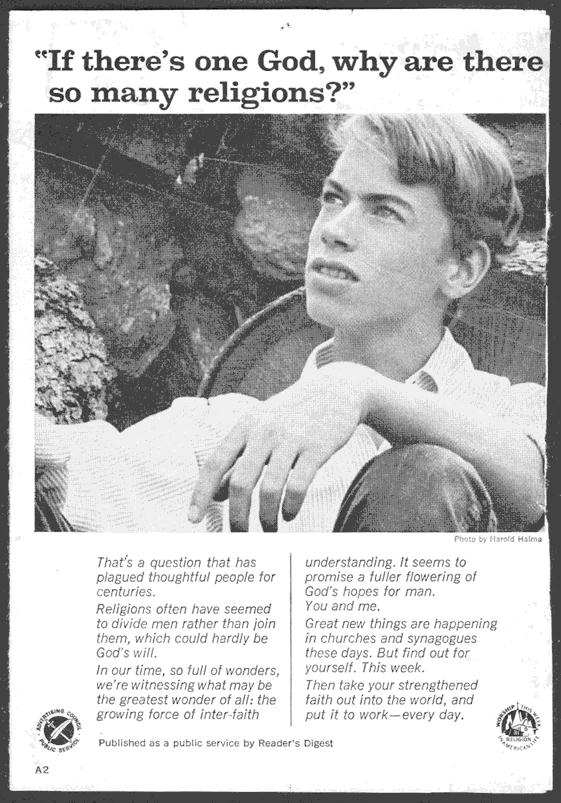
Back in Romeoville, Illinois, in 1964 maybe, or a little later, skimming through a Reader's Digest issue, I stopped at this full-page ad by Religion in American Life. It grabbed me. Why? Because the boy in the picture looked about as close to me as you could get, skinny, brownish hair, sitting like that lookin' up… that was me! Well, not really, but I carefully tore out the page and stuck it in whatever book I was reading at the time.

By then, we were not a religious family. My mom stayed up and prayed way into the night while she listened to all-night radio (sometimes I'd get up in the middle of the night and keep her company, it was good music), but none of us went to church anymore. Well, I did, sort of. My steady girlfriend was a Roman Catholic, and so, for a date, I used to accompany her to mass, and then go over to her house to hang out with her widowed mom and two sisters. Back then, there was nothing to do as a teenager, no drive-ins, nothin' at all in this small town of a few thousand people, just ice skating on Lake Shirley (man-made mega-pond) or exploring the forest with my best friend Ed. Sheesh! Marijuana didn't even come to town till the year I left for college… to another small town of 5,000 people even further in the boonies, Carlinville. For me at college, a date with my steady girlfriend was lying side-by-side in a mown hayfield looking up at stars on a clear night! No hanky-panky! And then, stopping for a donut or two at a local bakery that opened at 4 a.m. on the way back to campus.

As I was saying, we weren't a religious family (except for mom). But something in me kept tugging, "why are we here?"…"Is there really a God, or is this all a bad dream?" Somehow, I kept going back to this page torn out of a cheap magazine.

I've kept it all these years, maybe because it accompanied me as I took the first few steps… venturing inside a Catholic church with my girlfriend, finding the old family bible and starting to read it (at Proverbs!) and take notes, starting to write poetry with spiritual themes, exploring the Eastern religions… Well, yes, I did take a few wrong turns, and that continued on through college. But it was there that I found my first Christian friends, kids like me who were struggling with issues of life and death (to us), and who tolerated me as a weirdo who wanted to hang around them and do InterVarsity Fellowship things even though I was, at very best, an "almost Christian."

Just a reminder that everything and everyone has humble beginnings, no matter how notorious they become in middle age…

Friday, January 5, 2007

Love without limits

As a young man, having just accepted the Lord at age 24, I was in informal apprenticeship in cabinetry to Philip, a man 32 years my senior, who became my spiritual father in every sense of the word. He was and still is my standard for what Christian manhood looks like.

Even though we both worked in an old inner city furniture factory and both on the time clock (though he was, in fact, the foreman of the whole shop), we both worked "off the clock" several times a week. He did it to make up for deficiencies and mistakes by the "crew". I did it because I wanted to spend as much time with him as possible.

One example of the love he showed…

A young co-worker was assigned the task of machine mortising a cart load of bed posts. Philip or I set up the machine. The fellow started off well, but somewhere along the way he got distracted and started putting the pieces into place the wrong way. By the time anyone noticed, thirty or more posts had mortises in the wrong place.

Philip passed by and immediately saw what was happening (I was following him). He said, "Norman, take Joe over to the parts racks and have him start putting away parts, it looks like he needs a break from this boring job!"

I grabbed the guy by the shoulder and said, "C'mon, let's go!" as Philip quickly moved the cart of ruined parts out of the way and covered them with a tarp, so the manager wouldn't see them. Then, when I got back, I finished mortising the bed posts that were left.

After work, Philip and I "punched out" and hung around till everyone was gone. Then we dragged out the cart of spoiled work, cut plugs, glued and hammered them into place, drum sanded them flush, and then lickedy-split Philip mortised the whole load, while I assisted him by offloading them. All this took about 2 hours. By then, it was dark.

Next morning, everything was ready to go, and no one but Philip and I knew how. What happened to the boy who made the mistake? Philip never told him. He got moved to jobs requiring less concentration. Philip tried to match every man under his care with jobs that suited the capabilities of each.

After working closely with this man for four years, the company closed and the equipment sold off piece by piece. Portland's furniture industry days were over, moved to the South. I got a new job as a cabinetmaker, Philip retired early.

Within the year, when I was home in Illinois visiting my Mother for (what we later learned would be) the last time, Philip quietly passed away. His wife came home from work one afternoon, noticed him sitting in his favorite chair in the basement rec room, and when she went to talk to him, found he was "gone."

Love without limits, without drawing attention to itself, quiet, strong, consistent love.
Love that he received from his Master, he was quick to pass on to others.

1 Corinthians 13

Monday, January 1, 2007

The prophetic call


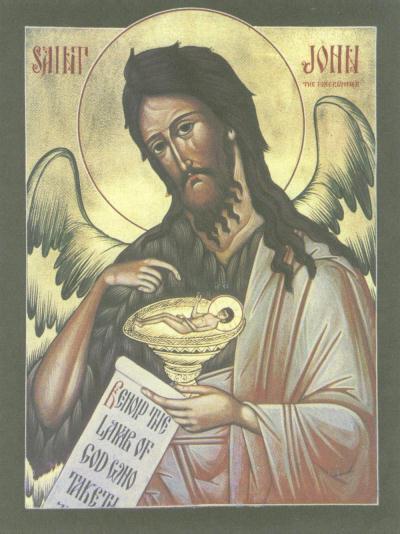
The honorable prophet and forerunner John the Baptist is commemorated on January 7.

The book Touching Heaven by John Oliver contains the following remarkable passage about the prophet John the Baptizer. Upon reading it, it became clear to me that these are also the characteristics of those who in our day have received the prophetic call from their Master Jesus Christ. May these words encourage them.

The portrait of St. John that emerges from the Gospels is that of a sane man who lives as if he is mad. His toned and disciplined body is dirtied with the matter of earth—sand, animal hair, vegetation. He dwells not in the dizzying centers of commerce, but in the desolate spaces of caves and open desert. We do not quite see him as a loner, but as a man who will only move in company as fiercely single-minded as he. He is not diplomatic, but deeply humane.

St. John takes each step through the Gospel narrative with the strength of generations of Hebrew prophets behind him. Specifically, we are told that he comes in “the spirit and power of Elijah” (Luke 1:17). That prophet was a burning flame who engulfed idolatrous Israel and its wicked king in a spoken truth that was unrelenting, unambiguous, and untamed. So we are not surprised when John the Baptist delivers a similar blow to the gut of the Jordanian community. He is not polite, but he is loving enough to passionately call for people to do what is best for themselves: “Bear fruits worthy of repentance” (Luke 3:8). His advice is timeless.

The biblical texts devoted to St. John reveal not only a deep vocation to his life, but his keen awareness of it. He voluntarily dwells in the desert—a landscape of shadowy death that compels man to cling to the necessities of life. And what emerges from the pages of those texts is that what is necessary for life is more than food and drink. St. John is more interested in the soul than in the stomach. Our Lord tells us that the Baptist “came neither eating bread nor drinking wine” (Luke 7:33). There is, to St. John's life, a conspicuous absence of frivolity and wasted time. He is not a “reed shaken by the wind” who conforms to the whims and trends of his culture, nor is he one “clothed in soft garments” who cavorts among the prestigious and powerful (Luke 7:24-25). No, St. John lives simply and close to the earth. He is acquainted with the basic wisdom of nature. And he recognizes that Wisdom even from a distance when He comes to him to be baptized.

Skipping ahead just a couple of paragraphs, I want to close with this final thought.

People drawn to St. John must have been the kind who were ready to trust a promise. “I am not the One for whom you seek,” he announces with conviction, “but after me comes One more powerful than I, the thongs of whose sandals I am not worthy to stoop down and untie.” He tells his followers to wait a little longer, not in idleness but in a spirit of preparation. Jesus is coming.

Yes, indeed, my brothers and sisters! Jesus is coming… and soon, “for the time is close.” (Revelation 1:3).