Friday, April 12, 2013

All you have to do


So you’ve sinned. You’re afraid, so you hide out. You don’t want your sin to be discovered. You don’t want anyone to know. Least of all Him, even though you don’t acknowledge Him, you don’t want to think of Him, you don’t want others to think that you think of Him.

You have this nagging voice inside you, telling you what you’ve done is wrong, but you turn away from it, and lose yourself in other sounds, noises really, anything that will voice-over the Voice, because you know, once again, that He’s found you out, that He knows all about you, even though you don’t want to know all about Him.

So you hide out, afraid of coming out of your room, afraid of being seen exiting the place of your sin, where you made unlawful deeds your companion. How do you know they’re unlawful? You just know, you just suspect they are. You’re not really sure, yet you are sure. You are cornered by the play between your faith suppressed and your doubt proclaimed.

You know the commandments in rough, and you know you’ve broken them in fine, probably all of them, in fact. But I’m telling you, though you should be afraid, what you should be afraid of is not what you think. Truth be told, we have all broken the commandments. Some of us are breaking them even now. It’s part of the human condition, but we all know, that’s no excuse.

Come out of hiding where we can see you, where He can see you.
Join the crowd. It’s certainly not lonely here. There’s so many of us, so many law-breakers, so many who have broken them, broken them all. Yet among us there is not even one who is lawless, not even one who is clothed in shame and guilt. Here, take a look.

The only One of us who has never sinned, who has never broken a commandment, not even the smallest, He is among us, He’s somewhere in this mighty throng. Actually, look a little more closely. He is not only among us, He’s all over us. Do you see anyone naked here? Do you see anyone weighed down by a burden too heavy to carry?

He has clothed us in Himself. Yes, the One who you’ve been tormented by, that Voice is His. I think you knew that, but you might’ve been hoping it was just an hallucination. I did too, once. Then I took the Voice at face value, finally. I found that behind the Voice there was a face, and when I saw that face I was surprised that it wasn’t angry.

Back to brass tacks. Yes, you’ve sinned, you’ve been sinning, and sinning all along hoping that no one would notice, especially hoping that He wouldn’t notice, trying to talk yourself into believing that He isn’t really there at all, that the Voice is an illusion. I’m here to tell you, Uh-uh! The Voice is no illusion, and Yep! Your sins are every bit as real as mine.

This game of hide and go seek has to end now, but only you can end it, and it can only be ended by going to seek. This is no time to put it off till tomorrow. Can you really keep on in this way, doing what you know is wrong, knowing there’s nothing you can do to change it? Well, you know there is something you can do, but that would take too much effort.

You know you’d rather pay the price in cash to get rid of this load of guilt, but that’s not an option. The price has to be paid in blood, and you’d be happy to pay it yourself, but you don’t want Anyone else paying it for you. You think you’d be happy to pay it yourself, but you don’t know what you’re talking about. It isn’t as though you could ever pay the price in blood, on your own.

But give it a chance. If you really want to pay the price in blood, to pay up like a man, then the first thing you’ve got to do is let that Other One pay the bill in full, yes, pay it in full with His blood. After you let Him do that, He’ll give you all the chances you could ever want to make good your debt. It won’t rob you of your manhood to let Him pay, it’ll give you a manhood you never could have had on your own.

Isn’t it about time you come out of your hiding place? Find out what the purpose of the Law really is? What the commandments are there for? How you can hear the unchanging Voice say a new word to you, after you have changed your mind? Remove the imaginary line between you and happiness. Acknowledge both your fears, that you sin and that He is real, and transform them into faith.

Remove that imaginary line. That’s all you have to do.

Thursday, April 11, 2013

Προσδοκώ ανάστασιν νεκρών

Our integration into the Divine Nature is no accident. Neither is it our due. It is not something that will inevitably happen, but it is where our being will lead us if we do not resist it, if we do not resist God.

Yes, God made man for immortality. We are not speaking of some kind of purely spiritual existence, eternal but bodiless. No, man was made, body and soul, for immortality, for deathlessness.

The entire culture, even Christianity, is infected with this idea—that any trans-mortal existence must be purely spiritual, as if we are going to be changed into angels—and it instantly recoils.

The religious recoil subconsciously by fantasizing about it. The irreligious recoil knowingly by rejecting it. Still, it is a fact of human nature: our bodies are made for immortality, and hence, our souls.

But what can it mean, our integration into the Divine Nature? Aren’t we spirits already? Some do indeed teach and believe, ‘I am a spirit, I have a soul, I live in a body.’

Simplistic thinking comforts for a while, but not for long. Although by nature God made us immortal, body and soul, that does not make us spiritual. Only One is Spirit: that is God.

Though we lost our natural immortality through our transgressions, by resisting our human nature as created, God, in becoming a man, Jesus Christ, accomplished more for us than immortality.

He, being One of the Holy Triad and pure Spirit, integrated with the body and soul of a man that He created. God became man, that man might become God, except for our free will, must become God.

St Gregory Nazianzen says in his Funeral oration for St Basil, ‘Man has been commanded to become God.’ He is also the first Church father to use the term ‘théosis’ for that God-charged deification.

So man who, body and soul, was created for immortality in the first Adam but forfeited that life by separation from the Divine Nature, that is, by suicide, in the second Adam is recreated for divinity.

Christ, in defeating death by death, bringing life to those in the tombs, Himself rose from the dead, body and soul, as first-fruits of all who have ever died. Not as a Spirit only, but as a complete man.

Yes, the God-man, who, though standing before His Father who is in heaven interceding for sinners, walks with His disciples on earth, even shares food with them, proving the resurrection of the dead.

Though in this present life our souls are the life of our bodies, in the world to come, the Spirit is the life of both our souls and bodies, our human nature fully integrated with the Divine Nature.

Through Jesus Christ the human race has gained more than it lost. Human nature has been raised to the Divine Nature. Respect your body as much as your soul, and expect the resurrection of the dead.

Asleep in our boat

Sometimes I wonder, when Jesus fell asleep with His head on a cushion in the disciples' fishing boat, what was He doing? He must have gone out countless times with them on that fickle lake, in clear weather and in foul, by night and by day. Did He often just fall asleep? Was He tired, or just bored with what was going on? Of Him, if of no one else, this saying is at least true, ‘I sleep, but my heart is awake,’ yet He is not the Bride (who speaks these words in the Song of Songs), but the Beloved whom the psalmist extols, ‘of all men You are the most handsome, Your lips are moist with grace, for God has blessed You forever’ (Psalm 45:2 Jerusalem Bible).

When the Word and Son of God became man, was that too a kind of ‘sleep in the boat’?
I mean, while reclining and growing in the womb of the Theotokos, He was asleep, yet the worlds continued to run their courses, and nature renewed itself as it always does, even though the Lord who creates, sustains and (yes!) destroys all things was hidden in a cleft, not of rock, but of human flesh.

Of course, how could someone not record that day when sleeping, they had to rouse Him? They needed His help. The wind and the waves were getting the best of them. They were in danger of capsizing. If He didn't wake up and do something, He would have to swim for His life as well. Or would He? Does He only pretend to be asleep, so we have to go to the trouble to rouse Him?

Perfect trust met perfect care on that day. He who slept for our sake in the Woman's virgin womb, and slept for our sake in the rich man's unused tomb, slept also for the sake of His disciples in that boat. Strong as that vessel was, they knew it could not withstand the tempest raging around them. They woke Him. ‘Master, don't you care? We're going down!’ We know how that story, and all the others written about that Man, ends.

Yet here we are in our boat, our fishing boat, the Holy Church, and the sea is getting very rough as we can see. The disciples have forgotten all about fishing. Some are attending to the management of the rudder and sail, some are counting the moneys garnished from the last catch, a few are mending nets, and all are worrying, mostly without admitting it, about the raging tempest around them. Do we know who it is that is asleep in our boat?

Wednesday, April 10, 2013

The unchanging change

What the [Church] Fathers require and give is the change which comes from the Spirit. If we want to approach them outside this reality, they will remain for us incomprehensible as writers, and scorned as persons.

Communication of the patristic word, the word of the Holy Fathers, is not a matter of applying their sayings to this or that topic with the help of a concordance. [The Kingdom of God is not a Talmud, nor is it a mechanical collection of scriptural or patristic quotations outside our being and our lives. ibid., p. 34.] It is a process whereby nourishment is taken up by living organisms, assimilated by them and turned into blood, life and strength. And, subsequently, it means passing on the joy and proclaiming the miracle through the very fact of being brought to life, an experience we apprehend in a way that defies doubt or discussion.

Thus the living patristic word is not conveyed mechanically, nor preserved archaeologically, nor approached through excursions into history. It is conveyed whole, full of life, as it passes from generation to generation through living organisms, altering them, creating “fathers” who make it their personal word, a new possession, a miracle, a wealth which increases as it is given away.

This is the unchanging change wrought by the power that changes corruption into incorruption. It is the motionless perpetual motion of the Word of God, and its ever-living immutability. Every day the Word seems different and new, and is the same. This is the mystery of life which has entered deep into our dead nature and raises it up from within, breaking the bars of Hell.

How beautiful it is for a man to become theology. Then whatever he does, and above all what he does spontaneously, since only what is spontaneous is true, bears witness and speaks of the fact that the Son and Word of God was incarnate, that He was made man through the Holy Spirit and the ever-virgin Mary. It speaks silently about the ineffable mysteries which have been revealed in the last times.


Archimandrite Vasileios
Hymn of Entry, pp. 35-36 passim

“Remember who your teachers were…”

2 Timothy 3:14

Today in your hearing


Thus says Yahweh,
“Let the sage boast no more of his wisdom,
nor the valiant of his valour,
nor the rich man of his riches!
But if anyone wants to boast, let him boast of this:
of understanding and knowing Me.
For I am Yahweh, I rule with kindness,
justice and integrity on earth;
yes, these are what please Me
—it is Yahweh who speaks.

Jeremiah 9:22-23

See, then, that the days are coming—it is Yahweh who speaks—when people will no longer say, “As Yahweh lives who brought the sons of Israel out of the land of Egypt!” but, “As Yahweh lives who brought the sons of Israel out of the land of the North and back from all the countries to which He had dispersed them”. I will bring them back to the very soil I gave their ancestors.
Jeremiah 16:14-15

Doom for the shepherds who allow the flock of My pasture to be destroyed and scattered—it is Yahweh who speaks! This, therefore, is what Yahweh, the God of Israel, says about the shepherds in charge of My people: You have let My flock be scattered and go wandering and have not taken care of them. Right, I will take care of you for your misdeeds—it is Yahweh who speaks! But the remnant of My flock I Myself will gather from all the countries where I have dispersed them, and will bring them back to their pastures: they shall be fruitful and increase in numbers. I will raise up shepherds to look after them and pasture them; no fear, no terror for them anymore; not one shall be lost—it is Yahweh who speaks!
Jeremiah 23:1-4

Yahweh says this:
Now I will restore the tents of Jacob,
and take pity on his dwellings:
the city shall be rebuilt on its ruins,
the citadel restored on its site.
From them will come thanksgiving
and shouts of joy.
I will make them increase, and not diminish them,
make them honoured and not disdained.
Their sons shall be as once they were,
their community fixed firm in My presence,
and I will punish all their oppressors.
Their princes will be one of their own,
their Ruler come from their own people.
I will let Him come freely into My presence
and He can come close to Me;
Who else, indeed, would risk His life
by coming close to Me?—it is Yahweh who speaks!
And you shall be My people and I will be your God.
Now a storm of Yahweh breaks,
a tempest whirls,
it bursts over the head of the wicked;
the anger of Yahweh will not turn aside
until He has performed and carried out
the decision of His heart.
You will understand this in the days to come.

Jeremiah 30:18-24

Tuesday, April 9, 2013

Falling pulpits

The day is full of deceptions.
Night enters,
cloaked in clerical brightness,
to do deeds in broad daylight
that shame the righteous,
corrupt the pious,
kill faith and trust.
Confusion reigns.

Yes, but signs,
there are signs given,
that robbers are abroad,
thus some, distinguishing the Voice
from the voices, flee.

Falling pulpits—
let those who have ears hear!—
and demons
flying through shattered glass—
let the reader understand!—
and lampstands removed
from the Holy Place—
let those who have eyes see!—
symptoms of great sickness,
panoplies of pride
corroding piety by dissimulation,
all speak warning—
let the buyer beware!

The fires are hot
but blaze not in hell only,
they burn those who hate,
enlighten those who love,
God’s kingdom
and His righteousness.

Father, deliver us from this calamity,
save us from these precipitous slopes,
that we may serve Thee
in singleness of heart,
purged of all pretense,
and in spirit and truth
worship Thee, and live.
— Romanós

Sunday, April 7, 2013

When Christ walks in hell

                 
                    When Christ walks in hell,
                    will I follow Him even there,
                    will I walk inside His footsteps,
                    out of fresh and sunlit air?

                    He suffered, yes, and suffers
                    though no longer on the tree,
                    whose standing from the grave
                    gave God glory freeing me.

                    Do I go down as He descends,
                    delve deep my brother’s grave
                    to hold him close and cradle him,
                    help Him one soul to save?

                    The nether regions of the dead,
                    not painted myths and lore,
                    are open if I only dare
                    to go through Him the Door.

— Romanós
x

Saturday, April 6, 2013

Do you want to be well?

It is the complete lack of freedom in the workplace that bothers me, in a country where freedom of speech is a supposed basic right, coupled with the almost universal compliance by most Christians with the world's determination to eliminate God from every aspect of public life.

It is not unlike what happened with the Orthodox Church in Russia in the Soviet era, when the clergy were forced to sign a document pledging their loyalty to the Soviet system, making ‘the victories of the motherland our victories’—seemingly a harmless, patriotic affirmation—yet, the professed aim of the Soviet-ruled motherland was the complete triumph of atheism! Hence, the bishops signed a document that made them say that it would be their victory if all belief in God were exterminated. Those who didn't sign became martyrs—witnesses—of Christ.

We read books about the history of Christianity, and its triumph in various countries, and they make it sound as if there were whole periods when Christianity was strong, vibrant and dynamic. Perhaps this has been true in local instances at various times for very short periods.

But I am beginning to suspect that at almost all times and in almost all places the Church has never been more than an ill-equipped, no, I should say, poorly-staffed, hospital for the sick human race, where the doctors were few, and few the patients who ever made it to health, while the rest were satisfied to remain mere patients, satisfied to let death be the cure for their miserable lives.

This is not the life which is the cure for our miserable death, that Jesus Christ the Physician of our souls, won for us on Calvary. He walks among the seven golden lampstands (cf. Revelation 2:1) as John the Revelator saw in his visions, He walks among them unceasingly from the beginning to the end, seeking those to whom He will present all the prizes of victory described in His letters to the seven churches.

This is not dead letter of a forbidden and mysterious book, but living words that will fall on our ears if we are among those of whom the Book itself declares, ‘He who has ears, let him listen, to what the Spirit is saying to the churches.’ (Revelation 2:7, et al.)

Courage, brothers! Either our lives in Christ are afire, or they are nothing. What do we want, whom do we want, what do we answer when Christ asks us, ‘Do you want to be well?’ (John 5:6)

It is I

‘Death is a sickness like any other,’ it has been written, but so is sickness a death, and so is death an invasion of privacy and illusion-shatterer like no other. We live our lives peacefully and prosperously in the short spells of quiet that are evacuated between cataclysms, we live as individuals, as societies, even as worlds. Clenched between the jaws of inflexible fate, without daring to delve the depths of the illusion that has captured us and freed us in the vise of time, we wait purposely ignoring the end of all. Like the sudden darkness and violence of a storm that makes our road impassable and causes us to halt, either for an hour or forever, without our foreknowledge or permission, an unwelcome diagnosis of terminal illness, or the death of a child, puts an end to what we were and pushes us into what we must be. Nothing remains the same, if anything remains of us at all.

By whose mercy or caprice, or whether by mindless, existence-taunting chaos, these brief moments of order and reason, that tempt us to hope, open to receive us and feed our illusions, we dare not ask. Swept along with the whole universe, if there be such a place, we cannot keep anything material but wisdom that adheres to the soul, that the soul itself, our souls, are nonetheless real, though everything around us, our implacable enemy, denies what we know to be, crushed by what is not. We do not choose, we realize, and in fact there is no choice. We march because that is what we are, seen between two unseens, without destiny or destination, proof only to ourselves that we exist at all, movements excruciated from primordial clay. Neither yesterday nor tomorrow hold meaning, so we grasp today to convince ourselves that if we can have nothing else, at least we can have that.

God appears, uninvited if not unexpected. The religious delightfully moan in welcome, the illiterate cover themselves with rocks, neither make sense of this or can really distinguish epiphany from mindless fate. Inexorable, impossible of deflection like the high walls of the narrowing chasm inside which we will disappear as we have seen others disappear, we hope we can charm him or her or them or it by clever constructions. Instead, though we fear to admit it, we fail to follow the only avenue that would focus our attention on the opening, as we crumple in self-defeat and congratulate ourselves on having avoided the end one more time. Meanwhile, the Light shines, we do not know from where, and so we shut our eyes, and fight on. This is why we are made, we think that we think, but know that these are just the turnings of immense wheels, and once again swoon to be mashed between their teeth.

In the night, awake, always awake in the night while others sleep, obsessed with the science of unknowing, in the darkness discerning light, out of wandering being delivered to the mark as an arrow takes flight, the archer aiming not at the bird perched on the high branch, seeing not even its head, only its neck, does he pass his test. Always, everywhere, overcome by the terror of the task, thinking it is kill or be killed, we are charioted forward to engage, what is against what is not, and we emerge, as we have been forewarned, almost alone. It seems no one has survived, the world is full of ghosts, but flesh and blood, decapitated, mangled forms fill the field of vision where great deeds were done. This was no mere clashing of worlds. We find no one with whom to share the victory. We return to forgetting all, because all is pain. Then He comes to take us by the hand, and we walk upon the ageless sea.

‘It is I. Do not be afraid.’

Friday, April 5, 2013

The poverty of God

The poverty of God. The poverty of God? What can this possibly mean? God is the richest, the wealthiest, the most abundant and powerful of all beings, creating all, owning all, sustaining all. He is the ground of being itself, ‘in Him we live and move and have our being.’ Yet I cannot escape this mystery, the poverty of God. We know from scripture and tradition that in Christ, God ‘came down from heaven,’ that He impoverished Himself to make us rich, He that is all righteousness ‘bent the heavens and came down’ to make us sinners righteous, to take away our shame, to remove our sin from us ‘as far as east is from the west.’ Yet, this is not the poverty of God that I meet in this moment of time I call ‘my life.’ This is still infinite wealth coming to the relief of finite poverty. Yes, infinity taking finity into itself, life taking death.

No, the poverty of God, who makes everything out of nothing, who does so much with so little, He wastes nothing, lets no opportunity slip by. ‘If you have seen me,’ says Jesus, ‘you have seen the Father.’ And we do see Him, whose life was passed in this world as unknown, inglorious, matter-of-fact, without fanfare, as the lives of the rest of us. He didn’t fraternize with the rich and famous and successful, not even with the ‘wise in their own eyes.’ The only time He came to the notice of the rich and powerful was when He was hauled in front of them to be condemned. Yet it isn’t as though He were a beggar. No, a beggar does nothing but beg, for whatever reason, unemployment, physical or mental handicap. No, He never begged His bread: He gave bread. In fact, He became bread. From five loaves He feeds the world.

Yes, He is very economical. He does so much with little. And where does He get it, that little with which He does so much? ‘How many loaves do you have? Go and see,’ He says, and when we do as He asks, that which we cannot supply, He supplies. Yet He doesn’t have any more than we have. All He has is His word, as He tells us, ‘Gather the pieces that are left over. Let nothing be wasted.’ That is the poverty of God, the same who says, ‘Are not five sparrows sold for two pennies? Yet not one of them is forgotten by God. Indeed, the very hairs of your head are all numbered. Don’t be afraid; you are worth more than many sparrows.’ He keeps very close count of us, down to our very hairs, hoarding all and losing none, just as the poor man watches what little he has, to get the most for it. That is God’s economy too.

The imprint of the poverty of God is on all things, and especially on all flesh, our flesh, where we can see it. Science, the study of what He makes, can trace out the economy with which everything is made. We see the evolution of the natural world, the immensity of space and time, just short of infinity, and our own smallness, making us feel insignificant, yet we notice the same ‘waste not want not’ design everywhere we look. As soon as we think we have discovered what something is or does or is used for, we find yet another. Studying ourselves, our physical nature, this is especially true. How many functions each of our organs and attributes has! It’s as though whoever made us had to fit so many capabilities into so few structures. His architecture in us, in all things, is poverty not surplus, yet it results in wealth.

‘The devil is in the details’ we hear said, as we plough our mental fields to turn over the soil of ideas, as we do what we’re best at, following our Maker. Our sin, though, is to deviate from His poverty, as we waste our lives trying to move from glory to glory while we litter the world with the signs of our success. Always trying to be rich, we impoverish ourselves. Always seeking ease, we discover drudgery. Always pursuing excitement, we catch up with boredom. Our fields become infertile because we overuse them, seed falling on depleted soil. No, the devil is not in the details for Him as it is for us. Why? Because He never tries to be what He is not and thus does not make what cannot be. ‘The whole world was shining with brilliant light and, unhindered, went on with its work.’ Reality does not operate at a surplus.

Neither does God. As I look back over my life, I see how this ‘divine economy’ operates. He may be a poor God, but He is not a stingy one. He has never afflicted me with any insufficiency. He gives neither too little nor too much. He is never too late but also never too early. Where I would have preferred to have a safety net or a cushion against calamity, He has relegated me to relying on His mercy, which again is sufficient. He uses my weaknesses not only to benefit me, but even to benefit others. By giving me the freedom to choose, He makes best use even of my mistakes to save me, and others. Teaching me gently but persistently, He never abandons me even when I run away from Him. He is too poor to buy back my attention and my obedience, so He waits, ready to receive me, when my poverty twins His.

The poverty of God. Yes, this is a strange kind of poverty and a very strange God. He lives among the poor of the earth, demonstrating His teaching, ‘How happy are the poor in spirit; theirs is the kingdom of heaven. Happy the gentle: they shall have the earth for their heritage.’ His poverty is not a state of having or not having, whether power or possessions, but of being. It is a nakedness that does not need to be covered by fig leaves. He may cover our nakedness with His own skin, but again, because He is so poor, that is all He has. He does this, so that we can learn how to be just as poor as He is. ‘You must be perfect as your heavenly Father is perfect.’ This poverty of God, far from what we fear as poverty, is the fertile womb of worlds. All true wealth arises from it. All true wealth flows into it.
Yes, the poverty of God.

Athenaïs / Evdokía

It’s been a few months since I watched the film Agora. It's one of my favorite historical films, and I watch it a couple of times a year. I once wrote a post about it. In spite of the historical inaccuracies in it, I do enjoy the film. From my study of history, I would say there are many parts in the film that ring true, historically I mean.

For example, the non-denominational mutual affiliation of the members of the Academy where Hypatia was lecturing. This seems to be factual. Synesios (later bishop of Cyrene in North Africa) was certainly one her pupils. Both Synesios and Hypatia were the type of highly intelligent and well-educated pagans whose philosophical views could be merged into the rising Christianity, but not at the popular level. In other words, there were barbarous Christians and there were enlightened ones. Not much different from the scene today.

Synesios was a man of such integrity that the Christians of Ptolemais elected him to be their bishop even as an unbaptized catechumen, and even though he was happily married and would not abandon his wife. As was common back then, the belief that baptism washes away actual sins was so strong that people waited till just before their deaths to be baptized, even though they were already believing in Christ and living their faith. In the case of Synesios, since priests had to be baptized come what may, he submitted to baptism and then took up the defense of the Christians of Ptolemais, leading and encouraging them to carry on, despite the repeated incursions of barbarians from the desert, who eventually destroyed their civilization.

All the while, Synesios remained in touch with and a close friend of Hypatia, up until her assassination. Though the records are silent on this point, many believe she was in fact a Christian in the philosophical sense at least, something that the film Agora does not allow. Instead, it tries to demonstrate that there is more freedom in non-Christianity, in science, in philosophy.

We know that Christ has applied a tourniquet to the severed arm of our unbridled speculations and actions, but that is only to keep us from spiritually bleeding to death. The freedom of a Christian is not just personal, but moral, freedom. Thus, it is in a somewhat different category than what the world calls ‘freedom.’ Nevertheless, history is full of examples of false authority being wielded in the name of Christ or the Church in suppressing freedom, but in this as in all other deviations from the Gospel, these are not Christian acts, but religious ones. And the spirit of religion serves many masters.

After watching the film the first time, I took up and began reading a wonderful but uncommon book about another pagan Greek female philosopher who was almost the exact contemporary of Hypatia, except that she lived not in Egypt, where the blend of ancient and sometimes violent cultures could lead to tragic results, but in Greece itself, in Athens.

This was Athenaïs, the daughter of Leontios the philosopher. Though she did not publicly teach, as did Hypatia, she was nonetheless educated in all things by her philosopher father, and like Hypatia she was a cultured and chaste woman of intelligence and dignity. When the widowed father of Athenaïs died, his estate was divided between his two sons, leaving her with only a purse of ‘a hundred coins.’ My guess is this was a hundred gold solidi, but perhaps it was a different coin, worth even less.

She was forced to leave the house of Leontios and lodge with a sister of her mother in Athens, who advised her to go to Constantinople and seek justice from the youthful Emperor, Theodosios II. This is the same Theodosios mentioned in the film Agora. While she was waiting for an audience, she lived with a sister of her father. Eventually, she was granted an audience with the older sister of the emperor, the Augusta Pulcheria. According to the author Jeanne Tsatsos, author of my book and wife of a former president of Greece, it was Pulcheria who picked out Athenaïs for her brother the emperor, as his wife.

“I found her young, pure, modest, fine-featured, with a well-proportioned nose, a complexion white as snow, large eyes, curly blond hair, little feet, also educated, a Greek virgin,” was what Pulcheria announced to her brother, leaving Athenaïs waiting in the reception room. Theodosios had to see her himself, and came and stood behind a curtain to view her. This was the beginning of a beautiful but, in the end, tragic romance. The emperor was not her equal in courage or brilliance of intellect, but he was faithful. They would marry, but first, the future empress of the Romans had to be evangelized.

Contrary to what many moderns think, not all conversions in the Christian Roman Empire were insincere. Constantine's was not; neither was the conversion of Athenaïs. The biography attests,

“A thick veil was torn from Athenaïs’ eyes. The horizon which spread before her had the force of revelation. A simple man spoke, without making a revolution, without abolishing anything, and the very essence of the world was changed. Here, mind and learning were not needed. Only a boundless heart to receive Him completely. ‘Blessed are they that mourn…’ ‘Another commandment give I unto you, that ye should love one another.’ The proud Logos of the Greeks and the severe Jehovah stepped aside respectfully before this trumpet-call of compassion for the overflowing pain of humanity. And this commandment God Himself gave from His Cross. By His total sacrifice, truth covered the earth, and this truth is our salvation. With her whole soul Athenaïs answered this call. In her sure, open acceptance of the first values, she was overwhelmed by the divinity of Christ. She studied His words; she lived by His precepts. ‘Walk while ye have the Light, lest darkness come upon you…’ ‘Enter in at the strait gate,’ and many others.”

Reading history is the best antidote, or at least the most fitting remedy, for correcting distortions intentional or merely dramatic that we find in the movies. Though the big screen captivates us, we should still come away with the desire to complement mere entertainment with knowledge, especially when sacred history is the subject. The life and times of Hypatia as depicted in the film Agora are at best a local snapshot in time and place. During the same era, other events were taking place, many of which shaped our world without us knowing it.

One final lesson in history that I learned early on, is that one age cannot judge another, just as one culture cannot really judge another. We tend to do both, and our judgments are usually very partial and motivated by self-love and the desire to be ‘better than them.’ But the best response to history is simply to learn from it, as best we can, and of course, to try to find real history among the hundreds of books that are written, again, with an agenda in mind.

Usually the victors in a conflict write the history books. But there is really only One Victor, and it is only what we find in His History Book that really matters.

Thursday, April 4, 2013

Mother Gavrilía

God had sent her to India. At the time, she herself did not know why. What is important, though, is that all who came to know her, whether Indians or Westerners, saw and recognized in her a completely different way of life. They saw and discovered the ascetic character, the humility and deep spirituality that Orthodoxy has preserved through the centuries. Those of the East saw another West. Those of the West saw their own East, the existence of which they did not even suspect. Had any other «missionaries» identified themselves, to such an extent, with those they served?
Who had ever eaten, drunk, slept or travelled the way these people ate, drank, slept or travelled? Who else had done that? In those days, too, almost all the «missionarizing» lived, wherever they went, under exceptional conditions—good hotels, special food and water, comfortable travelling arrangements—so as to care better for «their» Locals. Who were these people they were calling «theirs»? By never assuming this (sometimes imperceptible and latent in Missionary work) attitude of superiority towards those one is ministering [to], she always tended and helped without hurting… Yes… This is why her passage left a deep mark. «Indeed, I have become everything in turn to men of every sort». Actually, she never preached Orthodoxy, but rather, catechized with the heart, without words, with the unique example of her own life.

—The Ascetic of Love, p. 47,
a biography, with her sayings and personal testimonies,
of Gavrilía Papayánni (1897-1992)

Some of the sayings, numbered as in the book…
4. Orthodox spirituality is knowledge acquired through suffering, rather than through learning.
7. There is nothing cheaper than money.
29. True inner progress begins only when a person stops reading anything but the Gospel.
45. The faculty of judgment (Greek, krísis) comes naturally to man. Criticism (Greek, katákrisis) and reproval spring from malice. Discernment (Greek, dhiákrisis) is a gift from God, and we should pray for it; it is essential to our protection and progress.
48. When we must be helped, God will send someone to us. We are all fellow-travellers.
58. We are the first to feel the joy we give to others.
63. Miracle is the normal course of events according to God's will. What we call a Miracle is only what is natural to God.
81. Do what you must do, and God will do what He must do.
85. We must not «surrender» to His will. This is what soldiers do. We, who are His children, must offer Him our own will along with all our being—and tell Him: «Lord, take all my faults and imperfections and set them right».
99. Some of the sailors on a ship may quarrel and fight each other, but the ship sails on and reaches its destination. The same is true of the Church, because Christ Himself is at the helm.
101. Love alone is enought to make a miracle happen. Neither prayer nor the komboskini (prayer rope) have such power.
115. If we are interrupted while speaking, we must not continue. It means that what we were about to say should not be heard. The Angels do this.
124. To love someone with all one's soul is to pray for him. Whoever has this experience is in Paradise.
157. Never take part in a conversation when someone is being criticised or commented upon.
173. If you want to do something, do not announce it openly. In this way it will materialize in words rather than in reality. So, keep it secret from everybody until the last moment.
175. Speaking spontaneously about God comes truly from God, whereas in «preaching» the Ego comes first. In the first case, the seed takes root, in the second it does not.
201. Two things are of great importance: «Love one another» and «Do not be afraid; only have faith».
244. Only men of God who make no compromises can recognize each other.
258. Every person is «sent».
386. We should be interested neither in the other person's response nor in the results of our efforts. We must simply try—God will do the rest.

Wednesday, April 3, 2013

The Asker and the answerers

Δομήνικος Θεοτοκόπουλος, ‘El Greco’ - The Resurrection
Who is this obscuring My designs with his empty-headed words? Brace yourself like a fighter. Now it is My turn to ask questions and yours to inform Me.
Job 38:2 Jerusalem Bible

Who is the Asker, who the answerers?

We always assume that we ask the questions, and God answers them, but in actuality it is He who asks, we who must answer. Yes, must. That’s the one thing in which we do not have free choice,
whether to answer or not.
It is the very price of our being.
Put off answering for a time we may, but not indefinitely.

And what does He ask? Will He ask us a question for which He has not prepared us, of which we had neither inkling nor warning?
No, the question He will ask is one He has already asked.
It has been written down.
We can read it for ourselves before we will hear it from His lips.

What our answer will be is the sole determiner of who we were,
who we are, and who we will forever be. Yes, will, not shall.
We have freedom to answer what we choose,
but not to withhold our answer.
It is His very question that brings us into being,
and it is our very answer that makes our being eternal.

Jesus turned around, saw them following and said, ‘What do you want?’ They answered, ‘Rabbi,’—which means Teacher—‘where do you live?’ ‘Come and see,’ He replied…
John 1:37-39a

When Jesus saw him lying there and knew that he had been in this condition for a long time, He said, ‘Do you want to be well again?’ ‘Sir,’ replied the sick man, ‘I have no one to put me into the pool when the water is disturbed…’
John 5:6-7a

Looking up, Jesus saw the crowds approaching and said to Philip, ‘Where can we buy some bread for these people to eat?’ He only said this to test Philip; He Himself knew exactly what He was going to do. Philip answered, ‘Two hundred denarii would only buy enough to give them a small piece each…’
John 6:5-7

Jesus heard they had driven him away, and when He found him He said to him, ‘Do you believe in the Son of Man?’ ‘Sir,’ the man replied, ‘tell me who He is so that I may believe in Him.’ Jesus said, ‘You are looking at Him…’
John 9:35-37a

Jesus said, ‘I am the resurrection. If anyone believes in Me, even though he dies he will live, and whoever lives and believes in Me will never die. Do you believe this?’ ‘Yes, Lord,’ she said, ‘I believe that You are the Christ, the Son of God, the One who was to come…’
John 11:25-27

His disciples said, ‘Now You are speaking plainly and not using metaphors! Now we see that You know everything, and do not have to wait for questions to be put into words; because of this we believe that You came from God.’ Jesus answered them, ‘Do you believe at last?…’
John 16:29-31

That we may receive the King

St George Antiochian Christian Orthodox Church - Choir
We, who mystically represent the Cherubim,
And chant the thrice-holy hymn to the Life-giving Trinity,
Let us set aside all earthly cares
That we may receive the King of all,
Who comes invisibly escorted by the angelic hosts.

As I was thinking about the protest of certain Christians against the display of an image of Cesar Chavez on (Western) Easter Sunday in the Google logo, I suddenly noticed that playing in my mental background was the cherubic hymn as I heard it sung last Sunday by the choir of my parish, St George Antiochian Christian Orthodox church, in Portland, Oregon. The text that is sung is given above.

Standing in the congregation along with others, I also sing this much beloved hymn. For years I sang it in the original Greek in the various melodies I learned in the Greek church. I still sing it when I am home alone, or walking through a peaceful forest nearby. It really surprised me to hear our wonderful choir singing it in my mind—that has never happened before—but in a different way I am not surprised.

I have written on this subject many times before: Christians standing up for their faith and traditions against the encroachment and denial by the worldly authorities. Remember the removal of the Ten Commandments from various public buildings? Or the banning of Nativity scenes from display in front of the same? Well, this is really no different. It’s just that it’s in the electronic world.

I read somewhere that Google last used an Easter themed logo around the year 2000. I’m not sure why they did it even then, but to be sure, it was really quite innocuous, an unspiritual, merely cultural expression of ‘Easter’—Easter eggs and bunnies, perhaps—absolutely no mention of Christ. Well, how could they? To even mention Jesus Christ, except as a swear word, is considered proselytizing.

My mind wanders back to the cherubic hymn, ‘We, who mystically represent the Cherubim…’ Except in the Orthodox Church, hardly any Christians even know that human beings represent the cherubim during divine worship, hardly know even what a cherub is (certainly not a chubby baby with wings!), and saddest of all, hardly know what true worship is, that is, as Christ says, ‘worship in spirit and truth.’

‘Let us lay aside all earthly cares that we may receive the King of all.’ This line of the hymn comes to mind often, when I encounter people, especially Christians, striving and struggling and standing up for their rights. It’s not mine to judge which earthly struggles are worth pursuing and which are not, but it seems to me that those that are worthy of us are few. It seems better to ‘lay aside all earthly cares…’

This is not escapism, but the exercise of Christian discernment. Under the inspiration of ‘the still, small voice’ we are guided to choose our battles rather than let our passions or baiting by the enemy draw us into hopeless confrontations. Why hopeless? Because even if we were to win, what good would it do? What if Google were to use a logo incorporating the Orthodox ikon of the Resurrection on Pascha?

Well, yes, some people might become curious and there would be more hits on Wikipedia topics having to do with Eastern Orthodoxy, ikons, and the like—maybe. But there would also be an outcry about favoring one religion over another. Does Google show a festal logo for the holy days of other faiths? It wouldn’t hurt if they did, but where might they draw a line? Major faiths only? Which are major?

Once again, in protesting what we have no right to protest, we prove to the world that we are every bit as self-interested and biased as is the world. Is it really an instance of disrespect to the Christian community for an internet company not to have an Easter logo? Do Christian churches display images of Marx, Lenin, or Darwin on their respective anniversaries? Of course not! Why should they?

The Lord warns us not to throw our pearls in front of pigs. This is not calling non-Christians ‘pigs’ but merely stating an obvious fact. Pigs (or any other animals) are not likely to have the slightest interest in jewelry that is set before them. What they want is food to fill their stomachs. This is a characteristic of those who are worldly. Scripture says that they make their bellies their god. But this is not true of us.

Cram their bellies from Your stores,
give them all the sons that they could wish for,
let them have a surplus to leave their children!
For me the reward of virtue is to see Your face,
and, on waking, to gaze my fill on Your likeness.
Psalm 17:14b-15 Jerusalem Bible

Yes, ‘let us set aside all earthly cares
That we may receive the King of all…’

Tuesday, April 2, 2013

Truly merciful and loving

If we as followers of Christ are willing to lay down our lives for each other, what is it to us to lay down mere material things in order to share in the sufferings of our brothers?

It's easy to share in someone's joy, to party with him, to enjoy his company and stay with him when he seems to have everything, every blessing.

And what of the opposite?
Is it easy to share in someone's pain, sadness or loss?
Well, yes, it is, it has to be.

Help me, Lord!
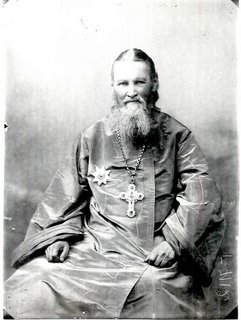
I want to live my life as John of Kronstadt lived his. I want that kind of life in me, the life that Father John and others have received from their Father, their only Father. 


Listen to what John of Kronstadt says…

He truly gives charity who gives from his heart, and with a loving heart. He is truly merciful who converses with everyone heartily, and not only with the intellect and lips, but who renders sincere, hearty respect to everyone; in a word, he who embraces all and carries all in his heart by love, despising everything material that may become a hindrance to love between himself and his neighbor; such a one is truly merciful and loving.


“Remember who your teachers were…”

2 Timothy 3:14

Although one falls

Although one falls, he does not forget the love of his Father; and although he is loaded with trespasses of every kind, his zeal for the service of good is not held back, nor does he desist from his course, nor abhor to stand in struggle against these things anew and with the same chance of being vanquished, nor cease from demolishing every day his building and beginning a (new) foundation.

And the word of the Prophet is in his mouth: ‘Till the hour of my departure from this world, rejoice not against me, O mine enemy; when I fall, I shall rise; when I sit in the darkness, the Lord shall be a light unto me.’ And he will not cease to struggle until his death.


“Remember who your teachers were…”

2 Timothy 3:14

Unwalled city

It seems to me, from my limited experience of sixty-two years, that if you really trust Jesus completely, you are unafraid to trust yourself to people, situations, and the world in general, as they come your way.

By this I don't mean that you entrust yourself into everyone's keeping. But you are somehow able to discern, even without giving it much thought, and without anxiety, what is appropriate in every encounter.

You seamlessly entrust yourself to others in exactly and only those areas where trust even has meaning at all. You can be fearless because there is no longer anything to gain or lose. Why? Because of Christ.

He has you, and you have Him. Beyond both need and want, unopposed and defenseless, you are an unwalled city defended, like Rome, by that invincible weapon, the peace of Christ.

Monday, April 1, 2013

What price, salvation?

There is a strange disconnect between what people say they want and what they really want, and yet they claim to be honest in their convictions. They declare their intentions and then go about laying down plans that cannot possibly bring them to their destination. What is wrong with us? Why do we try so hard to live up to our built-in law of failure?

We all know what the Church is, at least we ought to know, if we read our bibles, if we pray, and if we try to follow Christ in everyday life.

When we are honest with ourselves, how much of what we experience in the church ‘we go to’ is like what we know the Church is?

True, that may be an unfair question, but only in minor respects. We are used to massive failure in human society at large, and in human relationships up close. We have learned to adapt, ‘to roll with the punches,’ to be forgiving and indulgent, to accept the fact that ‘nobody’s perfect.’

We’ve taught ourselves not to expect the best, even when our faith in Christ keeps telling us to expect, not just the best, but ‘the resurrection of the dead,’ as we used to say in the Symbol of Nicaea before they ‘retranslated’ it to conform with modern churchly ‘norms’—it is now, ‘I look for,’ instead of, ‘I expect.’

Hey! I don’t look for the resurrection of the dead, I expect it! And it’s not my human pride, my ego or my flesh telling me to expect this: it’s the Spirit of the living God, living in me, who teaches me to expect it, and not merely look for it.

What do we find in church, then? They say that the Church is a hospital, that it is a place where the sick go to be healed. A nice metaphor, coming from the Orthodox East where sin is considered not so much a crime to be punished as it is a sickness to be cured. This is not an unhealthy attitude. It gives hope and relieves us somewhat of our natural instinct to blame and guilt-trip ourselves.

So we’re sick, that’s all it is!
Well, that means we can slow down, take it easy, follow instructions, take our medicines, and presently we will be well again. Not only that, we have this beautiful hospital, with beautiful procedures, we are simply surrounded by beauty, and we’ve been told, ‘Beauty will save the world,’ so we can be comfortable and content, as we wait to be made whole. This is the view from the patient’s bed.

We are told to be patient and follow instructions, and everything will right itself, almost magically, and we will be well again. But how long have we been lying there? Do we even know what being healthy feels like? And most importantly, do we really want to be made well?

A church says that they follow Christ, that He alone is Holy, that He alone is Lord. They say that they have seen the Light, that they have found the true faith, and that the Trinity has saved them. That’s great! But what of the others, those who can’t say these things? Those who don’t even know these things are possible? Who is supposed to tell them? Who to show them? We already know the answer to that—‘Here I am, send me!’ (Isaiah 6:8)

We go to church, and we hear the priest or deacon say—if they are good preachers—that we are the Church, not just the priests, and that ‘the great commission’ to ‘make disciples of all nations’ is our responsibility, not just theirs.

Fine rhetoric, this exhortation, very evangelical, but nothing more than fine rhetoric if it is not backed up by actions.

What happens if some of us take this responsibility to heart, and go forth two by two into the world to fulfill it? Are we supported by these same preachers? What preparations are they willing to take on behalf of our ‘mission’ and our ‘ministry’? Do they even know what preparations to take? Can it be, that all we have to offer the outside world looking in on us, is a once or twice yearly lecture series on such things as the history of the Church or its teachings ‘in our tradition, we…’, an invitation to come and ‘help us to get ready for the next festival,’ and of course, ‘just come and worship with us’?

I used to think the last one—just come and worship with us—was the best, and that it was enough, but honestly, it isn’t. We are not medieval Eastern Europe, where illiterate, barbaric people can come and be ‘awed by the beauty’ of our liturgical services. For them, perhaps, this wall of beauty was a real window into the Eternal, because they had little other possibility of access. For us today, it really can become just a wall.

Why? Because we have advantages, yet we don't make use of them. We can read. Bibles can be picked up in any language or dialect. Among us are experienced and knowledgeable ‘lay’ people, as well as clergy. If we rely on just the services to somehow magically inform and transform people, we are not giving them their true value, and we are lying to ourselves.

Christ came to make an end of magic, as holy father Ignatios of Antioch wrote to the church at Ephesos, “…every kind of magic was destroyed, and every bond of wickedness disappeared; ignorance was removed, and the old kingdom abolished, God Himself being manifested in human form for the renewal of eternal life. And now that took a beginning which had been prepared by God. Henceforth all things were in a state of tumult, because He meditated the abolition of death” (Ignatios to the Ephesians, ch 19).

If this was true and well-understood in the time of the early fathers, before the onslaught of the ‘dark ages’ submerged the Hellenic and Christian spirit, and continuing from the gospels and the apostles, how much more true today, when we have finally overcome those ‘dark ages’?

Where does this leave the churches?
Back to the statement made at the outset, there is a strange disconnect between what people say they want and what they really want, and yet they claim to be honest in their convictions.

What does the Church exist for?
Whom does it exist for?

They say it is a hospital for the sick, and that Christ is the Physician. Well and good.
Have they removed all obstacles to that purpose?
Have they laid out plans that facilitate it?
Have they got the priorities right?
Are the sick able to meet the Physician?
Are the instructions and medicines they are being administered working?
Are people being made well?

Or are secondary needs taking priority?
Are people being allowed to develop addictions to the medicines, dependence on the clinical staff, and diverted from getting to know their Physician personally?
Are the patients being administered cosmetic solutions to their real ailments, making them ‘look good’ to themselves and each other, while their critical illnesses remain untreated, because there’s no time for that, and no need?
Is a kind of spiritual homeopathy being applied, smaller and smaller doses of the same poison that created the symptoms, until these very ‘medicines’ have become nothing more than placebos, and health and recovery are redefined as ‘what the doctor tells you’ is healthy—not the Physician, but those who say they represent Him?


We are told that salvation comes through Christ. It doesn’t matter what church or denomination is speaking, the Message is the same, because we all use the same Book. “Here is a trustworthy saying that deserves full acceptance: Christ Jesus came into the world to save sinners—of whom I am the worst” (1 Timothy 1:15), and “God so loved the world that He gave His only-begotten Son, that whoever believes in Him shall not perish but have eternal life” (John 3:16).

Isn’t this what the whole mission of the Church is about, salvation through Jesus Christ? And isn’t this mission accomplished by following the simple command, “Therefore go and make disciples of all nations, baptizing them in the name of the Father and of the Son and of the Holy Spirit”? (Matthew 28:19).

Go, make disciples, baptize.
Can it be acceptable that churches do anything above and beyond these three things? Can it even be possible? Can we really think that we can add to the mission that Christ has already given us? Can we set priorities of our own that supersede what the Word Himself commands?
Go, make disciples, baptize.


A church says that we want the salvation of all, that we are offering the fallen world around us the gift of eternal life, vouchsafed to everyone who comes to Jesus and believes in Him.

Well, why aren’t they coming? Is that really how the Message entrusted to us works? Does the church go, do we make disciples, do we baptize, in that order? What have we put ahead of what we say we want? How can we have failed to realise that if we really want something, we remove all obstacles, and pursue it relentlessly?

We understand priorities in lesser things. How have we failed to apply the same principle to what we say is most important to us?
If we have to, what are we willing to give up to accomplish our mission? Have we really considered the question?
For there is really only one:

What price, salvation?

On these the universe is established

In the news coming daily from the European continent, churches, that is, Christian houses of worship, even Roman Catholic ones, are being offered for sale because they have no congregations, and they are being bought up by Muslims. Some of these properties are even very historic. It seems only a matter of time before even the great Gothic cathedrals—Cologne, Beauvais, Ypres, maybe even the Sainte-Chapelle—will be converted into mosques, just as the great church of Hagia Sophia in Constantinople was, only without the violence and carnage of military conquest.

Christians are justly concerned, but there is nothing they can do about it. Their numbers are dwindling, not all over the world to be sure, but in parts of Europe. Natural increase is insufficient to replace those who are dying off or just falling away. Religious indifference, combined with new personality-centered movements claiming to be Christian, have taken their toll. Yes, Europe as a ‘Christian continent’ has probably already been replaced by Latin America and Africa, but institutions change very, very slowly, wishing they were still alive, claiming to be, when in fact they are dead.

Nikolaj Velimirović, Bishop of Ohrid and Žiča, wrote of the ‘three ages in the history of the Church’…

There are three ages in the history of the Church: the Golden Age, when the Church was opposed to political governments; the Iron Age, when she was politically directing Europe’s kingdoms; and the Stone Age, when she has been subdued to the service of political governments. What a humiliation for the present generation to live in the Stone Age of Christianity!

It seems that we cannot have sunk lower than the Stone Age, but I think we have. The political governments have now in most places thrown away the Church, seeing that she is no longer of any value to them at all. In fact, in many places the Church is seen as an impediment to the progress of mankind and civil liberties. Ironically, however, having sunk below the Stone Age we do find ourselves—those of us who are still part of the confessing Church—back in a position very similar to the Golden Age. Whoever thinks that the Church is dead, or that we are post-Christian, is, I think, mistaken.

But that doesn't help those who are anxious for the fate of Christianity. In reality, they are grieving for the loss of what is essentially Christian real estate, not the loss of faith. Yes, the faith of Jesus Christ, used to power building projects throughout the ages instead of being allowed to transform and liberate humanity from bondage to sin and death, has produced a lot of beautiful, even awesome, things. But wherever the faith is alive, its works usually pass nearly unnoticed by the world, and even by the Church, whose leaders often pay lip service to virtue while trampling it in practice.

Human nature is fickle and weak. It is, we are, also very, very lazy. Having as a race abandoned our partnership with God in tending this garden universe, all our work is tedium, which we try to escape in various diversions, even—no, especially—in religious activities. And why? Seeking to serve the Lord, to harmonise our wills with His, to follow His true commandments (not those we make up), does not produce religion in us. It produces relationship. (There was no religion in Eden.) This is not easy. Religion gives us an easy way.

We offer God vegetables, like Cain did, and slay our brothers as he slew Abel. And why? Because we want to do things our way. God, if He does exist, should accept whatever we want to offer. This spirit is to be found in every religion, including Christianity. In the long run of Christian civilisations, the spirits of both Cain and Abel are present, just as the Lord tells us when He speaks, in another metaphor, of the field sown with wheat that has been also secretly sown with tares by the enemy. Religions come and go, wax and wane in the spiritual realm, just like wars and revolutions do in the earthly.

Christ says, ‘Do not be alarmed, the end is not yet’ (Mark 13:7).

Soon, it is said, Europe will become an Islamic continent. It is the Muslim belief that Muhammad's religion supersedes Christianity much as many Christians believe that their faith has superseded Judaism. Yet there are the faithful among the house of Israel worshipping, praying, studying the Torah, carrying out the commandments, as they always have, and with whom Christ has no quarrel. In the same way, there are the faithful Christians, worshipping in spirit and truth, rightly dividing the Word of God and applying it to their lives, loving mankind without condemnation, praying for those who hate them.

It is when the world no longer sees such as these, servants of the Most-High, sons of our Father who is in heaven, that those who remain unenlightened by the Gospel will have cause for anxiety, for it is on these the universe is established (as we publicly proclaim on the Sunday of Orthodoxy), and we should hope to be among them. They have no time to quibble and mourn over church properties, even the holiest shrines, because they know where their Treasure is. They know that their Kingdom, as Christ's, is not of this world. They know who it is they have trusted, and why.

Some religions are very long-lived, even when they are false, even when they don't really work, because people do not know, by nature, how great are those things which God has prepared for those who love Him, and they settle for less. Again, this is human weakness, frailty, desire for comfort rather than truth, wanting the feelings of solidarity even when unity is only an appearance, not the truth. Followers of Jesus Christ, wherever they find themselves, in whatever circumstances, are anxious for nothing, not that the Church will ever be lost, nor that anything that the Lord has willed shall fail to come to pass.

Yes, for Christ says, ‘These things I have spoken to you, that in me you might have peace. In the world you shall have tribulation: but be of good cheer; I have overcome the world’ (John 16:33).

Too much death

A few days ago my son wrote that he was upset by the number of deaths that have occurred within our circle of family, friends and acquaintances. Between us both, since December, I am sure that as many as eight people we know have died, one way or another. Within our own family, the two surviving grandparents finally passed away, my father in late January, my mother-in-law in early March. Two young people we knew of committed suicide, both young women, one of them being the mother of a six year old boy. It's one thing when the elderly pass away—two others were also aged grandmothers of friends—but when the young, or even the middle aged (like me!) pass away, it seems somehow tragic. In the case of the young because their potential was never realised, in the case of the middle aged, because they worked their whole lives and were cheated out of enjoying their ‘golden years.’

Of course, we can piously say, ‘God is in control, and He knows what He is doing.’ Of course He does, yet even God doesn't desire the death of anyone, as scripture says, ‘Death was not God's doing, He takes no pleasure in the extinction of the living’ (Wisdom 1:13). Myself, I have somehow escaped the feeling of grief when it comes to the death of my loved ones. I sometimes wonder, was it because I never loved them at all? That can't be it. It's quite possible that years of trusting in the promise of Christ that ‘If anyone believes in me, even though he dies he will live, and whoever lives and believes in me will never die’ (John 11:25-26) has worn down any possibility of me feeling grief. Probably not. I think my prayers to God to protect and prolong the lives of my loved ones have been answered. To me, our God has been a truly gracious God, and though His blessings have sometimes contradicted my desires, He has never ‘left me lying in the dust of death’ (Psalm 22:15c).

I wrote my son that death doesn't have to be awful, that it can be beautiful, and that those who are truly alive have nothing to fear in death. That may sound alright on paper, and such an explanation may work for the dispassionate person, but I think, for most people it simply doesn't hold water. In fact, even for Jesus Himself, such an explanation doesn't work. How do we know? Because in the shortest verse in the bible, considering the death of his beloved friend Lazarus, scripture says of Jesus, ‘He wept’ (John 11:35). Yet this same God-man—though at the time He asked this question, no one knew for sure or exactly what or who He was—said to the sister of Lazarus, ‘whoever lives and believes in me will never die. Do you believe this?’ At the same time that He truly grieved and really wept for the death of His friend, He still knew that He could, and would, raise him.

Martha said, ‘I know he will rise at the last day.’ Well, to her that was no consolation, and by her words and tone she let Jesus know that that was not enough. She wanted her brother back alive, now, though she didn't say it aloud. Christ, knowing everything about her just as He knows everything about all of us, testified, ‘I am the resurrection,’ even though He knew that unless He demonstrated it, what He said was just words. People then and now had some kind of belief in the afterlife, though no one ever has a clear picture of it. Some say it's just an extension of life on earth, where we appear the same and know each other, and live forever, carrying on as we did on earth, only without end. Just as the resurrection on the last day was not enough for Martha, so this kind of imagination about the afterlife is not enough for me.

God is real. Jesus Christ the God-man is real. Paradise is real. Therefore, all that we can think about or imagine of the life hereafter is at best a kind of pill we swallow to keep our anxieties quiet. The fact is, we can't know, we can only believe, and so sometimes we let our beliefs carry us away into fantasy. Whatever else death is, it is without doubt the end of our lives on earth, all that we are and were is no more. We will be seen here no more. There is only one of each of us, and nothing about us or anything else in the universe really repeats itself or can continue forever as it was. I once wrote, ‘The perfection of anything solely human consists in the fact that it must end,’ and I meant what I wrote. We exist only to run our courses to the finish line. When we break through that line, our utter exhaustion from the final effort to finish sends us careening into ‘the great cloud of witnesses’ who catch us as we fall, completely out of breath and, if we were still alive, close to suffering a heart attack.

But we are dead—thank God!—and so a heart attack is simply out of the question. We made it to the finish, but we're no longer what we were, not at all. As we lie there dazed for a moment in the arms of the heavenly host, for a moment we remember what we were on earth as one almost remembers the figments of a waking dream, and then, as we come back to ourselves, we are as different from our earthly identity as uncreated is from created. Where once we were contained in our bodies, now our bodies are contained in us. It would not be an exaggeration to say we are no longer human, but only as we say that an oak tree is no longer an acorn. Lord have mercy! Here I go imagining the afterlife and what we will be just like the next guy! And after all I just said! What I really wanted to write was something I just feel, something I just ‘know in my knower,’ but there aren't any words for it. Holy apostle Paul writes something that gives me the same feeling, ‘We shall not all die, but we shall all be changed’ (1 Corinthians 15:51).

It's that word ‘changed’ that comes closest, without defining, to what it is that we are, after we have expired in the body of flesh. But, back to grief. We are right to be sad, to mourn, the death even of an aged parent or grandparent, just as we grieve for the death of a child or still-born. Why? Well, again, because He who created all, who knew us all before we appeared on earth, and who by knowing us after we have disappeared holds us forever suspended in a new and unknowable life, He too grieved, He wept, He was sorry that His beloved friend had to physically die. And did He weep knowing Lazarus was just dead, or even more so, because He must raise him temporarily again so that he must endure that same disembodiment and transformation again? Only God knows all, including the answer to this. ‘Memory eternal,’ that hymn with the haunting melody, tingeing the air of purply pre-dawn with expectation and transformation: ‘Awake, my soul, to the real life!’

God became man, that man might become God. We can say the words and even imagine, but there is nothing we can say truly, until happens to us what holy apostle Paul wrote, ‘No eye has seen, no ear has heard, and no mind has imagined what God has prepared for those who love him’ (1 Corinthians 2:9).