Saturday, September 10, 2011

Who needs eternal life?

The institutional manifestation of the Church that pretty much all Christians experience is essentially stuck in a world view that is completely anachronistic; hence, rendering their witness to the world of marginal effect.

We have all inherited a form of church that comes from a world where everyone was "Christian" except the Jews and a few marginal unbelieving types or groups. That world has completely vanished, yet we cling to church structures (forms of ministry and real estate), activities (worship services and other programs), and modes of belief (religiosity, denominationalism) that allow the world of the present to marginalize us; hence, the supposition that we are in a post-Christian age.

None of this is to say that there are not churches or ministries that are alive in Christ and effective vehicles of the good news, but unless you set your expectations very low, such churches are few and far between. The majority of churches maintain their congregations and do next to nothing in terms of the commission to "make disciples of all nations." They just don't know how to do it, as institutions.

In my experience, it continues to be the individual Christian who is following the call of Jesus on a daily basis who is the primary witness for Christ. In the Orthodox Church, that is more or less how it is expected to be, but there is still a disconnect that often undercuts our personal evangelism: the growing attitude of clergy professionalism.

Once upon a time, and in some place even today, the thing that distinguished Orthodox clergy from those of other churches was their complete abandonment to Christ. This gave them the power and effectiveness to really anchor their churches, corporately and individually, in the Lord. Now, in the Greek church anyway, it is vanishing.

The Christian world has disappeared, and the world that has replaced it seems indifferent to the call of Christ, the need for salvation, and the claims of the institutional Church.

Just as modern man cannot face the fact of death but disguises it and distances himself from it as much as he can, he does the same with Christ, whom he knows about, sometimes knows a great deal about, and with the Church, which he cannot possibly understand from the outside. Yet human beings continue to be the same, in spite of their higher educational and cultural levels, their various attainments, and so on.

And while we debate, discuss and develop "new" and "relevant" ways to reach the lost of the new world, they are slipping away into the abyss, rejecting what, or rather Who, will give them eternal life, because they no longer even want it.

Friday, September 9, 2011

Man in his prosperity

As a citizen of the Kingdom of Heaven, life on earth has taught me one consistent lesson which I have turned into a saying in my mind, "It's not when I find myself in trouble, but when I find everything going my way, that I feel afraid." This saying, of course, is just how Romanós expresses what he has ingested and internalized from the Word of God. "Alas for you when the world speaks well of you! This was the way their ancestors treated the false prophets." (Luke 6:26) "If the world hates you, remember that it hated Me before you. If you belonged to the world, the world would love you as its own; but because you do not belong to the world, because My choice withdrew you from the world, therefore the world hates you. Remember the words I said to you: If they persecuted Me, they will persecute you too…" (John 15:18-20)

Elder Ephrem, a contemporary Greek monastic from Mount Athos, has written…

God loves us and through involuntary pain seeks to count us worthy to participate in His most perfect blessings. Unfortunately, we do not love our soul in a spiritual way. If we loved it we would endure trials of both soul and body without complaining, in order to attain the eternal blessings.

Pain softens the heart and removes its hardness. As the heart is softened in this manner, the ground is prepared for the sowing of genuine repentance and correction. We who are cowardly in every affliction chase away, so to speak, the grace of God.

When man is prospering, he cannot remember God, and if he remembers Him, it is only faintly. When affliction or pain approaches, he remembers Him vividly and with fervor, then he prays most ardently. And our holy God is pleased with this, just as a mother is pleased when her child seeks her with heartfelt pain, for in this she discerns love.

No matter how man is tried, he always benefits when he shows the corresponding patience and gratitude during the trial. This is revealed at the end of the trial, when he sees the lightness of his soul, the clarity of his mind, and the sweetness that comes to his inner self.

Man in his prosperity forfeits intelligence:
he is one with the cattle doomed to slaughter.
Psalm 49:20
Jerusalem Bible

Facing facts

Most people are not evil, nor are most people complete fools. We are, however, a very selfish race, and ungrateful. Some of us have met with circumstances in our lives that have halted us in our tracks, making us look at and think about the world around us a little more deeply. There is, after all, a lot to ponder. The deeper we live our personal stories, the more we can begin to understand the stories of others, and empathy grows in us. The human mind seeks patterns in its experience of the world and of the self. There are plenty of patterns out there too, and it seems the more we look for, the more we find. Sometimes we try so hard, we even find patterns that aren’t really there. Hence, the humanist atheist’s criticism of “religion” and God, which sometimes comes close to the truth. So much for the human world and our experiences there.

Still, some of us, as flawed as we are, and as damaged, insist on the reality of a Being we call God. Most of us are also not evil, nor are we complete fools either. We find ourselves to be, in spite of our “belief” in the existence of the Being we call God, very selfish and, yes, ungrateful too, just as selfish and ungrateful as the rest of humanity. That doesn’t stop us from believing and insisting that this God exists, whatever else we do or say about Him. This fact gives the majority of people a very sour taste in their mouths when it comes to the subject of “religion” and God, or as we have it in America, a “Christian” country, the subject of church. Most people are not evil, nor are most people complete fools. They can tell when people are “playing church,” and being sensible (except for a universal blindspot—personal sin) they want no part in the “game,” and can you blame them?

Most people will only play games that they’ve made up and whose rules they’ve accepted, games that are “fun,” and which they think they can win, that is, that’ll put them ahead of others. Hmm, what does that remind me of?

Back to my statement that most people are not evil, at least they don’t think they are. They haven’t yet encountered sin, or else they’ve refused to acknowledge it, being tutored by a world system that actually glorifies it under other names. So not meeting sin in themselves, or hiding from it, thus being unaware of the bad news about themselves, they have no ears for the good news. If they have heard the bad news preached at them somewhere, that only hardens their hearts against the good news even more. “First they tell me I’m broken, so they can fix me, but if you ask me, it’s them that are broken and need fixing! They can keep their Jesus!” I wonder why they would think that?

Can it be true that most people aren’t complete fools? Even if they were able to see their brokenness or whatever they might call it—though sin is its real name—how should they respond if the “repairers of the breach” are easily seen to be just playing a game, pretending to be healers, helpers, heralds of good news, but in fact, only playing?

“Where do you fellowship, brother?” a twinkly, heavily-bearded middle aged man asks a young man sitting in a coffeehouse, wearing a tallit [Jewish prayer scarf] and studying a Hebrew interlinear Old Testament. Without waiting for a response, “Tallit is rabbinical; I follow only Torah.” Then, as the young man begins to respond, and giving some testimony of his life in Christ, the other continues to promote his “messianic synagogue” and boasts of “following the commandments” because Y’shua [Jesus] was a Torah observant Jew. Then he goes on to say that living your life as “a living sacrifice” is impossible unless you know and understand the book of Vayikra [Leviticus] and what sacrifice is all about.

My mind is trailing off into silence and my eyes glazing over, while I wait for this blast of hot wind to pass. Ah, but his wife is a real Jew, who teaches Hebrew, and who was saved and is now a tongue-speaking, born-again believer in Mashiach. “Good,” I mutter softly and nod, while I half-listen patiently. Finally—I knew it was coming—the business card. After all, he’s on his Father’s business. He knows his lines well, though his Hebrew knowledge is spotty at best, enough to corral the biblically illiterate whom he usually meets here.

So why don’t they come to church and be Christians? What’s wrong with the people of the world? We’ve certainly given them enough time and plenty of free literature and televangelism to round them up. Don’t they feel welcome? We say on our church marquees, “Everyone welcome.” Look, we even have a prayer request box in the parking lot, if somebody needs to be prayed for. What more can they want? They don’t even have to tithe, at least not at first. After all, “the church doesn’t need” our money, “we need to give it.” As they say, "You can't outgive God!" And as for expecting miracles, like living a transformed life, well, don't worry… that’ll gradually happen. All they have to do is hang out with us, and they’ll be infected with Christianity. It’ll just rub off on them. See, we’ve made the way to God absolutely appealing, fun and easy. Got nothing to do, no where to hang out? Don’t worry! You can volunteer in one of our great ministry opportunities. What? What did you say? What do you mean “What does all this have to do with Jesus?” Why, it has everything to do with Him! After all, Christ is all things, and in all things, especially at our church! Don’t worry, we’ll put you to wo… I mean, we’ll give you plenty of opportunities for Christian growth. And remember, “grow where you’re planted!” We love you, and Jesus does too!

Christ, our Lord, have mercy on us!

Thursday, September 8, 2011

Saving grace


וייקץ יעקב משנתו ויאמר אכן יש יהוה במקום הזה ואנכי לא ידעתי׃
ויירא ויאמר מה נורא המקום הזה אין זה כי אם בית אלהים וזה שער השמים׃

And Jacob awaked out of his sleep, and he said, Surely the Lord is in this place and I knew it not! How dreadful is this place! This is none other than the house of God, and this is the gate of heaven!
Genesis 28:16-17

This passage, in slightly different wording, was chanted as an introit by the choir of my family church, the parish of Saint Mark, in Portland, Oregon (Episcopal then, now, schismatic Anglican). It was my favorite introit, and the chanting of it, even though it happened only once a year on the anniversary of the dedication of the church, is indelibly engraved in my memory, and I can chant it still.

We were a very high church congregation, but then it was a flawless act, covering unbelievable wickedness and hypocrisy. Little did I know it at the time. To me, the place was all magic, and in a good sense. It was in that darkly sparkling nave that I saw and venerated my first real ikons, old Russian ones blackened with the centuries, for ours was a unique parish, commemorating the Archbishop of Canterbury, the Pope of Rome, and the Patriarch of Constantinople, in every mass.

We were moved from that old church, into real Orthodoxy, the Greek Church, by a fortuitous accident, just as the old ship of Episcopalianism was about to disappear beneath the waves of the world's seductive charms. The parish of Saint Mark almost followed, but at the last minute threw its lot in with one of the new continuing Anglican groups, and it has floundered ever since. Only later did I find out what depravity was hidden beneath the brocaded chasubles and immaculate altar frontals.

This is a comment of sad reminiscence, but also a testimony that the Lord in His divine economy and faithfulness can still lead us to the Truth, to Himself, out of Babylon, and still preserve for us the tokens of His saving grace. “Oh, how dreadful is this Place, this is the house of God, and gate of Heaven, and men shall call it the Palace of God” (Introit for the dedication of a church, The English Hymnal, 716).

Let's pray now!

I don't have very much to say these days that's bloggable. A drowning man doesn't talk much. Well, not drowning exactly… I'm exaggerating. But learning to walk on water is tough, and I can't even swim!
I found this cartoon on the OrthoDixie blog, and it shows visually something that I practice and sometimes preach, "Let's pray now!"

Early in my life as a Christian I'd meet people who'd say things like, "I'll pray for you," or "Please pray for me."

I thought the first was a kind of pious ‘put on’, and I'd say "Thanks!" and I always felt very uncomfortable with the second and hastily responded, "Of course, I will!" and then I'd just forget about it, like the guy in the cartoon. Clergy and pious old ladies usually said the first, and ‘humbler than thou’ wannabees usually said the second. Occasionally both the offer and the request were genuine, but rarely.

One day, I just sat up and decided to do what the Word of God says, "Pray all the time, asking for what you need, praying in the Spirit on every possible occasion" (Ephesians 6:18 Jerusalem Bible).

One thing that meant to me was this, I never again (or almost never again) told someone I'd pray for them. If someone needed to be prayed for, I'd just drop everything, including the pretense, and say, "Okay, let's pray now!" and start praying right then and there.

This readiness came with not a few surprises. Some people actually wanted to pray and wanted to be prayed for. Others simply excused themselves and so much as said, "Don't bother!" with an embarassed grin.

Being ready to pray at the drop of a hat (or yarmulke) is a very good way to increase your faith, because you have to rely on God to give you the words—and that's how prayer is supposed to be. If you haven't thought about this before, try it out. It has the same wonderful and incredible results as wearing a smile does. It catches people off guard and disarms them, and you too, and puts you in a place where, as Dietrich Bonhoeffer says, faith becomes possible.

The only time I express something like "I'm praying for you" is in a letter or email, and I am doing just that while I am writing it. Never the future tense, not even in a letter. Always the present. Always in His presence. He's with us here, with me while I type these words, with you as you read them. And in this written tabernacle I can ask your prayers for Romanós the sinner, and I can know that if only for a moment you're now bringing my cause before the Father, because that's all it takes, and that's all that's possible.

Wednesday, September 7, 2011

By faith and not by sight


What this strange, ‘tremblesome’ quality of my life means—I am beginning to understand. I am living forward, one day at a time, like a blind man who cannot see what's ahead, but can only feel his way, taking short, deliberate steps, groping into the next moment, listening to a barely audible voice that's calling me. By faith, not sight. And faith comes by hearing. And hearing by the Word of God.

This quality has been growing, and I, sensing it growing, am surprised that the initial fear has lessened somehow. But the meaning of ‘living one day at a time,’ that I once glibly repeated along with others, has truly become the nature of my life.

There's no wonder, then, nor merit, in the fact that every morning I am surprised, yet usually happy, to wake up, and find myself still alive. No wonder, then, that when I see the sun rising as I drive to work, I am happy and thankful beyond measure. One more day. I remembered my first elder, Philip the cabinetmaker, who taught me when I was in my young twenties, how to saw up boards and make furniture. I remembered how he would confess to me, on a bright sunny morning, how he wept as he drove to work. I couldn't understand it then, but I'm beginning to understand it now. I too have wept on the way to work. Sometimes for sadness, sometimes out of gratitude inexpressible any other way. God is good.

I think to myself, Has it always been like this, only I didn't notice?

When you're ‘young’ the thought of death (as the end) never crosses your mind. Life extends limitlessly before you. You can plan things far in advance and expect to do them when you get there. When you're ‘older’ the thought of death starts intruding on this scene of self-confidence, and you begin to understand what ‘pride of life’ means. Is this when some people have their mid-life crisis?

You'd probably expect that life will always go on in the same seamlessly perfect way, though, like it did when ‘the world was new’ (Cat Stevens, Silent Sunlight, Album: Catch Bull at Four).
Perfect in that it's in your control.
But thank God, for at any chronological age, He is always there and willing to let us give our lives to Him, a little at first maybe, and then more later, and at some point, maybe all of it.
As we approach that point of no return, the giving up of all, time begins to ‘stretch out.’ Limited time, chrónos, becomes limitless time, kairós, which also means acceptable time.

Every day means more, every hour, minute, second. Every particle of being, of life, takes on the quality of being in the center, of being important beyond measure. The beetle that crossed my path as I fumbled for the key to unlock my door, God's handiwork, down to the least barbed leggy. The coolness of the empty warehouse I walked through on the way to my office, God's gift, at the beginning of a day that promises to be very hot.

When it comes to lunch, there's no question of ‘saying grace’ wherever I am or with whom, He feeds me and I thank Him. Every mouthful of 10 cent a bag ramen tastes as luscious as my favorite food. It's all manna. And if I'm with a friend, it doesn't matter if I eat at all, because the warmth of a friendly smile feeds more than any food. All from God's hands.

To know with every fibre of my being, He is here, He provides, in His hands are life and (what we call) death, as in the old spiritual ‘He's got the whole world in His hands,’ did this knowledge come first? Or was it the willingness to follow Him blindly, and to accept each next moment as His free gift, that ushers in the leading edge of His parousía?

"Let us go where He is waiting and worship at His footstool."
Psalm 132:7 Jerusalem Bible

Tuesday, September 6, 2011

Thirty-six years later

Psalms for the 6th day are Psalms 30 to 34.

Reading them and meditating on the meaning they've had for me these many a year, I spoke them in prayer, and received back, as the Lord never fails me, He's the faithful one.

Hear, Yahweh, take pity on me;
Yahweh, help me!
(Psalm 30:10)

Back in 1975, we were still on the trail of that elusive commodity, the ‘perfect’ commune.

Chuck and Tish owned a half section of land on the western slope of a mountain outside of Harrisburg, Oregon, and another half section down in the valley. The upper section was organized as a commune called Ahimsa (Sanskrit for ‘non-violence’), and they had invited us to live there if we could make it work.
They were letting their friends build homes out in the wilds, and the commune was going to be very (as we say in Greek) idio-rhythmic. In other words, people did not share everything in common materially or spiritually. They only shared the land and each other's company. Everyone was expected to have their own income and build themselves a home at their own expense. The ethos of the commune was to be ‘spiritual,’ but in the New Age sense—all paths ultimately lead to God.

Before we moved down here, we visited Ahimsa in the spring of 1975. That's when I took the photos that illustrate this post. At that point, I was still a New Age spiritual seeker myself, though Anastasia was a ‘born again’ Christian. We didn't go to church, though, because I had a problem with the hypocrisy I heard tell of. Our visit left us both with a positive impression of the commune, and so we packed up our transportable belongings in about a hundred and twenty boxes and shipped them via Canadian Freightways to the Portland terminal. Our irreplaceables went into a car carrier that I built out of plywood and mounted to the top of my 1972 Pinto hatch-back. (In the end, we didn't join Ahimsa. Chuck and Tish ended up becoming Mormons. We became Christians. I don't know what became of the others at Ahimsa.)


We arrived in Corvallis the evening of Rosh Hashonah, September 5, 1975, and stayed with a young Jewish couple we had known in Edmonton, Debbie and Harold. (Next morning we drove to Salem with them for our first experience of synagogue worship.)

This is not going to be the story of how I smuggled my wife and child into the U.S., but rather how I found myself, on the Thursday morning of November 6, 1975, ready to meet the Lord.
(Let the reader understand: I'm not now talking about just any Lord.)
Let me cite a verse from the psalms for the 6th day…

Happy the man whose fault is forgiven,
whose sin is blotted out;
happy the man whom Yahweh
accuses of no guilt,
whose spirit is incapable of deceit!

All the time I kept silent, my bones were wasting away
with groans, day in, day out;
day and night Your hand
lay heavy on me;
my heart grew parched as stubble
in summer drought.

At last I admitted to You I had sinned;
no longer concealing my guilt,
I said, "I will go to Yahweh
and confess my fault."
And You, You have forgiven the wrong I did,
have pardoned my sin.
(Psalm 32:1-5)

That morning I was at work, a rough sawyer in an old furniture mill in Albany. It was cold outside. The wind was blowing through the cracks in the barn-like plank walls. My fingers were freezing, even though I had gloves on. Behind me, a large planer was roaring. My off-bearer was shivering as he slid the scrap off the saw with one hand into a waste bin, while with the other guiding the good rips onto a cart.
I heard a voice inside my head, ‘Why do you resist Me…?’

I will instruct you, and teach you the way to go;
I will watch over you and be your advisor.
Do not be like senseless horse or mule
that need bit and bridle to curb their spirit
to let you get near them.
(Psalm 32:8-9)

Quickly, I sensed this was not just my imagination. I waved my off-bearer a signal, ‘Go empty the wood box!’ That would take him at least fifteen minutes, maybe longer, because it meant dragging a heavy load of wood down to the boiler hut. ‘He's probably going to want to warm himself there,’ something in me quipped. As he hauled his heavy load away to be burned, another heavy load was going to be hauled away and burned, one only I and the Off-bearer could see.

You, who have seen my wretchedness,
and known the miseries of my soul,
have not handed me over to the enemy,
You have given my feet space and to spare.
(Psalm 30:7b-8)

The talk began, slowly at first, then more heatedly. I argued with the voice. Sometimes I seemed to switch sides. I wanted to surrender, but then, I had investments. How could I give these up? Would I get something to replace them? What? How can you bargain with Him? What are you expecting? He's already told you everything, and you know it's all true.

The Word of Yahweh is integrity itself,
all He does is done faithfully;
He loves virtue and justice,
Yahweh's love fills the earth.

By the Word of Yahweh the heavens were made,
their whole array by the breath of His mouth…
(Psalm 33:4-6)

My temperature was rising, in spite of the biting cold around me. With every last ounce of my will, my flesh resisted the voice, and I kept feeling hotter. ‘This can't be happening to me! You know I want to accept You, but I can't, I can't!’ Finally, I asked Him to remove what was binding me.

Hear, Yahweh, take pity on me; Yahweh, help me! (Psalm 30:10)

That which I couldn't do of my own power, somehow He called forth from me. ‘All that I am, and all that I have, I surrender to You, Lord, to You, Jesus. I don't want anything now, nothing but what You want me to be and to have.’ This was the jist of what came tumbling out of my lips, along with sobs, because by now my face was a liquified mess. A coolness like a stream of icy water flowed over my head and then my body. I don't know what it was, but it pacified me. The planer with its attendee still roared behind me, none hearing or seeing what was happening to me, and me hearing and seeing nothing outside of me.

Every face turned to Him grows brighter
and is never ashamed.
A cry goes up from the poor man, and Yahweh hears,
and helps him in all his troubles.

The angel of Yahweh pitches camp
around those who fear Him; and He keeps them safe.
How good Yahweh is—only taste and see!
Happy the man who takes shelter in Him.
(Psalm 34:5-8)

Something that can't be put into words really, yet I've tried on this and other occasions. This time I'm only hinting at it. What is this thing that happens to us? Years ago I wrote a post, Born again? When? in which I tried to recount what happened to me that morning. That's my testimony, or at least part of it, because the new life in Christ, the birth from above, is really an event in kairós time—though you can sometimes pinpoint it on a calendar, it really encompasses more than a moment. You can't look at it, you can't even remember it, as it really is, was and is to come, because it's hidden with the One who will give it back to you on the last Day.

Our soul awaits Yahweh,
He is our help and shield;
our hearts rejoice in Him,
we trust in His holy Name.

Yahweh, let Your love rest on us
as our hope has rested in You.
(Psalm 33:20-22)

Monday, September 5, 2011

Love without limits

As a young man, having just accepted the Lord at age 24, I was in informal apprenticeship in cabinetry to Philip, a man 32 years my senior, who became my spiritual father in every sense of the word. He was and still is my standard for what Christian manhood looks like.

Even though we both worked in an old inner city furniture factory and both on the time clock (though he was, in fact, the foreman of the whole shop), we both worked "off the clock" several times a week. He did it to make up for deficiencies and mistakes by the "crew". I did it because I wanted to spend as much time with him as possible.

One example of the love he showed…

A young co-worker was assigned the task of machine mortising a cart load of bed posts. Philip or I set up the machine. The fellow started off well, but somewhere along the way he got distracted and started putting the pieces into place the wrong way. By the time anyone noticed, thirty or more posts had mortises in the wrong place.

Philip passed by and immediately saw what was happening (I was following him). He said, "Norman, take Joe over to the parts racks and have him start putting away parts, it looks like he needs a break from this boring job!"

I grabbed the guy by the shoulder and said, "C'mon, let's go!" as Philip quickly moved the cart of ruined parts out of the way and covered them with a tarp, so the manager wouldn't see them. Then, when I got back, I finished mortising the bed posts that were left.

After work, Philip and I "punched out" and hung around till everyone was gone. Then we dragged out the cart of spoiled work, cut plugs, glued and hammered them into place, drum sanded them flush, and then lickedy-split Philip mortised the whole load, while I assisted him by offloading them. All this took about 2 hours. By then, it was dark.

Next morning, everything was ready to go, and no one but Philip and I knew how. What happened to the boy who made the mistake? Philip never told him. He got moved to jobs requiring less concentration. Philip tried to match every man under his care with jobs that suited the capabilities of each.

After working closely with this man for four years, the company closed and the equipment sold off piece by piece. Portland's furniture industry days were over, moved to the South. I got a new job as a cabinetmaker, Philip retired early.

Within the year, when I was home in Illinois visiting my Mother for (what we later learned would be) the last time, Philip quietly passed away. His wife came home from work one afternoon, noticed him sitting in his favorite chair in the basement rec room, and when she went to talk to him, found he was "gone."

Love without limits, without drawing attention to itself, quiet, strong, consistent love.
Love that he received from his Master, he was quick to pass on to others.

1 Corinthians 13

Will He know me?

"What matters supremely is not, in the last analysis, the fact that I know God, but the larger fact which underlies it—the fact that He knows me." — J. I. Packer


This idea took hold of me one day when as a 22-year-old furniture maker's apprentice in Edmonton, Alberta, my mind took a leave of absence as my body was doing the mindless job of sanding furniture tops on an old-fashioned belt sander. There I was, pushing the sanding table in and out with one hand, the other pulling down on the lever of a sanding shoe, trying to achieve a level surface on each piece.

I was thinking of how important it was to believe that Jesus would come back some day. Funny, though, because I was still not a believer, but rather a philosophic hanger-on to the New Age kind of spirituality that combines "belief" in Jesus with a grab bag of other "spiritual" concepts.

Why should it matter to me that Jesus would be coming back, if he were only one of many "saviors", as is currently being taught by people like Deepak Chopra? I think deep down my original Christian upbringing was pushing its way back into my consciousness. I was starting to see where New Age thought was leading, and it must have been unsettling the real me, the one that would live forever… or suffer the second death.

As I was pushing that sanding table in and out, my limbs automatically sensing the right amount of pressure to get the work done, my mind was drifting into the realm of pure thought.

I kept thinking, "He's really going to come back. He really is. What will happen to me then? Will He recognize me? Will He know me?"

Suddenly, in my mind's eye, I could see something like an image of Jesus above me, and a little behind me to my left, looking down at me with a serious but not angry stare, just looking at me very hard. Without moving my head for a closer look, something in me just said, "When You come back, will you know me? Will You recognize me?" Pausing for the answer, there was none. He just kept looking, almost sadly.

All this, you understand, in my mind's eye. I don't know how else to put it.

After a few seconds more, and something external to my thought roused me to physical action, and the chink in time closed. But that moment of kairós time, and that thought "Will He know me?" was the beginning of my conversion to Jesus Christ, which came about after two more years of struggle against the good testimony of others.

Brethren, keep witnessing!

"Whoever acknowledges me before men, I will also acknowledge him before my Father in heaven. But whoever disowns me before men, I will disown him before my Father in heaven."
Matthew 10:32-33 NIV

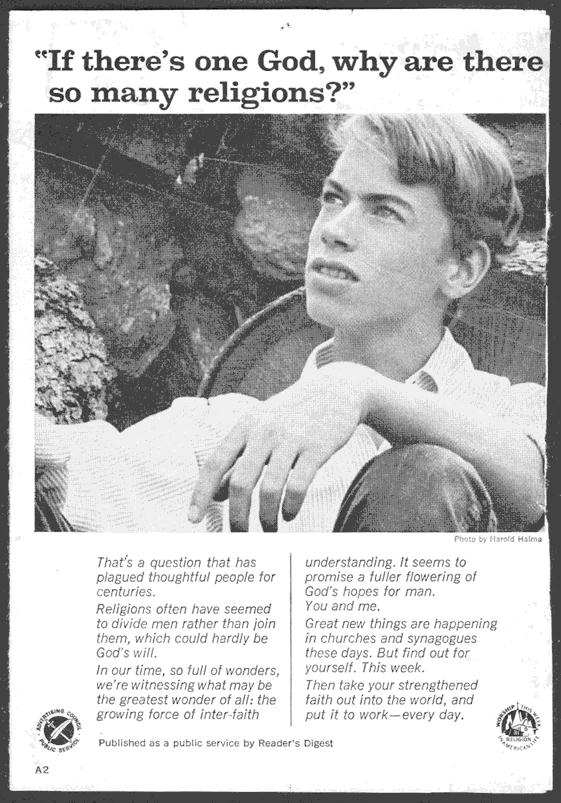
I started here

Back in Romeoville, Illinois, in 1964 maybe, or a little later, skimming through a Reader's Digest issue, I stopped at this full-page ad by Religion in American Life. It grabbed me. Why? Because the boy in the picture looked about as close to me as you could get, skinny, brownish hair, sitting like that lookin' up… that was me! Well, not really, but I carefully tore out the page and stuck it in whatever book I was reading at the time.

By then, we were not a religious family. My mom stayed up and prayed way into the night while she listened to all-night radio (sometimes I'd get up in the middle of the night and keep her company, it was good music), but none of us went to church anymore. Well, I did, sort of. My steady girlfriend was a Roman Catholic, and so, for a date, I used to accompany her to mass, and then go over to her house to hang out with her widowed mom and two sisters. Back then, there was nothing to do as a teenager, no drive-ins, nothin' at all in this small town of a few thousand people, just ice skating on Lake Shirley (man-made mega-pond) or exploring the forest with my best friend Ed. Sheesh! Marijuana didn't even come to town till the year I left for college… to another small town of 5,000 people even further in the boonies, Carlinville. For me at college, a date with my steady girlfriend was lying side-by-side in a mown hayfield looking up at stars on a clear night! No hanky-panky! And then, stopping for a donut or two at a local bakery that opened at 4 a.m. on the way back to campus.

As I was saying, we weren't a religious family (except for mom). But something in me kept tugging, "why are we here?"…"Is there really a God, or is this all a bad dream?" Somehow, I kept going back to this page torn out of a cheap magazine.

I've kept it all these years, maybe because it accompanied me as I took the first few steps… venturing inside a Catholic church with my girlfriend, finding the old family bible and starting to read it (at Proverbs!) and take notes, starting to write poetry with spiritual themes, exploring the Eastern religions… Well, yes, I did take a few wrong turns, and that continued on through college. But it was there that I found my first Christian friends, kids like me who were struggling with issues of life and death (to us), and who tolerated me as a weirdo who wanted to hang around them and do InterVarsity Fellowship things even though I was, at very best, an "almost Christian."

Just a reminder that everything and everyone has humble beginnings, no matter how notorious they become in middle age…

Sunday, September 4, 2011

Although one falls…

Although one falls, he does not forget the love of his Father; and although he is loaded with trespasses of every kind, his zeal for the service of good is not held back, nor does he desist from his course, nor abhor to stand in struggle against these things anew and with the same chance of being vanquished, nor cease from demolishing every day his building and beginning a (new) foundation.

And the word of the Prophet is in his mouth: ‘Till the hour of my departure from this world, rejoice not against me, O mine enemy; when I fall, I shall rise; when I sit in the darkness, the Lord shall be a light unto me.’ And he will not cease to struggle until his death.

Saturday, September 3, 2011

Am I not in paradise now?

From Fr Stephen's blog, Glory to God for All Things…

In Dostoevsky’s great last work, The Brothers Karamazov, the story is told of Markel, brother of the Elder Zossima. Diagnosed with tuberculosis, he is dying. In those last days he came to a renewed faith in God and a truly profound understanding of forgiveness. In a conversation with his mother she wonders how he can possibly be so joyful in so serious a stage of his illness. His response is illustrative of the heart of the Orthodox Christian life.

‘Mama,’ he replied to her, ‘do not weep, life is paradise, and we are all in paradise, but we don’t want to realize it, and if we did care to realize it, paradise would be established in all the world tomorrow.’ And we all wondered at his words, so strangely and so resolutely did he say this; we felt tender emotion and we wept….‘Dear mother, droplet of my blood,’ he said (at that time he had begun to use endearments of this kind, unexpected ones), ‘beloved droplet of my blood, joyful one, you must learn that of a truth each of us is guilty before all for everyone and everything. I do not know how to explain this to you, but I feel that it is so, to the point of torment. And how could we have lived all this time being angry with one another and knowing nothing of this?’ [He spoke even of being guilty before the birds and all creation] …‘Yes,’ he said, ‘all around me there has been such divine glory: birds, trees, meadows, sky, and I alone have lived in disgrace, I alone have dishonored it all, completely ignoring its beauty and glory.’ ‘You take too many sins upon yourself,’ dear mother would say, weeping. ‘But dear mother, joy of my life. I am crying from joy, and not from grief; why, I myself want to be guilty before them, only I cannot explain it to you, for I do not know how to love them. Let me be culpable before all, and then all will forgive me, and that will be paradise. Am I not in paradise now?’

Read more…

The utterly unlike

There’s lots of things, even persons, who are, or will soon be seen to be, utterly unlike what we have imagined them to be all our lives.

Firstly, of course, there’s God. Whatever you conceive Him or Her to be, and even if you have memorized and understood everything the bible and all theologians have said about Him, and even read what the pagans have said about Him, you still (I should say, we still) are going to find out that though in everything that really mattered we knew Him quite well, there will be a whole lot about Him that will just take us by surprise—mostly, things that we couldn’t have even begun to know about Him, due to our puny brains and sensory apparatus not having a way to process the information. Ants may know that we’re there, and they may even have a good idea that we’re big, clumsy, slow-moving and dangerous. In everything that really matters to them they know us quite well. They won’t understand why some of us avoid stepping on them. They won’t begin to suspect that we compose and listen to something we call music, even though they may have something analogous to it on a very minor scale. Unfortunately for them, one of us hasn’t been transformed into an ant like themselves, so as to give them a better idea of what those big shadow-casters are that pass over their trails.

Secondly, there’s our own human nature, that which we seem to be while we are alive “in the flesh.” As a young man, I spent many hours observing my body and my spirit in function, long hours lying quiet but wide awake in the night. The result of my observations was a gradually increasing awareness that “I am not that” in reference first to my body, then even to my spirit, even to my mind. Anything that I was able to observe, watch and study, was yet experience outside whatever it is that I am. All these observations and my non-verbal thinking about them only demonstrated to me what holy scripture teaches, “For that which is,” that which exists, the world of things in its essence and with its causes, “is far off,” far removed from the sight of man, “and it is deep, deep; who can discover it?” (Ecclesiastes 7:24) How ironic, that even our very own selves, that we (think we) can know first-hand, should still be beyond our ken! Most of us don’t want to put the label “utterly unlike” on our cache of life experience, but I think that what life really is is utterly unlike our perception. We only know what we need to know and can know, and that’s not much.

Thirdly, or maybe I should say lastly, there’s death. Whatever you conceive it to be, or not be, and even if you’ve had a near death experience, or even been dead and through miracle or modern science been resuscitated, you still can’t come closer to knowing or understanding what it is than the distance separating East from West. My youthful experiments in observation also impinged on death. I used to withdraw my energy from my bodily extremities to experience “this is a hand, not my hand” and even “this is a body, not my body.” I tried to observe what remains when all senses, sight, hearing, touch, and finally even all thought, become inaccessible to a mind. What is left? Locked in a realm of being which cannot exist, yet does, I imagined the body I once inhabited, breathless, unfeeling, unmoving, as a formless numbness, and the existence of the outer world (where life was still going on) as an inaccessible “it,” not a thing or a place, just a nothing that somehow is, and beyond my penetration. That was as close as I came to apprehending death. It was very unlike what my normal mind envisions when I think of death, but it was still not “utterly unlike.”

It is this kind of approach that brings us, I think, to the threshold of at least sensing that what awaits us after this (what we call) life is something and Someone “utterly unlike” everything we have ever seen, heard, felt or thought. It makes even spelling the Name with a capital letter pale as insolence and ignorance before the reality of Him Who Is, and of As It Must Be. Not even speaking of God or of what we know about Him and His plan of salvation as written in His Word, the scriptures, we can still know Him as He reveals Himself to us and through us without our help or our imagination, and knowing Him thus, the “utterly unlike” gradually dawns on us, and of that, no man living can speak.

The incredible God

Perhaps it is, as I have often thought, that people dismiss the very idea of God as incredible because it is claimed that He does impossible things, what we would call miracles and—of course—the idea of ‘miracle’ itself is inadmissible to the modern, scientific mind.

It is easy to dismiss a God who, it is claimed, creates the universe in six days, causes a universal flood that drowns all air-breathing life except for a few humans and animals in a paltry, primitive ark;

who, it is asserted, afflicted ancient empires with unidentifiable plagues to release a tribe of wayward ethnopaths, opened a passage through the waters of the sea for them to escape, kept them alive in a trackless waste with a mysterious airborne nutrient that tasted like whatever one wanted to eat;

who, not satisfied with creating a world and peopling it with predatory races, keeps coming in and out of history at intervals, speaking and acting by means of possibly deranged individuals who are taken to be prophets or even gods;

who, to crown all, is said to have entered the created order through a woman's womb and become one of His own creatures, yet not a creature, born as a man yet not as other men, who, it is believed, never sinned, never did an immoral deed, thought a sinful thought, or spoke a destructive word.

Yes, it is easy to dismiss such an incredible God, even when, it is recorded that as a man He was slain and rose again to life, and not just to ordinary life and to die again, but to a different kind of trans-mortal life, knowing no death, but a life which could not be lived on the planet as it is.

Yes, it is easy to dismiss this God, because nothing but nothing can be proved—scientifically; nothing verified through analysis; nothing counted, weighed, measured, because the whole story is a complete sham, a delusion, a pious fiction. Easy to dismiss a lie so obvious.

People are proud to not believe, to be indifferent, to prove they are too intelligent, sophisticated, judicious, wise to believe in the incredible God, and they think all the evidence is on their side.

But really, they dismiss the Only True and Living God for none of these reasons: That would be too easy, but they make it sound difficult, so they can be congratulated, adulated. What they want to avoid is looking bad, to themselves, and to others. What makes this God incredible to them is—that He forgives.

An early Church Father, Peter of Damascus, writes,
Even if you are not what you should be, you should not despair. It is bad enough that you have sinned; why in addition do you wrong God by regarding Him in your ignorance as powerless? Is He, who for your sake created the great universe that you behold, incapable of saving your soul? And if you say that this fact, as well as His incarnation, only makes your condemnation worse, then repent; and He will receive your repentance, as He accepted that of the prodigal son (Luke 15:20) and the prostitute (Luke 7:37-50). 
But if repentance is too much for you, and you sin out of habit even when you do not want to, show humility like the publican (Luke 18:13): that is enough to ensure your salvation. For he who sins without repenting, yet does not despair, must out of necessity regard himself as the lowest of creatures, and will not dare to judge or censure anyone. Rather, he will marvel at God’s compassion, and will be full of gratitude towards his Benefactor, and so may receive many other blessings as well.
No other god, or rather, no other human idea of God, is so incredible as this, ‘working wonders among His saints’—and these wonders are not primarily the supernatural miracles recorded in scriptures and even in secular histories, but the constant and effervescent miracles of unconditional, and ever-loving mercy with which He treats the sicknesses of mankind.

It is easy to dismiss a God who does what no one else does or can do, but hard to dismiss one who does what everyone can and should do—forgive, restore and love—not yesterday, far away, but now, here.

The great divide

Everywhere we look, there is a process of winnowing, of dividing, going on…

In the world, it's between the followers of Jesus and the devotees of ‘demons who are not God’ (Deuteronomy 32:17).

In the church, it's between those who know who Jesus was, and those who know who He is.

In the individual, it's between what we say we are, and what we are.

Time is only given to us, so that we can make a decision.
As long as time seems, even if we have (or think we have) forty, fifty, sixty, or seventy more years of life, it will all be over in the blink of an eye, and we will come to the Lord full of His acceptable years—kairós—or bearing in our hands only our empty, wasted years—chrónos.


Night is coming, when no one can work. John 9:4 NIV

For he says, ‘In the time of my favor I heard you, and in the day of salvation I helped you.’ I tell you, now is the time of God's favor, now is the day of salvation.
2 Corinthians 6:2 NIV

Now this is eternal life: that they may know you, the only true God, and Jesus Christ, whom you have sent.
John 17:3 NIV

Faith

       In the closest following of Jesus, the miraculous is not only possible, it is inevitable. It is into the life of this kind of faith that we are called, but very few Christians even consider it.

      ‘Ordinary’ Christian faith usually means just ‘trust Jesus’ and ‘God will take care of everything, no need to worry.’ But this is not the kind of faith that Jesus is leading us to when He says, ‘I tell you the truth, if anyone says to this mountain, “Go, throw yourself into the sea,” and does not doubt in his heart but believes that what he says will happen, it will be done for him.’ (Mark 11:22-23)

       Brothers, yes, we are on the edge. Yes, we are standing on the precipice of something miraculous. We all are. Some of us have stepped off into that ‘walk on the waters’ and have known that kind of faith, but it is too strong for our weak human nature, and we dash back to safety. But the call doesn't go away, and when we have been strengthened, we go out again, following the call, into the realm where ‘all things are possible, if you only believe.’

       Everything that Jesus says is true. He isn’t joking when He says, ‘Father, forgive them, for they know not what they are doing.’ Neither is He joking when He says, ‘Again, I tell you that if two of you on earth agree about anything you ask for, it will be done for you by my Father in heaven.’ (Matthew 18:19)

Broken but not divided


Fortunate is the man who is broken in pieces and offered to others, who is poured out and given to others to drink. When his time of trial comes he will not be afraid. He will have nothing to fear. He will already have understood that, in the celebration of love, by grace man is broken but not divided, eaten and never consumed. By grace he has become Christ, and so his life gives food and drink to his brother. That is to say, he nourishes the other’s very existence and makes it grow.
— Archimandrite Vasileios

He's a Lover

            
            He’s been walking in us all
            He’s been seeing through our eyes
            He’s been battered by our falls
            He’s been gladdened by our rise
            and there’s been no body here
            that He hasn’t been inside
            He’s no secret to our ears
            and He’s got nothing to hide

            And He’s a lover,
            He’s a lover, Babe
            Don’t run for cover
            Don’t go hiding now, girl
            He’s a lover
            He’s a lover

            Were you walking in the street?
            Was it you I saw last night
            looking like you couldn’t sleep
            and your heart done up too tight
            with your painted eyes and face
            holding back the tide of fear?
            Did you finally find a place
            where someone paid to drink your tears?

            But He’s a lover,
            He’s a lover, Babe
            Go, run for cover
            Go, run to Him now, girl
            He’s a lover
            He’s a lover

            Where you look it can’t be found
            Man, the books just fill the sills
            of your mind, you can’t get down
            from your bed of selfish will
            For the Spirit’s just a clown
            who’s been dressed up for the kill
            In His letters you may drown,
            but He’s waiting for you still

            ‘Cause He’s a lover,
            He’s a lover, Man
            Don’t blow your cover
            Don’t go crazy now, oh no
            He’s a lover
            He’s a lover

            He’s been counting out our days
            He’s been filling in our names
            He’s not satisfied with praise
            we offer up between our games
            He’s so tired that we must sleep
            but He offers us a light
            as He walks the lonely street
            He’s been walking every night

            ‘Cause He’s a lover,
            He’s a lover, Babe
            Throw off the cover
            Get up and open the door, girl
            He’s a lover
            He’s a lover


— Romanós


Commentary on this song by the author

      What is the meaning of that recurring description of God as mónos philánthropos, ‘only lover of mankind,’ that appears in so many prayers and hymns?

      In this song I explored this idea of the ‘One Who Alone Loves Us’ in four metaphors:

      The first stanza and refrain allude to Adam and Eve, particularly to Eve, on whom was heaped the blame for their common transgression. (Genesis 3:8-13)
      The second stanza and refrain refer to the woman caught in the act of adultery. The crowd wanted to stone her. Jesus, however, released her without harming her. He was her protector.
(John 8:1-11)
      The third stanza and refrain echo Christ’s indictment of the lawyers and pharisees, though He still loved them and held out the offer of His love. (Several passages in the synoptics and John)     
      The fourth stanza and refrain recounts the all-knowing forebearance of God, the forgiveness Jesus had for the sleepers in Gethsemane, and closes with a paraphrase of a scene from the Song of Solomon. (Song of Solomon 5:2-8)

Friday, September 2, 2011

The cost

     So often when we say ‘I love you’ we say it with a huge ‘I’ and a small ‘you’.

     We use love as a conjunction instead of it being a verb implying action. It’s no good just gazing out into open space hoping to see the Lord; instead, we have to look closely at our neighbor, someone whom God has willed into existence, someone whom God has died for.

     Everyone we meet has a right to exist, because he has value in himself, and we are not used to this. The acceptance of others is a danger to us, it threatens us. To recognise the other's right to be himself might mean recognising his right to kill me. But if we set a limit to his right to exist, it's no right at all.

     Love is difficult. Christ was crucified because he taught a kind of love which is a terror for men, a love which demands total surrender: it spells death.

     If we turn to God and come face to face with him, we must be prepared to pay the cost. If we are not prepared to pay the cost, we must walk through life being a beggar, hoping someone else will pay. But if we turn to God we discover that life is deep, vast and immensely worth living.


— Anthony Bloom
Metropolitan of Sourozh


Thursday, September 1, 2011

Greetings of the New Year 7520

If it seems that I am absent from here lately, republishing many of my older testimonies and passages from the Church Fathers, yes, I have been absent. I am learning a new occupation, and it is literally taking up almost all of my time. My thoughts and words are only for the Lord in those moments when I can be alone with Him. But I am still here, humming my tuneful prayer as I work, and remembering those the Lord has placed in my path.

One of these is a dear sister and daughter for whom I proposed the name
Kallista, in the day when she and her husband, Evangelos, should be joined to Holy Church. In case you happen to read this, dear sister, yes, Kallista (Καλλιστη, in the lower right corner of the ikon) is the name of an early martyr, remembered on the first day of the Orthodox Year, September 1. So in the longer view of eternity,
I wish you, ‘happy name day’ and ‘chronia polla, many years.’


The commemorations and prayers for the Beginning of Indiction, Orthodox Year 7520, are taken from the bulletin of the Greek Orthodox Patriarchate of Alexandria and All Africa, along with the ikon above. To all whose name day falls on this day, again and again, ‘chronia polla, many years.’

1 September 2011
New Year's Day, 7520
The Beginning of the Indiction

Also the Feast of… St Joshua the Son of Nun,
St Ammoun the Deacon, the 40 Virgin Martyrs of Heraclea, Thrace:
St Theona, St Lambrou, St Arevoia, St Alone, St Mosho,
St Theofani, St Akrive, St Ermia, St Sappho, St Athena,
St Adamatene, St Kalliroe, St Evterpe, St Terpsihore, St Erato,
St Elpinike, St Melpomene, St Polymbia, St Dodone, St Troada,
St Koralia, St Theano, St Aspasia, St Erasmia, St Theonymphe,
St Aphrodite, St Aglaia, St Pandora, St Polynike, St Antigone ,
St Ourania, St Marianth, St Thaleia, St Harikleia, St Kleio,
St Athena, St Penelope, St Kleopatra, St Kleonike, St Margarita.

Also the Feast of…
St Kallista and her Brothers,
St Evodos,
St Hermogenes, together with other Holy Martyrs of Nicomedia,
St Symeon the Stylite and his Venerable mother,
St Martha of Sisan, Cappadocia,
St Aithalas of Persia,
St Meletios the New of Cappadocia,
and St Evanthia.


Apolytikion Of The Indiction — Tone 2
     O Creator of all the Universe, Who has placed times and seasons under Thine own Authority; Bless, O Lord, the Crown of this year of Thy Kindness, keeping in Peace Thy Kings and Thy City; by the Intercessions of the Theotokos, O Only True Lover of mankind.

Apolytikion of our Ever Blessed Lady Theotokos
     Rejoice, O Theotokos Virgin Full of Grace: for from Thee has shone forth the Sun of Righteousness, Christ our God, giving Light to those in darkness.
     Be glad also, Thou Righteous Elder, for Thou hast received in Thine arms the Deliverer of our souls, Who bestows upon us Resurrection. Thou became a Pillar of Patience, and the Ancient Fathers Thou equaled and rivaled:  Thou rivaled Job in Sufferings, Joseph in Temptations, and the Lifestyle of the Incorporeals while in the flesh. Therefore, O our Righteous Father, Symeon, Intercede with Christ God to Save our souls!


Kontakion of the Indictos — Tone 4
     O Thou Creator and Lord of ages, O God of All, truly transcending all essence, we earnestly beseech Thee to Bless the year, and, O Tender-Loving Lord, in Thine Infinite Mercy, O only Master, Save us all who worship and serve Thee, O our Redeemer, and who cry with fear: For all Thy servants make the coming year fruitful.