Wednesday, December 29, 2010

Sol Invictus

Sol Invictus, ‘the unconquered Sun,’ was a Greco-Roman deity popular especially in the later Empire, beginning with the era of the military emperors, particularly among the soldiers.
A syncretistic deity, connected to the observable phenomena of nature, his cult was a conscious replication in the human world of the sun’s movement through the heavens. His feast day, the 25th of December, relating to the winter solstice, celebrated the turning point from the shortest day, longest night, towards the lengthening of days, the time of increasing light. He was a favorite god of the emperors themselves, including Constantine, who exchanged his worship for that of the true and living God.

It’s amazing, how similar the truth can be to our not quite correct guesses about it. Among the episodes of man’s search for God, we are not surprised to find how universal is the attraction of man for the sun and how frequently the solar disk has become the object of our veneration in place of the Divine Being. From ancient Egypt’s first stab at monotheism, the pharaoh Ikhnaton’s cult of Aton, the sun, with which he tried to overthrow the worship of Amon-Re and the pantheon, to the solar cults of ancient Peru, and China, Greece and India. Even among the pagans of today, the sun worshippers who bathe practically naked in its light on the beaches without giving theology a thought, he reigns.
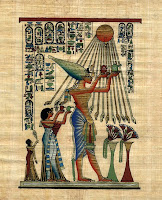
The ancient Church immediately incorporated feast days of the Christ into its calendar, imitating the biblical festivals of Judaism which it early discarded, and emulating in some respects the pagan feasts it was replacing. In the law codes of the first Christian emperors are edicts allowing the observance of the old pagan holidays as to the festivities while banning the religious offerings to the false gods that were the reason for them. This they did, the laws explicitly state (Code of Justinian, Book 1, Title 11, Paragraph 4), so as not to eliminate occasions of joy and revelry for the people. Even in those days, politicians, Christian though they might be, knew better than to suppress all at once what little fun the common folk enjoyed.

The commemoration of the birth of the Christ, of Jesus of Nazareth, was celebrated by the early Church on the same day as was His epiphany, the manifestation of Himself to the world at His baptism in the waters of the Jordan River by holy prophet and forerunner John, that is, on the 6th of January. Only later, after the Church had been incorporated into the Empire’s plans for world domination, was the commemoration of the actual birth, the incarnation, of the Christ separated from that of His epiphany.

The date chosen for this separate commemoration?
In step with their program of supplanting the native paganism throughout the Empire with Christianity as the national cult, the feast day of Sol Invictus, the unconquered Sun, was chosen. After all, wasn’t the coming of Jesus Christ the turning point in human history, just as the winter solstice was the turning point in nature, from the time of growing gloom to increasing light? It all made sense to the ancient mind; it still does, even to us today, when we think.

So much for the history of the feast day we are celebrating—yes, still celebrating in the Church, which celebrates for twelve days, not one—which we call ‘the Nativity of Christ,’ revealing in the name a somewhat better reason for it than does the common English expression ‘Christmas,’ which has taken on other meanings for the world. Yet there is more to this connexion between Christian beliefs and the pre-Christian speculations about the sun in relation to God, to the Divine Nature.

In the ethos of the ancient Church, there is this notion of God’s revelation of Himself being accomplished only through the Divine Logos, through His Word. We would never have been able to have any real contact with the Being—Yod-he-vav-he, Yahweh in Hebrew, Ho Ôn, ‘the Being,’ in Greek—had He not sent forth His Word into our midst. That Word was recognized as being Jesus Christ, as He is announced in the first chapter of the holy gospel according to John.

This notion was translated into an attitude that the Word of God, the self-revelation of God, was available in two books—the greater book, and the smaller book. What were these two ‘books’? The greater book was the book of nature. The smaller book was the written scriptures, the Holy Bible. The greater book was called ‘greater’ because it was greater, larger. It was God’s nature revealed, written very, very large, in His physical poem, the heavens and the earth.

The smaller book was called ‘smaller’ because we could ‘hold it in our hands’ as the apostle writes. It was God’s nature revealed in human language, a human literature taken up to become the vehicle of God’s most sure and complete revelation of Himself, everything that He wants us to know about ourselves and Him in one handy, little volume, and in a dialect—human speech—that we could understand. Hence, the two books, one Truth revealed in both, never in opposition to each other.

That being true, it follows that what is written small for us in the Bible is also written large for us—if we are wise—in the greater book of the heavens and the earth. This is where the wisdom of the Church in supplanting Sol Invictus with the truly ‘unconquered Son’ enters. In English and other Germanic languages we are favored to have a similarity in the sound of two words, ‘sun’ and ‘son’, that is not present in most other tongues. Sometimes this confusion works well, other times not.

Herein is found one of the most excellent examples of the wisdom of God imparted to the Church in the idea of the book of nature and the book of scripture revealing Him and confirming each other. The Holy Triad, the Trinity, a doctrine much misunderstood and maligned by those who want to believe in a single Divine Being, is revealed in the Bible but not all in one place and never by name. In the book of Nature, however, we have been given a sign that is both simple and unique. It is the sun.

The sun is one thing, it is one being. Yet there never was a sun without light, but light is not the sun. There never was light without heat, and heat is neither the sun nor is it light. Though the sun is the source of both light and heat, and there never was the sun without either, in the same way light and heat could not be without the sun. Moreover light, though it is one thing, has two ‘natures’. It exists both as waves of pure energy, and as photons, particles like matter.

Do you see where ancient man in knowing that the sun had some wisdom to offer about the Divine Nature was not entirely wrong? But the mystic key was missing until the Word became flesh and dwelt among us, so that we could hear from His lips, see with our eyes and touch with our hands, His holy, otherwise hidden, Divine Nature.

Just as there was never a time that the sun existed without light or heat, so never was there a time that there existed the Father without Son or Spirit. Just as light and heat are not the sun, in the same way the Son and the Spirit are not the Father. Just as the sun is their source, so is the Father Their Source. Just as light exists as waves and photons but is one thing, so does the Son exist as divine and human but is one Person. Just as the sun, light and heat are one, so are the Father, Son and Spirit only One. The sun in physical nature reveals the Triune God of Divine Nature. The greater book and the smaller book agree.

Sol Invictus
, the unconquered Sun, was yet another form of that ‘unknown God’ to whom the altar was raised in the agora of ancient Athens, and we are not surprised when we discover that the God of nature is the God who created nature, and the God of scripture is the ‘Poet of heaven and earth,’ and that they are not two different Gods, but One and the Same. C. S. Lewis writes,

God sent the human race what I call good dreams: I mean those queer stories scattered through the heathen religions about a god who dies and comes to life again, and by his death, has somehow given new life to men.
(Mere Christianity, Book 2, Chapter 3)

What Lewis has tapped is the deepest well that was ever drilled by God for man, proving that preparation was made for us to know Him long before any man had become fully conscious, had become fully human, had been changed from soil to soul by the inbreathed life of the living God.

The waters from that wondrous well
That made my eyes to see
And made my mind to ever show
My greatest friend to me.

— from Greatest Friend, by Mike Heron, Incredible String Band

Tuesday, December 28, 2010

Proskomidí - Hidden Treasure

There is a service that no one, or rather, very few, ever get to witness, except for bishops, presbyters, deacons and their helpers. It takes place quietly, early in the morning, before the beginning of the divine liturgy. It is in fact the preparation for divine worship. It is the hidden treasure of prayer mixed with the commemoration of Christ's very life, hidden from the world as it was, and still is. Seeing the image of the bread of the proskomidí (pro-sko-mee-DHEE) in an earlier post, also shown above, kept taking me back to the wonder of this intimate service. Intimate? Yes, intimate, because in this service we are very, very close to the Lord, whose birth and death we remember behind the closed doors of the ikonostásis (ee-koh-noh-STAHSS-ees).
I had the privilege of being back there in attendance only once in my life, and I have never forgotten it, the awe and splendor of the divine humiliation.

What a surprise to meet God, and to find out that He is not here to annihilate you, but to restore you.

The service of the proskomidí is what I learned to call it from the first Orthodox presbyter I ever knew, Father Ihor Kutash, a Ukrainian Greek Orthodox priest in Canada, just a few years older than me, when I witnessed my first Orthodox liturgy in a country church in the village of Bellis, Alberta. It is also called, less mystically, the office of oblation. The full text and explanation can be found here, at the Greek Archdiocese website, from which the following brief excerpt is taken.

Since the early Church, the Office of Oblation (Proskomide) has been a service of offering gifts to God in preparation for the Sacrament of Holy Eucharist or Holy Communion in the Divine Liturgy. The Office of Oblation is thus a prerequisite for the Divine Liturgy.

Today, the priest conducts the Office of Oblation inaudibly during Matins behind the Altar Iconostasis (Icon Screen). The Table of Oblation (Prothesis or sometimes Proskomide) is located to the left of the Holy Altar table. The Table of Oblation represents the cave or stable of Bethlehem where our Lord and Savior Jesus Christ was born.

For the Oblation, members of the congregation bring wine and bread as an offering to the Church. During the Divine Liturgy, the wine will be consecrated into the blood of Christ, while the bread will be consecrated into the body of Christ.

The wine is a pure grape sweet wine. It is often the Greek sweet wine Mavrodaphne or the sweet wines from Samos or Cyprus.

The holy bread (also called prosphora or offering) must be made from pure wheat flour and water, and is leavened and well baked. Usually, there are five loaves to represent our Lord's miracle of feeding of "five thousand men besides women and children" with only five loaves of bread (Matt. 14:17-21). But if it is not possible to make five loaves, at least one is necessary for the offering.

In the center of the top of the bread is a round seal. During the Office of Oblation, the priest cuts small portions of the bread to prepare for Holy Communion. The seal on the bread looks like this:

The full text of the service and the ceremony that goes with it, as well as an explanation of all the implements that are used and what they represent, can be read by clicking here. The same breads, prósphora (PROSS-for-ah) that are consecrated for the mystery of Holy Communion are also distributed after an ordinary blessing (not consecrated) to everyone who has been present at the divine liturgy. In this form, the chunks of bread are called antídoron (ahn-DEE-dho-ron), or in English, the ‘bread of fellowship’. You never come away from Orthodox worship without receiving something, even if it is a fragment of freshly baked bread.

‘O gracious image
embossed upon the several measured loaves,
secretly yeasted, and browned
within the earthen ovens of tribulation.’

— from the poem “O purified virgin” by Athanasius Blalock

Monday, December 27, 2010

Ambassador, not conquistador

For anyone who is in Christ, there is a new creation;
the old creation has gone, and now the new one is here.
It is all God's work.
It was God who reconciled us to Himself through Christ
and gave us the work of handing on this reconciliation.
In other words,
God in Christ was reconciling the world to Himself,
not holding men's faults against them,
and He has entrusted to us the news that they are reconciled.
it is as though God were appealing through us,
and the appeal that we make in Christ's name is:
Be reconciled to God.
For our sake God made the Sinless One into sin,
so that in Him we might become the goodness of God.
2 Corinthians 5:17-21

The Lord sends people to us, and us to people. That's a fact. If you witness for Jesus Christ—and who cannot?—He continually places people in your path.

The Lord is drawing a young man close to you at work who belongs to a sect that denies the full deity of Jesus Christ, a sect that the world despises. He has found out you share a common interest, perhaps it is history. He knows you are Orthodox and he respects that, and the two of you are getting closer every day.

He is married and has two beautiful children and a faithful wife. He is an innocent, virginal soul, and he is trying to live according to the commandments. There is something in both of you that makes you recognize each other somehow. You both know you are not the world's friend, but Someone else's.

What do you do?
You simply love him, and desire for him the same blessing of God that you desire for yourself. You do not divide by words or actions. You simply be who you are in Christ, remembering whose ambassador you are.

You leave the outcome of every word and action in His merciful hands. You let God be God in your midst. You welcome the one that God has placed in your path.

We cannot draw imaginary lines barring anyone from our love. Anyone can be saved and know the Truth, know Jesus Christ. With every new person whom God sends, let us be as loving, supporting, welcoming and free as we can.

Quoting holy apostle Paul, "I am all things to all men," this is what I can be because I am not afraid to lose anything, because nothing God gives us is ever lost, unless we throw it away.

Love this young man as much as you love the brethren, and pray for his salvation. The Lord will open your mouth and fill it with good things whenever you are with him, if you just forget yourself and any agenda.

It's because those who represent the Church approach others with a sword in their mouths—‘Orthodoxy is the true faith’—that they slay rather than save many of the people that God sends to them.
Don't be like that!

Be an ambassador, not a conquistador. There is nothing and no one for you to conquer, only souls that are falling before the God you serve, if only you don't frighten them away.

Love whoever God sends to you and call him brother, even though he belongs (for the time being) to a heretical sect, because that's only a name he's taken on. Let's see what the Lord has in mind in bringing you together.

Think of this: He loves God, and God loves him, and you love both.
Be patient, welcoming, and loving, and see what God has in mind.
No one can come to the Son unless the Father draws Him.
He drew you to the Son. Now, let Him draw your brother.

A reprise on the Body of Christ

Originally posted in February, 2008. Only the deacon preacher is still with us. Two new priests now minister at Aghía Triás in Portland, Oregon, and we’ve been a Cathedral for two years now!
Watch your step on those marbles!
Again, it will be like a man going on a journey, who called his servants and entrusted his property to them. To one he gave five talents of money, to another two talents, and to another one talent, each according to his ability. Then he went on his journey …
… 'Take the talent from him and give it to the one who has the ten talents. For everyone who has will be given more, and he will have an abundance. Whoever does not have, even what he has will be taken from him. And throw that worthless servant outside, into the darkness, where there will be weeping and gnashing of teeth.'

Matthew 25:14-30 NIV

Did you know that the Body of Christ, that is, the Eucharist or Holy Communion, is actually referred to by Christ in His parable of the Ten Talents? What? No? Me neither! But that doesn't mean it ain't true. After all, Holy Trinity Cathedral's preaching deacon says it is!
Here's how…

Coming to church every Sunday but not coming forward to receive the Body of Christ in Communion is like being the foolish servant who was given only one talent and buried it, instead of investing it. That's right. And to confirm this notion, Fr Deacon quoted from a modern English translation of John Chrysostom's Homily III on Ephesians. I tried to find his text on line, but all I could find was Christian Classics Ethereal Library's 19th century "ye and thou" version. It was interesting what John Chrysostom (Greek 'golden mouth', his nickname) had to say, but I still couldn't quite make the connexion between the parable and what Fr Deacon was trying to get across. Here's some of the things the deacon read to us…

"I observe many partaking of Christ’s Body lightly and just as it happens, and rather from custom and form, than consideration and understanding. …

"Oh! the force of custom and of prejudice! In vain is the daily Sacrifice, in vain do we stand before the Altar; there is no one to partake. These things I am saying, not to induce you to partake any how, but that ye should render yourselves worthy to partake. Art thou not worthy of the Sacrifice, nor of the participation? …

"Look, I entreat: a royal table is set before you, Angels minister at that table, the King Himself is there, and dost thou stand gaping? …

"He hath invited us to heaven, to the table of the great and wonderful King, and do we shrink and hesitate, instead of hastening and running to it? And what then is our hope of salvation? We cannot lay the blame on our weakness; we cannot on our nature. It is indolence and nothing else that renders us unworthy."

In his own words to us, Fr Deacon admonished us for coming to church and not receiving the Body of Christ. With Chrysostom he said, without receiving Communion, there's no point in being in church at all. Sheesh! You'd think that'd make people's heads take a tumble. But no! I looked around and the yiayias and pappous (grandmas and grandpas) were quietly taking this all in without batting an eyelash or squirming in their seats. And at Communion time, as usual, most of them, along with many of their juniors, stayed standing, while the rest of us sinners went up to receive. Hmm! And this in the face of the deacon reminding us, that after three absences in a row from the Cup, we are automatically excommunicated!

Orthodoxy can be quite funny. If I was an outsider looking in (is there ever really an 'outsider' among Christians?), over several Sundays in a row, I would be completely baffled. Who are these people who seem to be saying one thing now, and the complete opposite the next?
Talk about diversity!

Brothers, it wasn't always like this here, nor will it always be…

So, here it was, time for Communion. As usual, the kids and women go up first (and any men who are helping them). Then, it's our turn. We usually have three Cups, Fr Deacon on the left (that's where I usually go), the Proistámenos (senior pastor) in the middle, and Fr Marín (our Romanian priest) on the right. As I consider myself a goat, I go left and let the sheep go right and center (though who knows, left and right from the nave might be right and left from the Throne). Fr Deacon and I have old ties to a church we both attended once, Saint Mark's. I also like to go to him for Communion because I know he likes to say the "formula" with my Russian-sounding name, "The servant of God, Román, receives the Body and Blood of Christ, for the forgiveness of sins and life eternal," to which I respond emphatically, "Amín!" It's kind of a ritual between us.

Today, however, just the way the line sorted itself out, I found myself standing in front of Fr Paul in the middle, a rare occurrence.
I quickly made a metanoia (bent down, touched the floor with the fingers of my right hand opened forward, and then after straightening up, crossed myself with my right hand), to show respect to Christ in the mysterion. Then, I grabbed a swatch of the red communion cloth and held it under my chin and opened wide like a good baby to receive the Body of Christ into my gaping mouth. The spoon held a morsel of bread like a blood-soaked sponge. As I partook, and wiped my lips on the cloth, all that Fr Paul said was, "The Body of Christ." That was it! I still pronounced the "Amín!" as usual, but it just wasn't the same.

Where was "The servant of God, Romanós…"?
In Orthodoxy, every little thing counts. Nothing is added unecessarily, but also, nothing is taken away.
"…if anyone adds anything to them, God will add to him every plague mentioned in the Book; if anyone cuts anything out…" (Revelation 22:18-19 JB) It's because our worship is the earthly counterpart of the Divine Liturgy that is always going on in heaven, according to the book of Revelation, "…and day and night they never stopped singing: "Holy, Holy, Holy is the Lord God, the Almighty; He was, He is, and He is to come." (Revelation 4:8 JB).

Did I learn anything new today? Well, I dunno. Maybe this… Nothin' but nothin' quenches the thirst of a human soul like Jesus Christ, the Word of God. And if I haven't learned to partake of Him always and everywhere I go, then I haven't found Him anywhere.

"Lord, give us that bread always."
Jesus answered, "I am the bread of life.
He who comes to Me
will never be hungry;
he who believes in Me
will never thirst."
John 6:34-35 JB

To be or not to be

An Orthodox Christian brother wrote in a blog post dated November 6 (perhaps he was meditating on the feats of Nicholas of Myra) …

One thing becomes glaringly obvious to me when I read the lives of the saints—they are spiritual giants in a land of dwarves. I am continually bowed low when I realize the immensity of the meaning of salvation in Orthodoxy, and the abyss of sin that separates us from such a lofty name of "saint"—their freedom from passionate actions and even desires; their faces radiant with God's glory; their souls filled with every virtue; their bodies so subservient to their spirits that they are capable of feats of physical rigor, sleeplessness, and fasting that would kill most healthy people; their hearts filled with love even for their most vicious enemies; their profound spiritual gifts such as the ability to look into the hearts of men and discern their sins, to foretell future events, to heal the sick and raise the dead by their prayers; the profound theology that pours forth from their lips; and courage beyond courage to face whatever God in His providence has granted for their lives including for very many a most terrible martyrdom consisting of the cruelest bodily tortures and an ignominious death. God often confirms His grace upon the saints to the Church by rendering their relics incorrupt or miracle-working.

‘Spiritual giants in a land of dwarves’ is what first caught my attention—a poetic and picturesque description of the contrast between those who obey Jesus Christ in everything, and those who don't. It also brought to mind a scene from C. S. Lewis' book The Last Battle, in which a bunch of disgruntled and treasonous dwarves keep proclaiming ‘The dwarfs are for the dwarfs!’ Perhaps the author of this piece had neither in mind. I don't know.

The stories of the saints, sometimes, the legends of the saints—who can know if some of them are literally true?—can be an inspiration to those who read them. Myself, I am particularly moved, encouraged and strengthened in my faith when I read the stories of the holy martyrs. My favorite synaxarion of the martyrs are the two books produced by DC Talk, Jesus Freaks, Volume I and Volume II. This is not to dismiss our Orthodox synaxaria, but these DC Talk books include many martyrs that our synaxaria leave out. I also like to read a 19th century edition of Butler's Lives of the Saints, and Foxe's Book of Martyrs (which curiously includes Emperor Constantine), and one or two other non-Orthodox martyrologies. I like the ones best that read like news reporting, and the least those that read like fairy tales.

The praise that the author of the above quoted passage lavishes on the saints is, I am sure, well-deserved. My hesitation to use such language myself comes from a fear of devolving my life in Christ to that of a worshipper, not of God, but of the saints. Who is to say where the line is to be drawn between proskýnisis and latreía, the proper veneration shown to the creature and the divine worship offered to God the Holy Triad alone? We all know intellectually the teaching of the Church on the subject of veneration and worship, but through human weakness, the tendency to hero worship rather than hero emulation, it's easy to let the distinction become blurred in us. Hence, Christianity as ‘spectator sport’ in spite of itself.

The admission that the Church does not adequately recognize the saints is perhaps one of the reasons for the feast of All Saints. Some people continue to insist that even that feast day is only about people whom the Church would've canonised, had it noticed them, but to me, All Saints is the formal recognition of our call to be saints, yes, we ourselves, alive now, ‘the people of God,’ called to be saints. It is also an admission that everyone who receives the call to follow Jesus is ipso facto a saint, as they (and we) are addressed by the holy apostles in their letters. Does this mean that we are wonder-workers, charismatists, myrrh-gushers and the like, alive or dead? I hardly think so, unless we're brave enough to acknowledge that the same grace working in the ‘great saints’ is also alive in us, working just as many miracles when we cooperate with it, whether anyone takes notice of them or not. Who is there living in Christ who is not a wonder-worker? A real Christian seems to be a freak of nature.

Orthodoxy is the Kingdom of the Saints, yes, capital S and all, even applied to us, mere mortals, mere sinners saved by grace—how else should we be saved?—and that is what the Church herself is. Whether or not we read the lives of the saints, the important thing is that we live them. Whether or not we venerate the saints (it is much better if we do, for therein is love), the important thing is that we venerate each other. Maybe if we do these two things, we can begin to resemble those mighty men and women of God whom we extol for their wonderful lives. The question always before us as followers of Jesus Christ is, whether to be or not to be.

Unutterable - The Assyrian feast of the Holy Innocents - December 27

Today is the feast day of the massacre of the Holy Innocents, according to the calendar of the Assyrian Church. In two days' time the rest of the Eastern Orthodox will observe it (if they are following the Gregorian calendar; those on the Julian 13 days later). This event is larger than history. It made history, and it continues to make history to this day. Along with my sister in Christ, from whose blog I am borrowing what follows, I agree that saints are made by Christ and the faith of the martyrs, hence by the suffering Church and her Lord, irrespective of canons and decrees. Adam and Rania, confessors and martyrs of today, are standing with the martyrs under the altar of God waiting for us to join them. Here is the Good News in its most invincible form, here it is happening now, today, for us. Here is Christ's gathering of His lambs…


This is a repost from 8/14/08 in response to comments made by Dan Montana and John Jay regarding the mass killings of Christians in their church in Baghdad on All Saints Day and especially the murder of the heroic little boy, Adam, who followed the murderous sons of Allah as they slaughtered his friends and his family, pleading all the while, "Enough!"

John suggested canonizing Adam by the Catholic church, and my response is that he is already a saint. The church can no more make him a saint than they can unmake him a saint. What priests and bishops do in the comfort of palaces has no bearing on his sainthood. Christ made him a saint, and this child's blood is on his murderers hands. Perhaps the only prayer worth praying is that God, in His unfathomable love and mercy, may cause their consciences to accuse them night and day, and never give them rest. Adam is at rest, may his killers never find rest or peace until they seek Him.

In Jewel's original post, she has the music of Rachmaninov's All Night Vigil…

The fifth vesper [from Sergei Rachmaninov's Vespers] is titled Now Lettest Thy Servant Depart. And it is a fitting requiem for "Rania" a young teenaged Saudi girl who converted to Christianity, and was killed by her father, who worked for the Commission on Virtue and the Prevention of Vice.

I am trying to wrap my mind around the girl's hellish last moments on earth. The fact that we in the west even know about this is astounding enough, that the reaction to her violent murder has also been published in the Kingdom of Everlasting Hate is astonishment with compounded interest. Let Islam boast of its gains in the west. Mohammed is fast losing the hearts and minds of his offspring in Dar el Islam.

An appropriate tribute from the commenter, dumbledoresarmy at
Jihad Watch:

Since no-one in Saudi Arabia will do this for her; since her murdering father will have shoved her into the ground hugger-mugger; let those of us who are Christian say for her now the prayer of commendation.

"Go forth, O Christian soul, on your journey from this world.
In the name of God the Father, who created you.
In the name of Jesus Christ, who suffered for you.
IN the name of the Holy Spirit, who strengthens you.

In communion with the blessed saints
and aided by angels and archangels and all the heavenly host
May your portion, "Rania", this day be in peace
and your dwelling in the heavenly Jerusalem."

"Receive her, Lord, as a lamb of your own flock
as a child of your own creating
as a soul of your own redeeming;
and grant that whatever sins she may have committed
through the weakness of her earthly nature
may be forgiven
and that she may enjoy forever
the clear shining light of paradise."

The comments at Jihad Watch about this gruesome crime express, of course, outrage and horror, with the usual troll comment thrown in just to make things so much more angering. But what is missing is the silver lining of hope within the tale itself. Again, we know about this in the west, why? Because of the internet. Certainly, the mainstream press will ignore it or whitewash it as they do everything else. No surprise there.

Saudi Arabia bans Bibles, crucifixes, Stars of David...and yet, this girl became a Christian. She even blogged about her faith, and had the courage to confront her father and brothers about it. Again, why? Because a ban is foolish and futile. The truth came in over the transom of the internet. Ban a Bible. Faw! You can download a Bible in nearly every language on the planet as an MP3 file, or a pdf. One single person can put 50 Bibles on 50 discs or on secret little thumb drives. It is completely futile to ban the Bible.

Saudi Arabia deported 15 Christians over the last month or so. [This was written in 2008]. Perhaps they were a little too effective in their quiet witness.

Saudi Arabia exports its Wahhabist poison into all the ports in the West. Our craven leaders are too afraid to even name that religion which sponsors terrorism world wide! They scratch their chins in willful ignorance. Yet, from within the Evil Kingdom itself, "Rania" was a brief and brightly shining light in the darkest places of the human heart. As light which travels far and is seen long after it has been extinguished, we get to see for but a moment her ember.

Rest in Peace, sweet Rania. Your work is finished.
We must toil in your place.
And your brother,
Adam
, greet him with a sister's kiss.

Sunday, December 26, 2010

The blood, and joy, of freedom

It is meet and right to sing of Thee, to bless Thee, to praise Thee, to give thanks to Thee, to worship Thee. For Thou art God ineffable, incomprehensible, invisible, inconceivable;
Thou art from everlasting, and art ever the same.

Prayer at the Anáphora

This is a hymn of apophatic theology, an apophatic exclamation.
In other words, it is a hymn born from the life of the Cross and Resurrection, from the inalienable joy and life which come through the Cross into all the world. It is meet and right for God to be everywhere hymned, blessed, praised, thanked and worshipped by man because He is ineffable, incomprehensible, inconceivable, and from everlasting and ever the same. If He were not invisible and incomprehensible, He would not be God and it would not be worth the trouble of singing of Him; indeed it would be wrong for us to do anything of the sort. As it is, He keeps us watchful and sober, and gives us life through incorruption.

What reassurance this gift from the Liturgy brings!
What an opening into life, what a victory this is!

We give thanks, we hymn, we bless God for the difficulties we have, for what we cannot approach or attain. For it is these things alone, as realities and trials and not artificial verbal constructions, that pour into the veins of our existence the blood of freedom and life which the living God has given us and gives us still.

We are nothing and less than nothing, and He who is all and more than all draws near, and becomes permanently one with us: one soul, one body. He gives His soul and body, the whole of His divinity and His humanity to us.

If He were not invisible and incomprehensible, He would not be God. He would not have led us up to heaven. He would not now be able to bestow upon us the Kingdom which is to come; and we should not be able to give thanks for benefactions “known and unknown.” In the “unknown,” in ignorance, in the area we cannot approach, we should never be able to find and see the most marvellous and endless of His benefactions towards us. “Now all things have been filled with light, heaven and earth and what is under the earth.”

Only He who is true God, in His true worship, can create true men.
Thus the statement “For Thou art God ineffable, incomprehensible, invisible, inconceivable…” rises before us “like a very mountain, steep and hard to approach,” from which the uncreated breeze descends and swells the lungs of man, bringing life to his innermost parts with the joy of freedom, of something unqualified, dangerous, and wholly alive.

How often we want to make God conceivable, expressible, visible, perceptible with worldly senses. How much we want to worship idols—to be shut into the prison of the non-essential, of error and heresy. The Divine Liturgy, however, does not allow us to do anything of the sort. It destroys our idols of God and raises up before us His saving Image, the Word “who is the image of the invisible God” (Colossians 1:15), the archetype of our true, hidden, God-made being.

—Hymn of Entry, pp. 63-64, by Archimandrite Vasileios

How much lower

There are two attitudes one will have in life, and all of us alternate between them. They are real opposites, unwilling of any mixing of themselves, except when we move from one to the other, and then it only appears that they merge. I call these attitudes ‘high’ and ‘low.’ Not only are they attitudes, they are states, but being expressed they can be called attitudes. ‘High’ has nothing low about it, and ‘low’ has nothing high. They are not each other and cannot be, nor can they meet, nor merge, nor integrate. High is high, and low is low. This is the nature of being itself. Well, until Jesus Christ came, that’s how it was. There was no room for anything else.

In Jesus Christ, the ‘high’ was made ‘low’ and in a manner that no human explanation has ever adequately described. We never saw it coming. We couldn’t have. We still can’t understand how it’s possible. All our thinking is based on slides, on gradual shift, on evolution, on observable metamorphosis. We think we can understand how humanity might have evolved from lower life forms, and we fantasize about what lies ahead on our evolutionary path. It is still inconceivable that the ‘high’—or whatever it is that created and governs what exists—can enter, or manifest as, or simply be, the ‘low’—for in spite of ourselves, most of us think that’s what mankind is, ‘dust in the wind.’

We read, ‘His state was divine, yet He did not cling to His equality with God but emptied Himself to assume the condition of a slave’ (Philippians 2:6-7), and we ask ourselves, ‘How much lower can you get?’ In our modern world slavery is not even supposed to exist, but we all seem to know what it means. Perhaps slavery isn’t as dead as we thought. Perhaps it’s still happening among us under a different name. ‘At any rate,’ we say to ourselves, ‘I won’t let that happen to me.’ This speaker has the ‘high’ attitude. He won’t do something for nothing. He won’t go out of his way to help a stranger or friend. He’s out for number one—himself. His first question is always, ‘What’s in it for me?’

If we believe what the Bible says about Christ, do we also believe what it says about us? Or do we shrug that part off—sin—with an innocent sounding, ‘What sin? I haven’t done anything wrong,’ and then go our merry way, doing what seems good in our own eyes? After all, we’re all good people, really, very, very good. We can have the ‘high’ attitude without even realizing it, talking to ourselves like this. We may even think we have the ‘low’ attitude because of our occasional ‘good deed.’ But only if we don’t read the Bible. That horrible book—though we love to praise it, talk about it, even worship its syllables—can luckily have no effect on us if we don’t read it, and so we don’t. There! That was easy!

It tells us of a ‘high’ God who became ‘low’ and that’s fine. Let’s stop reading there, because if we read a little more it might tell us something about us, how much lower we might have to go ourselves. No, that wouldn’t do. We’re satisfied to be ‘high’ while pretending to be ‘low’ just as we’ve learned to parrot our sinfulness so we can pretend to be saved. But what does the apostle say? ‘Though I am not a slave of any man I have made myself a slave to everyone so as to win as many as I could. I made myself a Jew to the Jews, to win the Jews; that is, I who am not a subject of the Law made myself a subject of the Law to those who are subjects of the Law, to win those who are subject to the Law.

‘To those who have no Law, I was free of the Law myself (though not free from God’s law, being under the law of Christ) to win those who have no Law. For the weak, I made myself weak. I made myself all things to all men in order to save some at any cost; and I still do this, for the sake of the gospel, to have a share in its blessings’

(1 Corinthians 9:19-23). Who but an apostle could say such things about himself? How much lower could a person sink than to say things like that, let alone do them? That is really having a ‘low’ attitude. Aside from being too impractical, who has time for such things? And what’s in it for me? This is why I wrote at the outset, ‘high’ and ‘low’ have nothing to do with each other.

A better way to put it is in the words of Jesus, ‘No one can serve two masters, for either he will hate the one and love the other, or he will be devoted to the one and despise the other’ (Matthew 6:24). Yes, He is speaking about God versus money, but what is money, or mammon in the original text, but that which can keep us propped up on our ‘high’ chair, our throne? And what happens when we intend to serve God and carry out our intention? Who sits on the throne, and who serves, and who is served? ‘A man who does not love the brother that he can see cannot love God, whom he has never seen’ (John 4:20). Yes, how much lower can you get?

Saturday, December 25, 2010

If He was not flesh

Jesus, our Saviour, the God-Man…

We confess one and the same individual as perfect God and perfect Man.
He is God the Word Which was flesh.


For if He was not flesh, why was Mary chosen?
And if He is not God, whom does Gabriel call Lord?


If He was not flesh, who was laid in a manger?
And if He is not God, whom did the angels who came down from heaven glorify?

If He was not flesh, who was wrapped in swaddling clothes?
And if He is not God, in whose honor did the star appear?


If He was not flesh, whom did Simeon hold in his arms?
And if He is not God, to whom did Simeon say, “Lord, now lettest Thou Thy servant
depart in peace”
?


If He was not flesh, whom did Joseph take when he fled into Egypt?
And if He is not God, who fulfilled the prophecy,
“Out of Egypt have I called my Son”?


If He was not flesh, whom did John baptize?
And if He is not God, to whom did the Father say, “This is my beloved Son, in Whom I am well pleased”?

If He was not flesh, who hungered in the desert?
And if He is not God, unto whom did the angels come and minister?


If He was not flesh, who was invited to the marriage in Cana of Galilee?
And if He is not God, who turned the water into wine?


If He was not flesh, who took the loaves in the desert?
And if He is not God, who fed the five thousand men and their women and children with five loaves and two fish?


If He was not flesh, who slept in the ship?
And if He is not God, who rebuked the waves and the sea?


If He was not flesh, with whom did Simon the Pharisee sit at dinner?
And if He is not God, who forgave the sins of the harlot?

If He was not flesh, who wore a man's garment?
And if He is not God, who healed the woman with an issue of blood when she touched His garment?


If He was not flesh, who spat on the ground and made clay?
And if He is not God, who gave sight to the eyes of the blind man with that clay?


If He was not flesh, who wept at Lazarus’ tomb?
And if He is not God, who commanded him to come forth out of the grave four days after his death?

If He was not flesh, whom did the Jews arrest in the garden?
And if He is not God, who cast them to the ground with the words, “I am He”?


If He was not flesh, who was judged before Pilate? And if He is not God, who frightened Pilate's wife in a dream?

If He was not flesh, whose garments were stripped from Him and parted by the soldiers? And if He is not God, why was the sun darkened upon His crucifixion?

If He was not flesh, who was crucified on the cross? And if He is not God, who shook the foundations of the earth?


If He was not flesh, whose hands and feet were nailed to the cross?
And if He is not God, how did it happen that the veil of the temple was rent in twain, the rocks were rent and the graves were opened?


If He was not flesh, who hung on the cross between two thieves?
And if He is not God, how could He say to the thief, “Today thou shalt be with me in paradise”?


If He was not flesh, who cried out and gave up the ghost?
And if He is not God, whose cry caused many bodies of the saints who slept to arise?


If He was not flesh, whom did the women see laid in the grave?
And if He is not God, about whom did the angel say to them, “He has arisen, He is not here”?

If He was not flesh, whom did Thomas touch when he put his hands into the prints of the nails?
And if He is not God, who entered through the doors that were shut?


If He was not flesh, who ate at the Sea of Tiberias?
And if He is not God, on whose orders were the nets filled with fish?

If He was not flesh, whom did the apostles see carried up into heaven?
And if He is not God, who ascended to the joyful cries of the angels, and to whom did the Father proclaim:
“Sit at My right hand”?

If He is not God and man, then, indeed, our salvation is false, and false are the pronouncements of the prophets.

From A Spiritual Psalter or Reflections on God
(from the works of our Holy Father, Ephraim the Syrian)
Click on the images to see an enlarged version.

At the name of Jesus

I was awakened from a light sleep just minutes before six in the morning in the pre-dawn darkness by my ringing telephone. It was a call from Radhakrishn, my Indian friend in Mysore, who worked with us for a couple of months back in 2006 when we had an affiliated company in India. He called to wish me a Merry Christmas. Yes, all the way from India. Here is a brother who, though not yet a Christian, believes strongly in the God he doesn’t know and does what He desires. It was of such brothers that holy apostle Paul wrote,
“…who never heard of the Law but are led by reason to do what the Law commands, may not actually possess the Law, but they can be said to be the Law. They can point to the substance of the Law engraved on their hearts—they can call a witness, that is, their own conscience—they have accusation and defense, that is their own inner mental dialogue. [This will take place] on the day when, according to the Good News I preach, God, through Jesus Christ, judges the secrets of mankind.” (Romans 2:14-16).

How a man half-way round the world can love a brother—of a different faith and with whom he is rarely in personal contact—enough to telephone him a greeting on the day of the birth of his God, makes up for those who don’t even give us a thought, say they are believers, may even be related to us—it puts us all to shame. Still, it is a joy to the God and Father of our Lord Jesus Christ, who draws people to His Son, and despite appearances and the judgments of men, will justify those whom He has chosen.

Radhakrishn’s little daughter, Riya, whom I had the privilege to name and bless, is now in school, and his family and life in India are going well. He says he hopes to be able to come back to America soon. As we can see, every seed that God has planted will come to bear fruit, more and more, and finally in abundance, but any plant that the Father has not planted will be plucked up by the roots. This friend and brother whom the Lord sent, who greets me on the day of Christ's birth, will be with me in spirit when I go to the temple later this morning to worship in the divine liturgy. For all I know, he is more worthy than I to even be there.

Meanwhile, this thought keeps filling my mind this morning as it has all night, and I can't seem to get it off my mind…

His state was divine,
yet He did not cling
to His equality with God
but emptied Himself
to assume the conditions of a slave,
and became as men are;
and being as all men are,
He was humbler yet,
even to accepting death,
death on a cross.
But God raised Him on high
and gave Him the name
which is above all other names
so that all beings
in the heavens, on earth and in the underworld,
should bend the knee at the name of Jesus
and that every tongue should acclaim
Jesus Christ as Lord,
to the glory of God the Father.

Philippians 2:6-11 Jerusalem Bible

The only possible future of Orthodoxy


Although as an ‘Orthodox Christian’ I am also a convert, I almost always trust the native Orthodox, experienced ones, that is, over any convert, when it comes to most things of the faith, but there are exceptions.

Those who have inherited their Orthodox faith more readily accept and go along with all kinds of customs which, if they only stopped and applied to them their knowledge of Christ and the gospels, they would easily see are quite worthless to achieving their stated aims.

The benefit of this ingrained attitude and these customary practices is not what one expects, but something unrelated. They keep the flock together and safe from the world. This was how it was done hundreds of years ago, and for hundreds of years.

What we Orthodox are slow to understand is, we now have bibles readily available, we are all able to read both the scriptures and the fathers, and all of us have been trained in critical thinking by our educational system. Thus equipped, we can better achieve the same goals of unity and safety by cultivating a serious devotion to the Word of God, and applying what we learn there to the making of disciples not only of ourselves, but of the whole world, beginning with those around us.

This is true whether we live in the old or the new Orthodox nations.

I have hope for Orthodoxy when those who espouse it really grasp that what it means is the following of Jesus Christ in everything, the remolding of our hearts and minds by the words of holy and divine scripture, the integration of our lifestyle with the Word of God, taking its exhortations literally and fulfilling them intentionally.

When we have this attitude, then everything done in the Orthodox Church falls into place. It becomes obvious what services, customs, traditions and practices are truly Orthodox and eternal, and which were only temporary fixes prescribed for conditions local as to time and place. When the brethren seek God’s Kingdom first and His righteousness, as Jesus Christ exhorts, then all these other things are given as well.

All what other things?
Everything that we really ought to have, everything and only everything that God Himself gives us, and not and never those things we have given ourselves, those that will pass away, for ‘Behold,’ Jesus Christ says, ‘I make all things new.’

Rather than appearing as a crusty, old and legalistic religion, Orthodoxy will emerge, will come out into the light, where it can be seen for what it really is, what it has always been in every age, the New and Everlasting Life that only Christ can bestow, the Victory in Him over every adversary, the Liberation of all mankind from every form of bondage, even unto sickness and death itself.

In every age and every place, people have lived and continue to live this life in Christ which we call ‘Orthodox,’ many without even realizing it because for them it is nameless, but when we meet them, we rejoice, and we recognize them, we recognize each other. This is the only possible future of Orthodoxy, for to have any other kind of future is to depart from Orthodoxy itself, to become a statue, to cease being an ikon, to affirm the ‘dead faith’ of the living, to deny the ‘living faith’ of the dead.

Who are these dead?
They are all who have gone through the Great Tribulation and washed white their robes in the Blood of the Lamb. They have followed, they are following, and they will yet follow the Lamb wherever He goes, Him who was, who is, and who is to come, the Pantokrator.

Why the image of the Last Judgment at the head of this testimony?
On this Day of His coming as Messiah Son of Joseph, the Suffering Servant, let us remember that the time that is granted us to follow His commandments is finite, and another Day, when He comes as Messiah son of David, the Anointed King and Judge, is indeed close. Let us prepare ourselves now, and willingly, in this world which is like a foyer leading into the world to come, that we may be welcomed into the Inner Chamber.

Friday, December 24, 2010

Giftless

Brethren, as you know, I am just an ordinary Christian, a simple follower of Jesus, with no formal education in ‘theology’ or in ‘biblical criticism.’ I’ve said it often enough, and so I believe, that theology isn’t learned in schools, nor is it possible to criticize the Bible. Sometimes I write things, just like the foregoing, that make me sound very dogmatic, very doctrinaire—some of you even think that I am denominationally biased, favoring one church over another, as if there were such a thing as ‘churches.’

If you know me well, as some of you do, you know very well that I am not being dogmatic or even denominational, that my words may seem pontificating, but I laugh at them, knowing they are the ravings of a fool who knows only the words of Jesus and is merely trying to accept them, accept Him, fully, letting you see his folly meanwhile, to elicit your prayers. But I don’t laugh only at myself. I laugh at you too, and often I seem to laugh all of us to scorn, nonetheless writing what I believe is true.

I really do believe that the Bible cannot be understood outside the Church, nor dogma grasped outside of worship, yet I write on subjects as if I knew something. As I’ve said often enough, I don’t witness for the Church, I witness for Christ, and He witnesses for the Church. I assume that anyone who studies the Bible wants to have faith, wants to hear the call of Jesus Christ, wants to be inside the Church, just as I do. As for dogma, well, I have done nothing if not invited everyone I meet repeatedly to worship.

What happens, though, when confronted with people who think they know the Bible and can use it as a weapon against others, even as a weapon against the Church? Personally, I am used to being attacked, used to being used and pillaged, used to being doubted, used to being suspected and slandered, used to being mocked, scorned, and discarded, used to finding myself having to start over from scratch, used to being eliminated from society.

Do you think I am speaking of Romanós? I am not; I am speaking of the Church. But then again, what does it mean if one’s life follows closely on the heels of these complaints? Could it mean that one is perhaps a member of the Church after all? Yet, we go to church and see all the marvelous things, the worship, the social and religious activity, the wonderful camaraderie of, well, some of the people there. Not everyone, it seems, fits in, but the Church makes room for us all, even us misfits.

We see the world around us with a sort of double vision—what it looks like, and what it really is. This double vision applies to how we see other people, and it even applies to how we see the Church. This is where faith either kicks in, or fails us—or should I say, where our faith fails us? Who can be strong enough to live in a world where, though the Truth be known, those who say they know the Truth cannot even be relied on to love those they see, as proof that they love Him who is Unseen?

How brittle are our lives to be so easily shattered! As I come to the end of all things—yes, the end of all that is merely human, all that is breakable, all that fails, yes, especially me—before I can welcome the One who makes all things new, who rewrites the broken ikons, refashions the fallen Adam in the image of the Eternal Man, even in His birth defeating hell and death because He fills all things—before I can welcome Him and hear the Message, ‘and on earth peace, and to humanity the favor of God’…

What must I do but confess that I am a failed human and deserve the rebuke of all, that I have not kept up my end of the bargain—yes, the bargain, for what better buy was there ever to be had than the one whereby the Son of Man purchased me for myself with His own Blood, to set me free? All my ravings and babble, worthless, all my thoughts, nothingness, and yet I stand as one who thinks himself sane in a world that has gone mad, but nothing and no one is sane in this mad world, only He.

Giftless
in a Christmasless land, I approach this bright feast of the Church—yes, only the Church celebrates it, while the world indulges itself in it—as one who has not even begun making an effort to live the good life, the only life worth living, as one who knows he doesn’t deserve to draw near.

Today the Virgin gives birth to Him who is above all being, and the earth offers a cave to Him whom no one can approach. Angels with shepherds give glory, and magi migrate with a star. For to us there is born a little Child who is God before the ages.

Shameless I come before Him empty-handed. Lord, have mercy on your servants who do not know You, who do Your will in spite of themselves, and on my enemy, on my worst enemy of all, on myself. In Your mercy make me worthy to say with the saints, ‘Christ is born! Glorify Him!’