Sunday, December 23, 2007

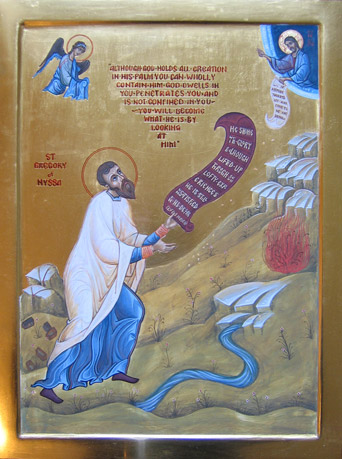
Wherever you go, He's there

Where could I go to escape Your Spirit?
Where could I flee from Your Presence?
If I climb the heavens, You are there,
there too, if I lie in She‘ol.
Psalm 139:7-8 Jerusalem Bible

It's obvious that prophet-king David in composing this psalm is not trying to run away from God, at least not in his better moments, nor are we. But from the beginning of our encounter with the living God, we knew that God knows all, and even that He is everywhere. When God the Son, Jesus Christ, became man, He joined us and now, in an even deeper penetration of our world, as the One who was dead but lives (ος εγενετο νεκρος και εζησεν, Revelation 2:8), He is among us, He is in our midst, in fact He walks among us (ο περιπατων εν μεσω των επτα λυχνιων των χρυσων, Revelation 2:1). This makes me think of a stanza in the Anglican hymn, Where cross the crowded ways of life…

O Master, from the mountain side,
make haste to heal these hearts of pain;
among these restless throngs abide,
O tread the city's streets again;
till all the world shall learn thy love,
and follow where thy feet have trod;
till glorious from thy heav’n above,
shall come the city of our God.

I've always liked the melody of this hymn and I still whistle it often while meditating on the idea of Jesus Christ walking the city's streets again. But when I've actually stopped and looked at the words, well, this hymn is really not very good at all, in fact it's misleading. It seems to be expressing a pious wish that Jesus would somehow come back and, in his own person maybe, do the things here and now that he did in Israel two thousand years ago. This is a hollow pipe dream if ever I heard one. Not only that, but it seems to be commanding the Lord to do things that, duh, He gave us the authority and the responsibility to do. The only verses in the stanza quoted above that are true are the last two lines, “till glorious from thy heav’n above, shall come the city of our God,” and it’s exactly what those two lines say that today's churches by and large consider a pious fantasy.

Run that by me again, please? The hymn tells Jesus to come back and do the work that He gave us to do, and Romanós, you say that's hogwash. And the last two lines about the city coming down from heaven (την πολιν την αγιαν, την νεαν Ιερουσαλημ καταβαινουσαν απο του Θεου εκ του ουρανου, Revelation 21:2) you say that the modern church rejects as a pious fantasy?
Yes, brothers, that's what I said, and here's an example…

I can remember a comment left on a blog (it has since been removed by the blog owner, who appears the want to avoid confrontation) by a “macho” Christian who mocked the idea that Jesus is already out there, spiritually and invisibly but really, and that all we have to do is follow Him there and do what He does. I had commented on the blog that helping a homeless person that God puts in your path is a worthy act, as long as you're just doing what Jesus does. Brother macho wrote contemptuously that the homeless person needs a hot shower, food, a roof over his head, serious counselling, and other improvements that social service agencies have to offer, not some “Jesus who’s already out there.” In other words, it's not a worthy act to help someone in their immediate need. If they really want help, the help is “out there,” and it's not Jesus.

Today I spent practically all day searching for appropriate Christmas gifts for my family members, part of the time using public transit. It made me realize how one's world view and personal philosophy of life is shaped by how one gets around. If the prosperous 2/3 of Americans experienced how the disadvantaged 1/3 actually live, they might think differently about social responsibility. I'm talking about myself too, and I'm talking about Christians specifically. It seems to me that a Christianity that has worked itself into a position of comfort is actually no Christianity at all. So it's not surprising that brother macho and others like him have an attitude problem.

I had two experiences today, still thinking about what Psalm 139 says about God being everywhere.

As I was leaving Portland Saturday Market, I passed a youngster (maybe 11 or 12 years old) of Asian or Native American descent who tried to hand me a tract. At first I waved him off, and passed by, but two seconds later I just did an about face and went up to the boy, “Are you passing out Christian tracts?” I apologized for not taking one and passing by, but I told him I was already a Christian, and I just wanted to thank him for witnessing. An older youth (about 18 or 19 years old) stepped up and I asked, “Are you with them?” By now I'd noticed that there were actually two Asian boys. Alec introduced himself and said he was with them. He was carrying some sign boards under his arm, and the three of them had been witnessing downtown. They came up from Salem to witness in Portland, because there is no street scene in their town. I had quite a good fellowship time with Alec and his two younger brothers, and I showed them where Brock and I sometimes stand when we're reading the Bible in public. The train arrived, and we all got on. The younger boys disappeared into the crowded train, as Alec and I got on and continued fellowshipping. Our destination was the same, and we all got off together. It was then that I noticed an older man, wearing the same baseball cap (Jesus Saves from Sin, I think it said) as Alec. “Is that your Dad?” I asked. He introduced me to Marvin, his Dad, and we continued walking for a short distance, and then we parted. I shook hands with them all and blessed them. They understood exactly what I meant when I told them, “We are just following Jesus who is already out here looking for His lost sheep.” They were from Salem Baptist Temple, if I remember. These boys were “light in the darkness” and really made my day. As I left them, I thanked the Lord, “If I climb the heavens, You are there.”
I went into the Lloyd Center mall afterwards and fruitlessly searched for the gifts. My other experience was going into a shop called Spencer’s Gifts. It may as well have been called Satan’s Gifts, because I've never seen anything so dark and depraved. I made a point of looking at everything, despite remembering Richard’s saying that in this world there are some things you just can’t unsee. But you know, as dark and dirty as their commodities were, I could see that they were just the images of the real evils, a sort of reflection of them. No, Satan is much more evil even than Spencer’s Gifts, as those who become his partners will discover. When I emerged from this shop, it seemed like everyone I looked at was wholesome and good. Well, I guess! After having visited She‘ol just moments before (where God also is), the “normal” world of passers-by seemed tame.

One thing, though. When I was in that shop, looking at everything, but also at every person there, from checkout clerk to customer, I had the curious sensation that they all knew that I was an agent from the Other Side, and they all backed away. Everyone except a group of four or five young girls eleven years old and under, who were too busy inspecting female sex toys and flashy underthings. A couple of the girls couldn't have been older than six or seven, and they were actually just standing around gazing into space while the older ones focused on the objects displayed. As I exited I thought to myself, “You are there, there too, if I lie in She‘ol.”

Jesus, help me to follow You anywhere.

Monday, December 17, 2007

Truth came by Jesus Christ

In Christianity, truth is not a philosophical concept nor is it a theory, a teaching, or a system; but rather, it is the living theanthropic hypostasis - the historical Jesus Christ. Before Christ, men could only conjecture about the Truth since they did not possess it. With Christ as the incarnate divine Logos the eternally complete divine Truth enters into the world. For this reason the Gospel says, 'Truth came by Jesus Christ.'
If you remember having seen the cartoon above before, I also used it in my earlier post, He IS the Truth.

Saturday, December 15, 2007

Παράδοσης ~ Handing it over

…this baptism into patristic study brings what we need, which is not an additional load of patristic references and the memorizing of other people's opinions, but the acquisition of a new and clear-sighted sense which enables man to see things differently and rightly.

If we limit ourselves to learning passages by heart and classifying them mechanically—and teach men likewise—then we fall into a basic error which simply makes us fail to teach and make known the patristic way of life and philosophy. For what is altogether distinctive about the patristic creation is that it is conceived and held together, it is formed and grows, as a result of the grace and power of the freedom of the Spirit.

… Communicating the patristic word, the word of the Holy Fathers, is not a matter of applying their sayings to this or that topic… is not conveyed mechanically, nor preserved archaeologically, nor approached through excursions into history. It is conveyed whole, full of life, as it passes from generation to generation through living organisms, altering them, creating “fathers” who make it their personal word, a new possession, a miracle, a wealth which increases as it is given away.

This is the unchanging change wrought by the power that changes corruption into incorruption.

… How beautiful it is
for a man to become theology.


— Archimandrite Vasileios, Hymn of Entry, pp. 34-35 passim

Opinions, and the Truth

In philosophy, in the field of theories, systems and hypotheses, each person can say anything and maintain whatever he likes. He can call his opinion whatever he likes. He can assign to it the most astronomical value, even to the point of saying that it has the value of “the truth.” In theology, however, this cannot happen. Orthodox theology is a different matter from beginning to end. It does not assert a proposition; it bears witness. It is not contradiction, but confession.

How frequently the Lord would stop people who wanted to start a “theological” conversation with Him. They ask, “Will those who are saved be few?” and the Lord replies, “Strive to enter by the narrow door” (Luke 13:23-24).
Again, with the Samaritan woman who is surprised when the Lord asks her for water, and explains her surprise, “For Jews have no dealings with Samaritans” (John 4:9), Jesus cuts short her comments on the relations between the religious communities with the command, “Go, call your husband” (John 4:16).
In a moment He leads the conversation into the field of personal life, of true theology. In every case He is interested in the person, not in theological discussion as an isolated occupation remaining out of touch with life and with the very person who is speaking.
“I seek not what is yours, but you”
(2 Corinthians 12:14), says Paul; I seek the person and his salvation. And theology seeks the person and his salvation. Therefore, while the Jews of Christ's day were so eager for theological discussions, He let them go unanswered; “But He was silent.” For He did not come to discuss, He came to seek out and save the one that had gone astray (Matthew 18:11).

— Archimandrite Vasileios, Hymn of Entry, pp. 32-33

Friday, December 14, 2007

Fasting

Presbytera Candace sent me this news article about fasting, which I'd like to share with visitors to my blog.

Stint your stomach and you will certainly lock your mouth, because the tongue is strengthened by an abundance of food. Struggle with all your might against the stomach and restrain it with all sobriety. If you labor a little, the Lord will also soon work with you.
— Saint John Climacus

FAST LIKE THE GREEK MONKS
Fast Like The Greek Monks and Live To A Ripe Old Age!
By Jo Willey, December 7th, 2007, Daily Express

Living like a monk can help you beat cancer. Researchers studying the 1,500 inhabitants of 20 Greek monasteries found that they have some of the lowest rates of the disease in the world.
But, before you all rush off to take your monastic vows, let us point out the drawbacks. The monks’ daily regime begins with an hour of prayers before dawn. At breakfast – a piece of hard, dry bread and a cup of tea with no milk – they sit in silence while passages from the Greek scriptures are read from a pulpit in the refectory. Much of the day is taken up with manual labour in the gardens. The monks grow most of what they eat. But there is little dairy produce because female animals, as well as women, are banned. Olive oil is allowed,but only on alternate days. And fish is a treat reserved for feast days.

The good news is that they are allowed to drink the local red wine – but only on Tuesdays, Thursdays and at weekends. The result of all this abstinence is that lung and bladder cancer are unknown on the remote, mountainous peninsula. Rates of prostate cancer are also extremely low. Since 1994, when doctors began testing the monks regularly, only 11 have developed the disease. That works out at less than a quarter of the international average.

Haris Aidonopoulos, a urologist at the University of Thessaloniki, said the monks’ diet could explain the difference in the statistics. “What seems to be the key is a diet that alternates between olive oil and non-olive oil days, and plenty of plant proteins. Small, simple meals at regular intervals are very important.”

Michalis Hourdakis, a dietician associated with Athens University, said: “This limited consumption of calories has been found to lengthen life. Meat has been associated with intestinal cancer, while fruit and vegetables help ward off prostate cancer.”
A diet based on staple foods like fruit and vegetables, pasta, rice and soya dishes, as well as bread and olives is thought to be the key to the monks’ good health. The lack of air pollution on Mount Athos, as well as their hard work in the fields, also play a part, the researchers said. Kim Hardwick, a senior nurse with charity Cancerbackup, said: “We know that people can reduce their risk of cancer by making lifestyle choices.”

“Eating a well-balanced diet that includes five portions of fruit and vegetables and cutting down on the amount of red meat we eat has also been shown to reduce the risk of cancer.”

Dr. Julie Sharp, of Cancer Research UK, said: “Our diet influences our risk of many cancers, including cancers of the bowel, stomach, mouth, throat and breast. You can reduce your cancer risk by eating a healthy, balanced diet that is high in fiber, fruit and vegetables, and low in red and processed meat and saturated fat.”

Note: While good health is not the reason we fast, it appears that it is a good side benefit.


Wednesday, December 12, 2007

Beware of blind faith

Make sure that no one traps you and deprives you of your freedom by some secondhand, empty, rational philosophy based on the principles of this world instead of on Christ.
(Colossians 2:8 JB)

Beware of false prophets who come to you disguised as sheep but underneath are ravenous wolves. You will be able to tell them by their fruits. (Matthew 7:15-16a JB)

This week, considering allegations I heard of against an Orthodox bishop, of the nature of “a fall into sin”, and meeting only with evasiveness when I enquired within my own community, I happened upon this resource on the internet: Pokrov.org, “a resource for survivors of abuse in the Orthodox churches.” I’d actually found this website once before, by accident and without any question in mind, and at the time I let it pass. After all, I didn’t want to be a “disloyal” Orthodox. Sergei Fudel writes in his book Light in the Darkness, “A person is not untrue to his Orthodox faith or to his piety if he comes to recognize a mistake or an error made by a saint. But he will be untrue to his Orthodoxy if he starts out looking for such errors, consciously searching them out.” Well, when the “errors” of the saints come after you in hot pursuit, I hope this belongs to brother Sergei’s first category!

Currently in the Greek church in America, there’s the case of sexual abuse of young males by a (now defrocked, former) priest, Nicholas Katinas. Without going into the particulars, it seems that there may have been a cover-up by Orthodox hierarchs and other clergy, not unlike what has happened in the Roman Catholic institution. My purpose in writing this has nothing directly to do with sexual abuse of Christians by their pastors, but rather with another type of abuse, far more widespread, and for which the victims have to bear at least equal responsibility with the perpetrators—abuse of church authority.

Only this from a report on the case is pertinent to my discussion:
The legal petition also alleges that, “…in the summer of 1987, when [the victim] was 11 years old, Katinas sexually abused him… [The victim] was confused by this behavior, but thought if a priest was doing it, it must be all right…” (Italics mine.)

If a priest is (doing it, saying it, writing it, commanding it),
it must be alright.
“Here,” thought I to myself, “is the root cause of every subversion of authority in the Church, from its first occurrence down to the present day—we place our faith blindly in men rather than in God.”
Hence, the title of this post, Beware of blind faith.

A few weeks ago in my email I was sent an appeal for monetary support for the Ecumenical Patriarchate, and in the same time frame I think I remember that a tray was passed by the Philóptochos (an organization of Greek Orthodox women who have it trumpeted before them that they love and help the poor—only those of their choice, of course) for the same thing. Patriarch Bartholomaios (whom I affectionately refer to as Patriarch Bart, pictured above with Pope Benny) needs money. Generally, I will “give to all who ask” (cf. Matthew 5:42), and in this case I probably should have, since the Lord declares, “your Father in heaven… causes His sun to rise on bad men as well as good” (Matthew 5:45 JB), but both requests I turned away, hypocrite that I am. Why am I risking my salvation over “the giving of five” to some crusty old patriarch who’s probably languishing in a Turkish prison? Well, actually, though the “Great Church” of Aghía Sophía in Constantinople has been stolen from him (about 550 years ago) and he has to be content with Saint George’s, a ramshackle tiny cathedral the size of an average American parish church, he’s personally well cared for. He just needs the money for lawsuits he’s filed against the Turkish government to get back other properties stolen from him more recently. Again, why not give the old guy something?

Back to the words of Jesus quoted above, of those “…disguised as sheep but underneath …ravenous wolves. You will be able to tell them by their fruits.”

Why not give the old guy something? Ask the monks of Esphigménou, a monastery in the republic of Mount Athos in northern Greece. They are currently under siege by the Greek government, which receives its orders from the Patriarch. There’s a blockade of all humanitarian deliveries to the monastery. As the monks continue to lose weight and become ill from the denial of food and medicine, the Greek government continues to prohibit the visitation of doctors to the monastery to provide medical care. There is a land and sea embargo enforced by the Greek Police and Greek Coast Guard, not broken even for humanitarian reasons. This is worse than the embargos placed against terrorist nations.
What are the crimes of these monks (five of them pictured above), that the Patriarch wants them evicted or killed?
They have withdrawn their spiritual support of Patriarch Bartholomaios because of his stated intentions and actions to bring Orthodoxy into union with Roman Catholicism.
Hey, I don’t want that to happen either!
The monks say this, “Our battle is for truth and the true orthodox way of life, which the patriarch is attempting to silence.”
I’m with them.

Still, the Philóptochos passes their trays. Either they don’t look closely enough at this “tree” to check its “fruits,” or else they think, “if a patriarch is doing it, it must be alright.”

Can you endure any more?
Let’s get a little closer to home, from Aghía Sophía in Istanbul to Aghía Triás in Portland.

Quoting from Pokrov.org’s welcome statement, “Abuse occurs anytime someone uses their power (spiritual power, political power, physical power, etc.) to trick, coerce, manipulate or force another person into submission.”

There’s no question (I hope) of anyone in my community being forced into sexual submission by the clergy. But that’s not the only kind of submission, as I’ve stated earlier. A more dangerous and hidden type is at work here. Referring again to the scripture quoted above, “Make sure that no one traps you and deprives you of your freedom by some secondhand, empty, rational philosophy based on the principles of this world instead of on Christ.”

One of the manifest weaknesses of Orthodoxy, in fact of almost all Christian churches, is the reckless willingness of the people to place blind faith in their leaders.
When it comes to politics, the Greeks are just as critical and rebellious against (what they perceive to be) what’s wrong as anyone else. Yet, when it comes to church affairs, though they can see and hear things from church leaders (bishops, pastors and other clergy) that they know are wrong, they acquiesce, ignoring usually, but sometimes justifying and agreeing with statements and actions they know are wrong, when their clergy say or do these things.

Some clergy do not speak from the lips and heart of Christ. They don’t speak out of the Holy Spirit but out of their own hearts. According to John Chrysostom, they preach false interpretations according to the human heart’s thoughts and ways, which are not God’s thoughts and ways. They’re not reforming themselves according to God’s Word, but creating a false religion after the pattern of their own ideas to please the flesh. Pretending to preach, they deceive. Deceiving, they persecute and do it atrociously. Yet they do all this in the name of Christ and God, “disguised as sheep, but underneath …ravenous wolves.”

I’ve spoken to many of my friends at Aghía Triás privately about the current state of affairs, and though they agree with me, they throw up their arms in resignation or despair, “What can we do?”
It seems we’re all so connected through various bonds of personal loyalty that we fear to take action when the flock is being picked apart, one by one.

I like to think that Orthodoxy will prevail as always, because the people preserve it even when the clergy don’t. That’s been an attitude, if not an official teaching, time out of mind. But can we always depend on it? Can we always just hope that “someone else will take care of it”? (I’m talking about those of us who do see what’s happening here and do not agree, not about those who place their faith blindly in men, thinking, “if father says it, it must be alright.” Hey guys, what about THE Father? “When you gonna wake up?”)

Keep alive in yourselves what you were taught in the beginning: as long as what you were taught in the beginning is alive in you, you will live in the Son and in the Father; and what is promised to you by His own promise is eternal life. This is all that I am writing to you about the people who are trying to lead you astray. But you have not lost the anointing that He gave you, and you do not need anyone to teach you; the anointing He gave you teaches you everything; you are anointed with truth, not with a lie, and as it has taught you, so you must stay in Him.
1 John 2:24-27
Jerusalem Bible


To the honor and in remembrance of Bp Anthony Gergiannakis of San Francisco (pictured),
and of Fr Elias Stephanopoulos,
both of blessed memory;
and following the straight teaching of their worthy
co-workers and successors,
Fr Michael Courey,
Fr Photios Dumont,
Fr James Retelas,
Fr Gerasimos Markopoulos,
and their worthy Presbyteres.


Και η δοξα τω Θεω!

Sunday, December 9, 2007

Reasons to weep, or to be glad

The following reading from The Prologue of Ochrid was sent me by Presbytera Candace, and it is very appropriate for the time we are in. Many of us are facing great trials as we head into the time of the Nativity of Christ.

If the whole of your life has passed smoothly and without care, weep for yourself.
For both the Gospel and human experience assert with one voice that no one has, without great sufferings and trials, left behind him any great work on earth or been glorified in heaven.
If your earthly road has been bathed in sweat and tears for the attaining of righteousness and truth, rejoice and be glad, for your reward will indeed be great in heaven.
Never entertain the foolish thought that God has forsaken you.
God knows exactly how much you can bear, and measures your sufferings and trials accordingly.
'When men know,' says St. Nil Sorsky, 'how much weight a horse can carry, or a donkey or a camel, and load them according to their strength; when a potter knows how long to leave the clay in the kiln for it to be neither shattered nor under-cooked, how could God not know how much temptation a soul can bear to make it ready and fitted for the Kingdom of Heaven?'
— Prologue from Ochrid, July 4

I also want to append to this quote some words of encouragement that I wrote to a young Christian brother who is suffering the pain of family problems that are outside his control. After I wrote him these words, I received the quote from Presbytera, and I thought, “How faithful God is, how merciful to us in our afflictions, taking such pains to reach us from every angle.” The quote with which I end my words to my young friend is another one sent me by Presbytera Candace. Little does she know how God uses her email ministry to reach His people.

Just when you think it can't get any worse… it does!
God must really want you hard, young brother, to be leading you at so youthful a chronological age to the very mouth of She‘ol.
When you follow Jesus, He can walk anywhere, and often He does.
Places you'd never dream of going, places you didn't even think existed.
Thinking inside the box, as we're trained to do, even by our churchly mentors, we don't suspect that even the jargon in which we've been taught to think will be so ruthlessly inadequate to help us through our earthly struggle.
Beyond thinking about them (because we can't always trust our thoughts), beyond the feelings that bombard us (we already know they can't be trusted), we still must live amidst the unbelievable chaos of our family members and others around us.
The necessity to live when everything around us speaks, promises, even desires death.
The necessity to die when we've been taught that ‘everything is going to work out,’ that ‘all will be well.’
We who follow Jesus are called to live in a way that only He could live, yet He does live in us that same life.

Finally, I want to share something that a modern Orthodox church father wrote…

If we abandon our own desires and opinions, and endeavor to fulfill God's wishes and understanding, we will save ourselves, no matter what our position, no matter what our circumstance. But, if we cling to our own desires and opinions, neither position nor circumstance will be of help. Even in Paradise, Eve transgressed God's commandment, and life with the Savior Himself brought the unfortunate Judas no good. As we read in the Holy Gospels, we require patience and an inclination to pious living.
— Fr Ambrose of Optina monastery, Russia

Thursday, December 6, 2007

And the fathers say…

Blessed is he who, with a hunger that is never satisfied, day and night throughout this present life makes prayer and the psalms his food and drink, and strengthens himself by reading of God’s glory in Scripture. Such communion will lead the soul to ever-increasing joy in the age to come.
— John of Karpathos

Wednesday, December 5, 2007

Εξεζητησε το προσοπον αυτου

“Seek His face.” Psalm 27:8 Jerusalem Bible

This evening I want to thank the Lord for the blessing of His psalms. About ten days ago I finally bought a copy of ‘Η Αγια Γραφη’… the whole Bible in Greek.
The Old Testament is the ‘Εβδομηκοντα’… the Septuagint, and the New Testament is, of course, the ‘Καινη Διαθηκη’…both written in koiné Greek. I've had the NT since college days, but only recently the whole Book. I haven't gotten too much into the Greek psalms yet, except to look over some of the ones I know from services. I can sing them now, having the text in front of me. Why would I bother?
Well, I understand Greek pretty well without translating, so my prayer can be almost as real as when I sing or pray in English.
I say ‘almost’ because there's always an element of unreality when mouthing anything but one's native tongue, in my case, English.
But God knows…

Psalms for the 5th Day:
Psalms 24 ~ 29
inclusive.
The psalms of the fifth day include many, many prayers. Reading them this evening ushered me into my prayer room like a welcoming old friend. Let me share some of the verses from this evening…


Who has the right to climb the mountain of Yahweh,
who the right to stand in His holy place?
He whose hands are clean, whose heart is pure,
whose soul does not pay homage to worthless things
and who never swears to a lie.
Psalm 24: 3-4 JB

The next verses form the text of the consecration service of an Orthodox house of worship. The epískopos raps the butt of his staff against the closed western doors reciting the first part. A voice from within asks the question. The epískopos answers. This is done three times, and then the doors swing open, and the congregation, waiting outside, enters the newly consecrated temple.

Gates, raise your arches,
rise you ancient doors,
let the King of Glory in!

Who is this King of Glory?
Yahweh the strong, the valiant,
Yahweh valiant in battle!

Gates, raise your arches,
rise you ancient doors,
let the King of Glory in!

Who is this King of Glory?
He is Yahweh Sabaoth,
King of Glory, He!
Psalm 24:7-10 JB

Psalms 25 to 28 are full of prayers.
These are some that speak for me…

Yahweh, make Your ways known to me,
teach me Your paths.
Set me in the way of Your Truth, and teach me,
for You are the God who saves me.
Psalm 25:4-5 JB

Do not remember the sins of my youth;
but rather, with Your love, remember me.
Psalm 25:7 JB

Let innocence and integrity be my protection,
since my hope is in You, Yahweh.
Psalm 25: 21 JB

Test me, Yahweh, and probe me,
put me to trial, loins and heart;
for Your love is before my eyes,
and I live my life in loyalty to You.
Psalm 26:2-3 JB

One thing I ask of Yahweh,
one thing I seek:
to live in the House of Yahweh
all the days of my life,
to enjoy the sweetness of Yahweh
and to consult Him in His temple.
Psalm 27:4 JB

Yahweh, hear my voice as I cry!
Pity me! Answer me!
My heart has said of You,
“Seek His face.”
Yahweh, I do seek Your face;
do not hide Your face from me.
Psalm 27:7-9a JB

This I believe: I shall see the goodness of Yahweh
in the land of the living.
Put your hope in Yahweh, be strong, let your heart be bold,
put your hope in Yahweh.
Psalm 27:13-14 JB

Yahweh is my strength, my shield,
my heart puts its trust in Him;
I have been helped, my flesh has bloomed again,
I thank Him with all my heart.

Yahweh is the strength of His people,
a saving fortress for His anointed.
Save Your people! Bless Your heritage!
Shepherd them; carry them forever!
Psalm 28:7-9 JB

The last verse above, “Save Your people…” I remember well the beautiful roar of song that the mighty man of God, bishop Anthony, let out when he was with us at Aghía Triás, blessing us with this verse, in English and in the original Greek, “…και ευλογησον την κληρονομιαν σου.” Though he has gone to be with his Lord, I can hear him singing still…

The last psalm for the fifth day, Psalm 29, didn't have the meaning it has for me today, until Brock and I started praying with the Jews at the Sephardi synagogue of Ahavath Achim, ‘brotherly love’, last January. The Jews sang this whole psalm, in Hebrew of course, during the Shabbat evening service that we used to attend on Friday nights. (Please note: Jews never pronounce the names of God. Where the Jerusalem Bible has ‘Yahweh,’ Jews pronounce ‘Ha Shem,’ and so do we whenever we pray with them.) The melody and tempo of their singing matched the vigour evident in the English text, which follows…

Pay tribute to Yahweh, you sons of God,
tribute to Yahweh of glory and power,
tribute to Yahweh of the glory of His name,
worship Yahweh in His sacred court.

The voice of Yahweh over the waters!
Yahweh over the multitudinous waters!
The voice of Yahweh in power!
The voice of Yahweh in splendour!

The voice of Yahweh shatters the cedars,
Yahweh shatters the cedars of Lebanon,
making Lebanon leap like a calf,
Sirion like a young wild bull.

The voice of Yahweh sharpens lightning shafts!

The voice of Yahweh sets the wilderness shaking.
Yahweh shakes the wilderness of Kadesh.
The voice of Yahweh sets the terebinths shuddering,
stripping the forests bare.

The God of Glory thunders.
In His palace everything cries, “Glory!”
Yahweh sat enthroned for the Flood,
Yahweh sits enthroned as a King for ever.

Yahweh gives strength to His people,
Yahweh blesses His people with peace.
Psalm 29 JB

End of the Psalms for the 5th Day.

Monday, December 3, 2007

A sobering thought for Advent

Presbytera Candace sent me this quotation from Fr Seraphim Rose which I'd like to share with my readers…

Christian compromise in thought and word and negligence in deed have opened the way to the triumph of the forces of the absurd, of Satan, of Antichrist. The present age of absurdity is the just reward of Christians who have failed to be Christians.

As to the fatalism of those who believe that man must be a slave to the “spirit of the age,” it is disproved by the experience of every Christian worthy of the name, for the Christian life is nothing if it is not a struggle against the spirit of every age for the sake of eternity.

— Fr Seraphim Rose (1934-82)

Sunday, November 25, 2007

Saving Everyone

I could've entitled this post "Universal Salvation" or something like that, but it sounds too grand. Just call it what it is, so "saving everyone" is the name of the game. And a game it is, indeed.

My previous post, a quotation of Abba Barsanuphios, was about free will and the message of salvation. In this post, I will be stealing from, and introducing my readers to, a dude by the name of Fr Neo, who is an Episcopal priest who preempts our questions with, "Yes, I am orthodox." His recent blog post "Dare We Hope for the Salvation of All?" drew some comments from me and a couple of others that I'd like to share on my blog. Since Fr Neo's post is short enough, I'm quoting it entirely, and then adding the comments somewhat edited for relevance. To read the whole thing, click the link above.

Dare We Hope for the Salvation of All?
by Fr Neo

So asks the Orthodox bishop, Kallistos Ware. In his work The Inner Kingdom, he dares to ask the question. Ware is not a squishy theologian. He is thoroughly traditional and Orthodox in all points. But he is expressing a true and, I think, orthodox hope.

He mentions that St. Gregory of Nyssa also had such hopes. Ware says,
“Gregory [writes], ‘the wickedness which is now mingled and consolidated with our nature has been finally expelled from it, and when all those things that are now sunk down in evil are restored to their original state, there will ascend from the entire creation a united hymn of thanksgiving…All this is contained in the great mystery of the Divine Incarnation.’ This final restoration, Gregory clearly states, will embrace even the devil.”


Ware does not deny the existence of hell, he only questions the purpose for it. Is it a place of condemnation and judgment, or does it have a restorative or healing element to it? Is the fire of God wrathful or is it remedial? Ware is not trying to presume that God’s purpose will eventually win out to save everyone, he is only expressing a hope and a sincere prayer.

Now, for the comments…

Human speculations and “sincere prayers” aside, even bishop Kallistos cannot gloss over the plain meaning of scripture regarding salvation and damnation. The bible, using baby talk as it were to communicate to us the truths of “how it all works” is not to be underestimated. Rather than the opposite, I think the little that is said in the scriptures about eternal separation from God (hell, damnation, lake of fire, etc.) is a merciful shielding of our eyes from the real horror inherent in the wrong use of our free will. Rather than “God doesn’t speak much or clearly about damnation, and we know He’s so good, well, maybe these are just little incentives for us to try to be nice,” perhaps something like this may be true, “God doesn’t tell us too much about the nature of damnation, because He doesn’t want us to be terrorized into accepting Him.” [Romanós]

Dare we hope for the salvation of all?
To do otherwise is nothing short of a sin.
[Constantine]

Constantine,
Indeed, it would be a sin not to hope for the salvation of all. To assume the salvation of all would also be a sin, to place ourselves in the place where only Christ belongs.
[John H]

Constantine,
Forgive me, brother, but can we really hope for something that the scriptures reveal as impossible? Pretty strong wording to say that hoping for anything other than the salvation of all is a “sin”. In a perfect world, that is, in a world where everyone (eventually) did what was right, humans and hypersomatic beings included, we could hope that all of them, even the sometimes naughty ones, would repent and turn back to God. That would be a legitimate hope, even in the face of temporal, and temporary, wickedness. But, brother, it’s not a perfect world, at least, not yet. Sometime soon, the Alpha and the Omega, the Pantokrator, will come to separate the sheep from the goats. It is not in vain that He spoke those words, nor was He fantasizing when He revealed to John the Revelator what was, what is, and what is to come. Scripture doesn’t speak to us in vain, nor is it for our entertainment, but for our investiture.

Stick close to the revealed Word, since you claim Him as your Lord, and let Him be a “curb for the wild horses” of your mind, as Clement of Alexandria so aptly wrote. Submit your thoughts to that Word.
If you can be safe, don’t put yourself in danger.

I could wish that everyone would be saved, but not one wish of mine will I work against the will of Him who has created all things, nor against His plan of “as it must be.” [Romanós]

John H,
As to your comment regarding the sovereignty of God, I suspect you are right. SDG as the Reformers cried out, no? I’m just counting on (trusting?) the same Christ to win the day, if you will–what He has begun, He will complete. I truly don’t say this in a snide or supercilious manner. I really believe Christ will make all well in His own way and time. I equally suspect it may be a painful process. But can anything, included the “free will” of man, thwart God’s ultimate eschatological purpose and intent for His creation? And what is that? Restoration! Wholeness! A union of love triumphant!

Romanos,
Have you read the late eminent theologian Hans Urs von Balthasar on said subject? I would contend that Holy Writ is not as clear and cut and dry as you propose (in spite of what the magisterial Reformer Luther would have us believe). When you say, “as it must be,” I wonder if we are not of the same hermeneutical mind, but just drawing different conclusions. The hyper-Calvinist insists in such a manner as well. I find it almost humorous that so many think and believe that all is determined categorically this side of the grave.
May I also ask of you: What is Hell–God’s absence or presence?
[Constantine]

Constantine,
You’ve lost me on most of what you said in your last comment. Holy scripture IS clear on everything that really matters. I wouldn’t use the term ‘cut and dry’ when referring to biblical truth, though, because ‘whatever you think it’s more than that, more than that’.

I don’t know what hell is, except what the bible says it is, acknowledging at the same time that God has given us very little detail about it, except that it is.

Your question, what is hell, God’s absence or presence, cannot be asked without begging the question. It’s an ontological issue. God is present always and everywhere, even in hell. The scriptures declare it, the fathers teach it, the Orthodox believe it, human conscience senses it. Whether you are in heaven or hell now or in some future state, depends solely on whether you really love God or really hate Him. Now and always it boils down to accepting God’s ‘as it must be.’ We are derivative beings. Our whole nature, when it’s in order, wants to submit to the Father’s will, because He is our Source. Even the Son and the Holy Spirit want to submit to the Father’s will because He is their Source, and this, being of one will, is the foundation and nature of the Holy Triad, and for us, of the ‘three-personal life’ as C.S. Lewis calls it in Mere Christianity. Any and all beings that possess free will receive their freedom by laying it down before the Throne, or be imprisoned by withholding it, while crying “MINE!”

It seems that we’ve actually said everything that can be reasonably said on this subject, at least for me. Time to get back to the Word of God, and let Him form us His servants and sons, renew our minds and, in Christ, restore His divine image broken in us. Go with God, Constantine, my brother. Thanks for your comments. [Romanós]

I don't want this post to end with something I've written, so let me close with a quote from C.S. Lewis' book The Great Divorce. This is put in the mouth of George MacDonald, who is correcting a mistaken sentiment that Lewis expresses to him. Read on…

'Son, son, it must be one way or the other. Either the day must come when joy prevails and all the makers of misery are no longer able to infect it; or else for ever and ever the makers of misery can destroy in others the happiness they reject for themselves. I know it has a grand sound to say ye'll accept no salvation which leaves even one creature in the dark outside. But watch that sophistry or ye'll make a Dog in a Manger the tyrant of the universe.' [C.S. Lewis]

Saturday, November 24, 2007

Sow in Hope


Do not force people's free will, but sow in hope; for our Lord did not compel anyone, but He preached the good news, and those who wished hearkened to Him.


—Abba Barsanuphios of Gaza
—pictured with Abba John

Thursday, November 22, 2007

He Makes Us Look

Holy Apostle Paul was very right when he compared the marriage relationship between a man and woman to the relationship of Christ and the Church, yet in these last days both these relationships are ravaged with bold-faced affrontery and unashamed hypocrisy. It all begins with the manhandling of the Word of God, ruling over the Word insteading of letting it rule over you. This misbehavior shares at least one important characteristic with lying—once you start lying, you can never stop, because you have to bury each lie with another. The same is true with manhandling the Word, which in a sense is also a form of lying—once you start twisting the Word, well, you see where this is leading? "What is twisted cannot be straightened, what is not there cannot be counted." (Ecclesiastes 1:15 Jerusalem Bible)

The man is, as the scriptures teach, the head of the woman, and Christ is the Head of the Church. When this order is not respected, true community breaks down rapidly, and tyranny replaces it. Worse yet, prayer is corrupted, because it cannot be honest. It becomes a formality, even if it is not a written prayer. If people can lie to one another without reading the lies out of a book, so also can people "pray" dishonestly without reading prayers out of a book. It's not whether a truth or a prayer is read from something written down. Everything hangs on the disposition of man's heart.

Why am I thinking about this? Because I have witnessed blasphemous prayers today being offered in rebellion against the Truth, futile prayers spoken for show, for the sake of keeping up appearances. And I ask the Lord, "Why do You let this continue? When will you show everyone up for what we are? How long, Lord, how long?"

Perhaps I've shared this already, but Sergei Fudel writes in his little book Light in the Darkness,

Prayer is born of love. Is it not the same as to say, "Prayer is born of tears?" I realized this quite recently when I heard a young girl answer a question addressed to her. "How can I learn to pray?" The question did not puzzle her and she said unhesitatingly, "Go and learn to weep and you'll learn to pray." She completed the words of the Fathers.

This is me again. The psalms for the 22nd day were Psalms 107~109. I didn't offer them in prayer today, but I have prayed a verse here, a verse there. These are the psalms of my wife's birthday, so I know them quite well. Psalm 107 is all about how we go and do foolish things, following our vain desires, and then get into trouble or danger, and… God to the rescue! And then we thank Him, profusely and, we hope, honestly. Here's a sample that speaks to me…

Some were living in gloom and darkness,
fettered in misery and irons
for defying the orders of God,
for scorning the advice of the Most High;
who bent them double with hardship,
to breaking point, with no one to help them.

Then they called to Yahweh in their trouble
and He rescued them from their sufferings;
releasing them from gloom and darkness,
shattering their chains.

Let these thank Yahweh for His love,
for His marvels on behalf of men;
breaking bronze gates open,
He smashes iron bars.
Psalm 107:10-16 JB

A verse in Psalm 108 expresses something I've been asking the Lord many a day "God, can You really have rejected us? …Help us in this hour of crisis!" (Psalm 108:11-12 JB) It isn't as though I think that He has rejected us, no, but that our free wills prevent Him from acting, and so I just keep pleading, "Help!"

The third psalm for this day, Psalm 109, is King David's plea for help against his enemies. Aside from everything else he prays, my spirit trembles when I pray these words "In return for my friendship, they denounce me, though all I had done was pray for them." (Psalm 109:4 JB) Things like this have happened to me and are happening still. We'd like to just turn a deaf ear to them, turn our backs on them, the people who trouble us. We might be able to do this, if we stayed away from God's Word. But if we turn to the Word of God, whether to the Psalms, or to any other part of it, He makes us look, makes us face the enemy in ourselves and in others. Maybe that's why we'd rather read anything else. We can read what people say about Him, and not listen to what He says about us.

God save us, and help us to be thankful for Your friendship, Your willingness to receive us.

Help me, Yahweh my God,
save me since You love me!
And let them know that You have done it,
that it was You, Yahweh, who did it!
Psalm 109:26-27 JB

Saturday, November 17, 2007

Seeking Just Our Own

Presbytera Candace Schefe sent me this quote from John Chrysostom:

We cannot be saved by seeking just our own individual salvation; we need to look first to the good of others. In warfare, the soldier who takes to flight to save his own skin brings disaster on himself as well as on the others, whereas the good soldier who takes up arms on behalf of his comrades saves his own life along with theirs. Many of our brothers and sisters have fallen in this battle, wounded and covered with blood, with no one to care for them. There is no one to look after them, no layman, no priest, no comrade, no friend, no brother, because we are all of us seeking our own individual salvation, and thereby spoiling our chance of attaining it.
Psalms for the 17th Day: Psalms 86~89This morning, the psalms appointed for the seventeenth day really spoke my prayer. Here is one of them…

Listen to me, Yahweh, and answer me,
poor and needy as I am;
keep my soul: I am Your devoted one,
save Your servant who relies on You.

You are my God, take pity on me, Lord,
I invoke you all day long;
give your servant reason to rejoice,
for to You, Lord, I left my soul.

Lord, You are good and forgiving,
most loving to all who invoke You;
Yahweh, hear my prayer,
listen to me as I plead.

Lord, in trouble I invoke You,
and You answer my prayer;
there is no god to compare with You,
no achievement to compare with Yours.

All the pagans will come and adore You, Lord,
all will glorify Your name,
since You alone are great, You perform marvels,
You God, You alone.

Yahweh, teach me Your way,
how to walk beside You faithfully,
make me single-hearted in fearing Your name.
Psalm 86:1-11 Jerusalem Bible


Later, this evening, we went to vespers at Saint Nicholas of Myra church. Today, as it turns out, was the commemoration of holy Prophet Obadiah, and his entire prophecy was sung by the cantor, followed by a lengthy, utterly quiet pause. It made us feel we were in a Quaker meeting house. Brock noticed, and remembering it with me afterwards cited the verse, "… there was silence in heaven for about half an hour" (Revelation 8:1). Somehow the quality of the silence after the singing of Obadiah's prophecy had this effect on us both. How could there not be silence after hearing these momentous words?

Yes, as you have drunk on My holy mountain,
so will all the nations drink unsparingly;
they will drink, and drink deep,
and will be as if they had never been.

But on Mount Zion there will be some who have escaped
—it shall become a holy place—
and the House of Jacob will despoil
its own despoilers.

The House of Jacob shall be a fire,
the House of Joseph a flame,
the House of Esau stubble.
They will set it alight and burn it up,
and no member of the House of Esau shall survive.
Yahweh has spoken.

Men from the Negebwill occupy the Mount of Esau,
men from the lowlands
the country of the Philistines;

they will occupy the land of Ephraim
and the land of Samaria,

and Benjamin
will occupy Gilead.


The exiles from this army, the sons of Israel,
will occupy Canaan as far as Zarephath;
and the exiles from Jerusalem now in Sepharad
will occupy the towns of the Negeb.

Victorious, they will climb Mount Zion
to judge the Mount of Esau,
and the sovereignty shall belong to Yahweh.
Obadiah 16~21 Jerusalem Bible
This prophecy made me think of the current restoration of Israel in the land which is not, as many churchables think, an accident of history, but the fulfillment of prophecy, specifically of prophecies like that of holy Prophet Obadiah.

This was a very good day.
Thank you, Lord.

Sunday, November 11, 2007

Michael Beautiful

Andrew performing his composition, Michael Beautiful.


I recently discovered that my son Andrew has upgraded his musical presence on the internet. In addition to his regular MySpace site, he also has a YouTube presence, jazzpsalti. Though the stated aim of my blog is to communicate, not to entertain, to advertise Andrew's music and give you a sample here is not, I hope, going back on my word. Music can be merely entertainment, but it can also be a testimony of one's life in Christ, and it can also minister to others. Andrew's music ministers to me, and I think it does the same for others as well. Sometimes I have his music in a loop on this blog. For now, there's no loop running, so you can view and hear this sample.

If you like this music, you can link to it anytime from my blog side panel, or open it and save it in your favorites. You will also see in Andrew's MySpace, a calendar of where and when you can see and hear him "live". He also lists the services at which he will be singing as a psalti (cantor) at Aghía Triás Greek Orthodox Cathedral in Portland, Oregon. I encourage you to check out his music and video sites and get in touch with him.

Tuesday, November 6, 2007

Thirty-two years later

Psalms for the 6th day were Psalms 30 to 34.

After getting home from work,
I read them and meditated on the meaning they've had for me these many a year. And I spoke them in prayer, and received back, as the Lord never fails me, He's the faithful one.

Hear, Yahweh, take pity on me;
Yahweh, help me!
(Psalm 30:10)

Back in 1975, we were still on the trail of that elusive commodity, the "perfect" commune.

Chuck and Tish owned a half section of land on the western slope of a mountain outside of Harrisburg, Oregon, and another half section down in the valley. The upper section was organized as a commune called "Ahimsa" (Sanskrit for "non-violence"), and they had invited us to live there if we could make it work.
They were letting their friends build homes out in the wilds, and the commune was going to be very (as we say in Greek) idio-rhythmic. In other words, people did not share everything in common materially or spiritually. They only shared the land and each other's company. Everyone was expected to have their own income and build themselves a home at their own expense. The ethos of the commune was to be "spiritual", but in the New Age sense—all paths ultimately lead to God.

Before we moved down here, we visited Ahimsa in the spring of 1975. That's when I took the photos that illustrate this post. At that point, I was still a New Age spiritual seeker myself, though Anastasia was a "born again" Christian. We didn't go to church, though, because I had a problem with the hypocrisy I heard tell of. Our visit left us both with a positive impression of the commune, and so we packed up our transportable belongings in about 120 boxes and shipped them via Canadian Freightways to the Portland terminal. Our irreplaceables went into a car carrier that I built out of plywood and mounted to the top of my 1972 Pinto hatch-back. (In the end, we didn't join Ahimsa. Chuck and Tish ended up becoming Mormons. We became Christians. I don't know what became of the others at Ahimsa.)


We arrived in Corvallis the evening of Rosh Hashonah, September 5, 1975, and stayed with a young Jewish couple we had known in Edmonton, Debbie and Harold. (Next morning we drove to Salem with them for our first experience of synagogue worship.)

This is not going to be the story of how I smuggled my wife and child into the U.S., but rather how I found myself, on the Thursday morning of November 6, 1975, ready to meet the Lord.
(Let the reader understand: I'm not now talking about just any Lord.)
Let me cite a verse from the psalms for the 6th day…

Happy the man whose fault is forgiven,
whose sin is blotted out;
happy the man whom Yahweh
accuses of no guilt,
whose spirit is incapable of deceit!

All the time I kept silent, my bones were wasting away
with groans, day in, day out;
day and night Your hand
lay heavy on me;
my heart grew parched as stubble
in summer drought.

At last I admitted to You I had sinned;
no longer concealing my guilt,
I said, "I will go to Yahweh
and confess my fault."
And You, You have forgiven the wrong I did,
have pardoned my sin.
(Psalm 32:1-5)

That morning I was at work, a rough sawyer in an old furniture mill in Albany. It was cold outside. The wind was blowing through the cracks in the barn-like plank walls. My fingers were freezing, even though I had gloves on. Behind me, a large planer was roaring. My off-bearer was shivering as he slid the scrap off the saw with one hand into a waste bin, while with the other guiding the good rips onto a cart.
I heard a voice inside my head, "Why do you resist Me…?"

I will instruct you, and teach you the way to go;
I will watch over you and be your advisor.
Do not be like senseless horse or mule
that need bit and bridle to curb their spirit
to let you get near them.
(Psalm 32:8-9)

Quickly, I sensed this was not just my imagination. I waved my off-bearer a signal, "Go empty the wood box!" That would take him at least 15 minutes, maybe longer, because it meant dragging a heavy load of wood down to the boiler hut. "He's probably going to want to warm himself there," something in me quipped. As he hauled his heavy load away to be burned, another heavy load was going to be hauled away and burned, one only I and the Off-bearer could see.

You, who have seen my wretchedness,
and known the miseries of my soul,
have not handed me over to the enemy,
You have given my feet space and to spare.
(Psalm 30:7b-8)

The talk began, slowly at first, then more heatedly. I argued with the voice. Sometimes I seemed to switch sides. I wanted to surrender, but then, I had investments. How could I give these up? Would I get something to replace them? What? How can you bargain with Him? What are you expecting? He's already told you everything, and you know it's all true.

The Word of Yahweh is integrity itself,
all He does is done faithfully;
He loves virtue and justice,
Yahweh's love fills the earth.

By the Word of Yahweh the heavens were made,
their whole array by the breath of His mouth…
(Psalm 33:4-6)

My temperature was rising, in spite of the biting cold around me. With every last ounce of my will, my flesh resisted the voice, and I kept feeling hotter. "This can't be happening to me! You know I want to accept You, but I can't, I can't!" Finally, I asked Him to remove what was binding me.

Hear, Yahweh, take pity on me; Yahweh, help me! (Psalm 30:10)

That which I couldn't do of my own power, somehow He called forth from me. "All that I am, and all that I have, I surrender to You, Lord, to You, Jesus. I don't want anything now, nothing but what You want me to be and to have." This was the jist of what came tumbling out of my lips, along with sobs, because by now my face was a liquified mess. A coolness like a stream of icy water flowed over my head and then my body. I don't know what it was, but it pacified me. The planer with its attendee still roared behind me, none hearing or seeing what was happening to me, and me hearing and seeing nothing outside of me.

Every face turned to Him grows brighter
and is never ashamed.
A cry goes up from the poor man, and Yahweh hears,
and helps him in all his troubles.

The angel of Yahweh pitches camp
around those who fear Him; and He keeps them safe.
How good Yahweh is—only taste and see!
Happy the man who takes shelter in Him.
(Psalm 34:5-8)

Something that can't be put into words really, yet I've tried on this and other occasions. This time I'm only hinting at it. What is this thing that happens to us? A year ago I wrote a post, Born again? When? in which I tried to recount what happened to me that morning. That's my testimony, or at least part of it, because the new life in Christ, the birth from above, is really an event in kairós time—though you can sometimes pinpoint it on a calendar, it really encompasses more than a moment. You can't look at it, you can't even remember it, as it really is, was and is to come, because it's hidden with the One who will give it back to you on the last Day.

Our soul awaits Yahweh,
He is our help and shield;
our hearts rejoice in Him,
we trust in His holy Name.

Yahweh, let Your love rest on us
as our hope has rested in You.
(Psalm 33:20-22)